
2 kg Flour Bag Packaging Machine: Twin-Station Output for Retail Paper Bags
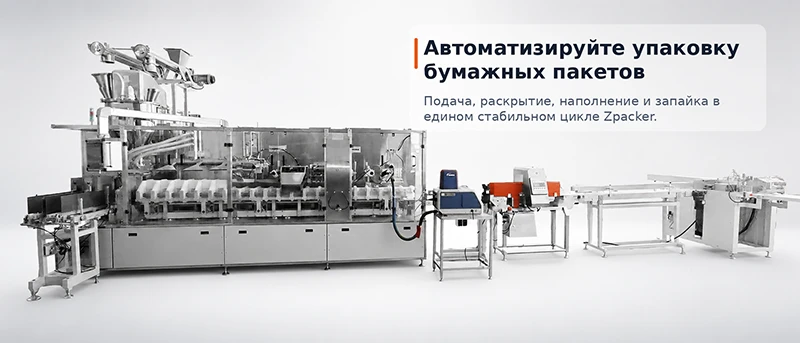
A mill or bakery that sells flour in 2 kg paper bags is not short of filling options. It is short of a machine that can pull a flat M-fold bag from a magazine, open it into a block, dose 2 kg of flour while the mouth is clamped, extract the powder that escapes at the spout, then fold the gusset back and glue the top closed. The Zpacker 2 kg flour bag packaging machine runs that whole sequence as one linear twin-station flow, at a reference output of about 30–35 bags per minute.
Where a 2 kg paper bag breaks the shift
On a flour line supplying supermarket chains, two layouts still dominate. In the first, an operator holds each flat-bottom bag under a semi-automatic auger spout, watches the scale and pulls the bag away by hand. In the second, a semi-automatic filler handles the weighing, and a second person folds the side gusset, trims the top edge, applies glue and presses the bag shut.
Both layouts work for one bag. Neither survives a full shift. Weight drift comes first: 2 kg is a small target, and an overfill of five to eight grams per bag is a material giveaway nobody catches until the month-end flour reconciliation. The closing step comes second. A paper bag that has just been filled is still settling, the glue line lands on a dusty flap, and the top seal opens later on the pallet. Air is the third problem: flour leaves the spout fast, the bag mouth is not a rigid container, and the person holding it works inside that dust cloud all day. A 2 kg flour bag packaging machine is worth its cost only if it removes all three, not just the weighing.
A vertical form-fill-seal unit makes its own bag from roll film. If the retail bag is already printed, gusseted and sitting in the warehouse, that unit has nothing to fill. The 2 kg flour bag packaging machine is built around the premade bag instead, so the bag already approved by the retailer stays in the project.
Why the premade M-fold bag changes the whole machine
A flat-bottom M-fold bag arrives flat and stacked. Once opened, the side gussets push outward and the bag becomes a three-dimensional block. After filling it must be closed again along the same fold lines: re-flattened, trimmed square, roll-folded and glued. Ordinary filling heads stop at the spout, which is why so many plants still hand-finish the bag. The machine frame, the clamps and the tooling have to be designed for that closing sequence from the start, not bolted on afterwards.
It also changes the output logic. Because the bag is pre-made, the line is no longer tied to a film roll width, but to the bag sample and its orientation. Bags have a front and a back; they cannot be loaded into the magazine at random. Every bag size that will run on the line needs its sample approved and its tooling set, and the machine must hold position without an operator re-seating the bag between cycles.
Field note: the fastest way to lose a 2 kg retail order is a bag that looks sealed at the packing station and opens on the pallet. Trimming before gluing, and alarming on glue temperature, is cheaper than a returned pallet.
What a 2 kg flour bag packaging machine does between pickup and glue
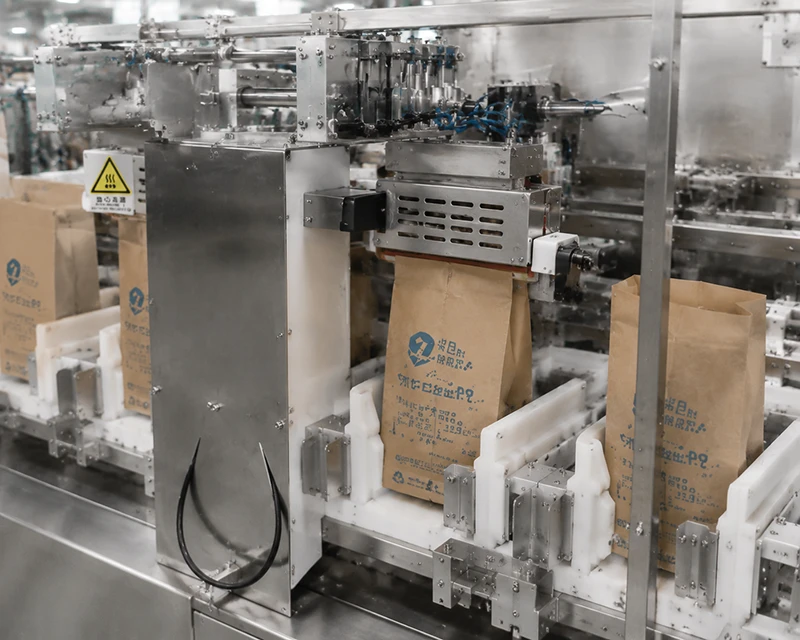
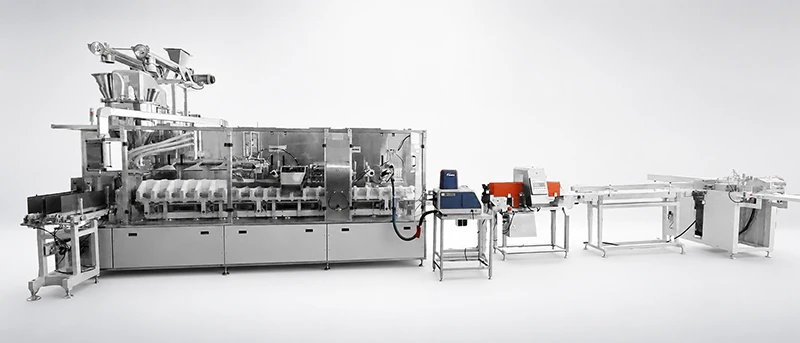
The flow is linear and split across two stations, so the same frame runs one bag size at a time without rebuilding the line. A belt feeder carries the flat bag from the magazine to the pickup position. Clamps take the bag by the top edge, air opens the mouth, and the bag is held open under the dosing spout so nothing rests on an operator’s arms. A vertical screw doser fills by weight, and a dust extraction hood sits at the filling position, so displaced air and the fine flour fraction leave sideways instead of rising into the room. After filling, the bag passes vibration and dust-removal positions that settle the flour and let trapped air out before the mouth is closed.
Closing is what separates this machine from a filler with a sewing head. The filled bag is re-flattened along its gusset, the top edge is trimmed, the flap is roll-folded, and hot-melt glue is applied as a dot or a line pattern before the top is pressed. Trimming first means the adhesive lands on clean paper, not on a dusty flap. Interlocks are equally unglamorous and equally useful: with no bag in position the machine will not open, fill or seal, and it stops with an alarm on low air pressure, an opened guard, a motor or inverter fault, or a glue temperature out of range. On a 2 kg flour bag packaging machine, those stops are the difference between one rejected bag and forty bags glued with cold adhesive.
| Item | Reference value for the 2 kg retail format |
|---|---|
| Bag format | Premade flat-bottom paper or paper-plastic bag, M side gusset, orientation fixed by sample |
| Fill weight, this specification | 1–2 kg per bag |
| Reference output | About 30–35 bags per minute, subject to material, feed and site conditions |
| Dosing accuracy | About ±0.5% |
| Bag size range | Width W 80–140 mm, length L 240–320 mm, gusset about 60–80 mm |
| Closing | Hot-melt glue dot or line spray, then top press; not heat sealing |
| Dust control | Extraction at the filling position plus multi-station vibration and dust removal |
| Air supply | 0.6–0.8 MPa, consumption about 0.76 m³/min |
| Power and weight | 15.5 kW, 380 V ±10%, 50 Hz; machine about 3000 kg |
| Control and material | 10.4 inch touchscreen with PLC; 304 stainless steel on product-contact parts |
Confirm these points before a 2 kg flour bag packaging machine is quoted
None of the items below is a shopping question. Each one maps to a setting on the machine, which is why the answers have to come before the drawing is fixed.
Bag sample and orientation. Send the actual bag, not a photo. The magazine and pickup are set for a confirmed front and back, and a random pile of bags will jam the line.
Weight range. Two specifications exist: one covers 1–2 kg, the other covers 2.5–5 kg. A 2 kg retail bag belongs to the first, and mixing ranges on one frame is a project decision, not a catalogue switch.
Gusset and bag dimensions. Width, length and gusset are checked against the fold, trim and roll-fold tooling; a project drawing showed about 70 mm gusset, so the sample governs.
Bag material. Plain paper closes predictably. Paper-plastic laminates must be tested for layer bonding and glue adhesion before the order is released.
Air and power. Plan the compressor against 0.6–0.8 MPa and about 0.76 m³/min, and the supply against 15.5 kW at 380 V ±10%, 50 Hz.
Dust routing. The extraction hood at the filling position and the downstream dust-removal stations need to be tied into the plant aspiration layout, not vented into the room.
Space and layout. The machine weighs about 3000 kg. A layout of roughly 17 m by 3.6 m appeared in the technical discussion as a reference only; a CAD layout replaced it, because the twin-station footprint depends on the infeed and secondary packing chosen.
Downstream scope. Decide early whether the 2 kg flour bag packaging machine hands over to check weighing and metal detection, coding, then shrink grouping or manual outer bags. That decision changes the conveyor length and the palletizing point.
What the end of the line should look like
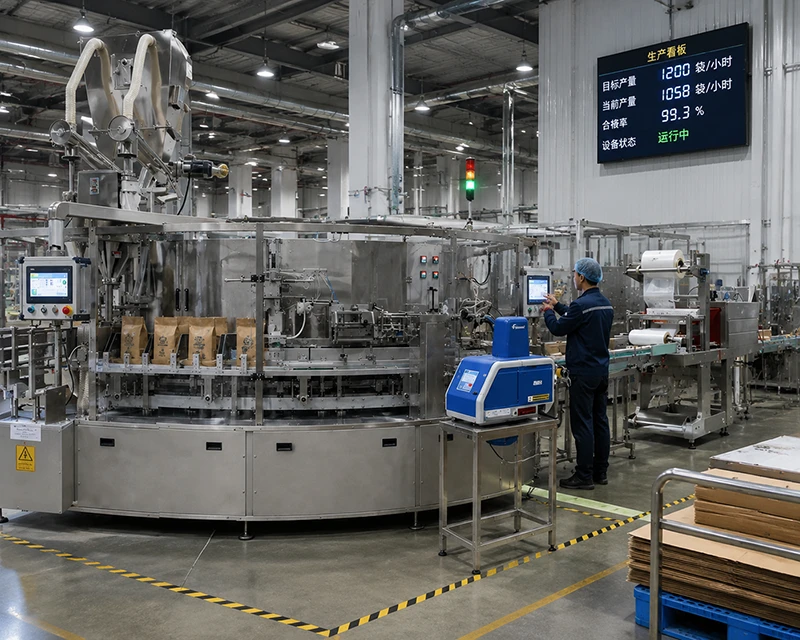
A 2 kg flour bag leaving this line is square, closed with glue that was applied to cleaned paper, and consistent enough that the checkweigher catches the exception rather than the average. Because the bag is opened, held and closed by the machine, the operator moves from holding bags to watching the touchscreen and reloading the magazine. Weighing to about ±0.5% and gluing only after trimming are what make the 2 kg retail paper bag a repeatable product instead of a hand craft.
Send one bag sample with the target weight, the intended output per shift and the downstream equipment you plan to connect, and the 2 kg flour bag packaging machine can be specified against your bag instead of a generic format.
Send your bag sample for a line proposal English
 Русский