
Powder Bagging Line: Settling Before Checkweighing
A flour, starch or dairy plant rarely loses output at the filler. It loses it in the last few metres, where a bag that is still full of moving powder arrives at the weigh cell leaning on one corner, and the checkweigher correctly rejects a bag that was filled correctly. A powder bagging line is judged by what happens between the closing head and the inspection gate: settling, shaping, transfer and the handoff to weighing.
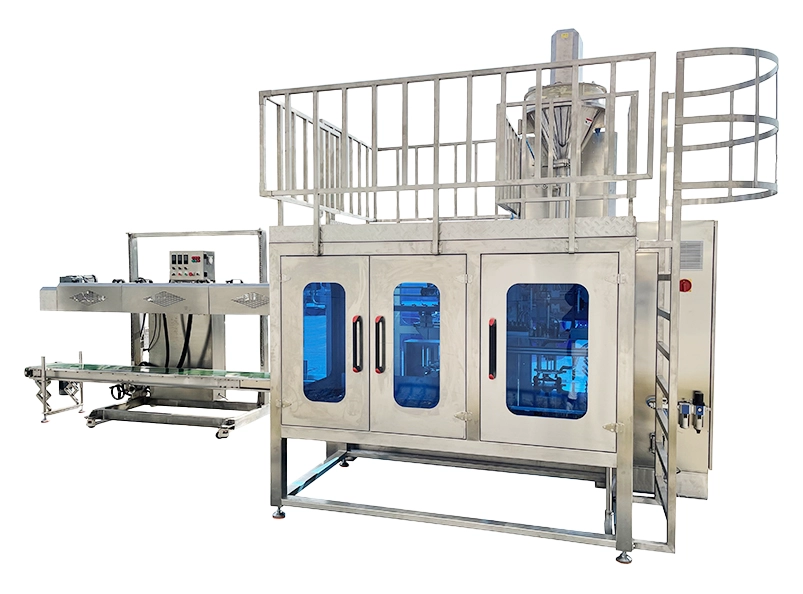
Where a 25 kg bag actually loses its shape
The closing head does not make a bad bag. The bag leaves the clamp with a column of aerated powder inside it, and that column keeps moving after the seam is shut. On a kraft paper or paper-plastic composite bag, the air has nowhere to go except into the bag faces, so the panel bulges, the bottom rounds over and the bag starts to sit on a corner instead of on its base. Twenty metres of flat conveyor will not fix that; it only carries the problem further down the powder bagging line.
The filling step is where the air enters. Bottom-up filling with a lifting platform that follows the fill level keeps the dosing outlet close to the rising material instead of dropping powder from a fixed height. Three-stage screw feeding — fast, medium, then a slow final dose — shortens the time the powder is in free fall at the end of the cycle, which is the moment that puts the most air into the bag and the most dust around the mouth. Fewer airborne fines at the mouth means a cleaner heat-seal or sewing zone, and a bag that has less internal pressure to release afterwards.
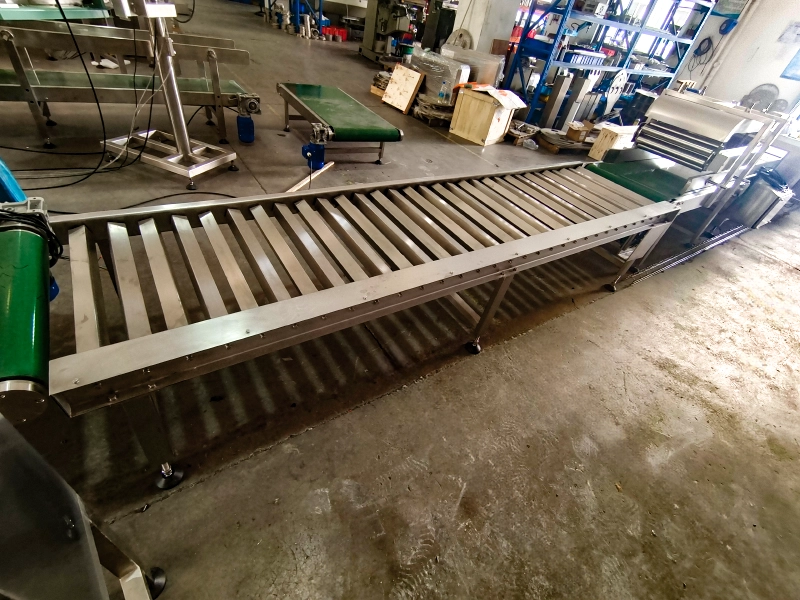
Operators usually report the symptom as “the bag arrives crooked”. What they are watching is an aerated bag being tipped from a belt onto rollers, then straightened by hand before it reaches the inspection gate. Every manual correction at that point costs a second of line time and introduces a variable the weigh cell cannot separate from a genuine weight error.
Settling and shaping: two jobs, two sections
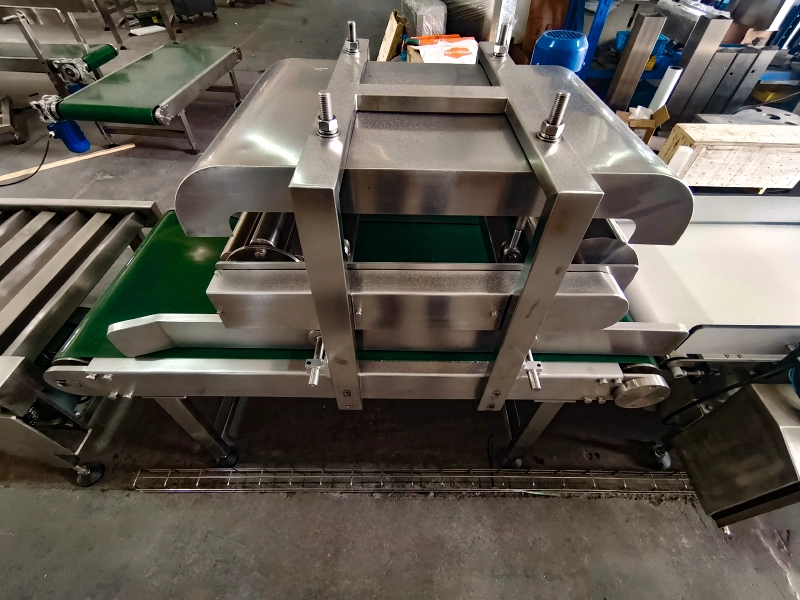
Settling and shaping are often treated as the same conveyor. They are not. A settling section gives the powder time and a low-vibration run to release air while the bag is still supported on a flat, level belt — on the Mipline layout this is a 3,000 mm section with a 600 mm belt running at 15 m/min on a 0.75 kW drive. A shaping section then works on the bag geometry: a 1,500 mm section with the same 600 mm belt width, running at 15 m/min, brings the two bag faces back to parallel and squares the base.
On the powder bagging line the shaping stage is where adjustable side guides earn their place. Guides set to the actual bag width, rather than to a nominal 25 kg size, stop the bag from rotating as it is handed from the twin-belt transfer to the roller run. The twin-belt arrangement holds both faces at once, so a bag that entered the section slightly rhomboid leaves it as a rectangle, and the mouth that reaches the sewing head or the heat-seal press is straight rather than skewed.
Engineering note. Set the guides by running twenty filled bags, not by measuring one empty bag on a bench. Kraft paper bags swell at the gusset once filled, and a guide gap set on the flat bag will pinch the filled one and re-introduce the tilt the section was installed to remove.
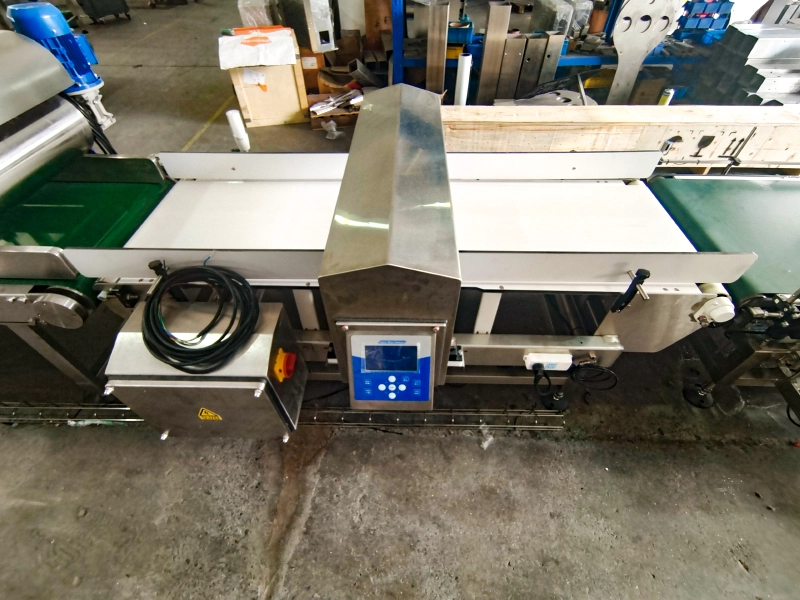
Handing the bag to the metal detector and checkweigher
Inspection equipment is where an unstable bag becomes a visible number. A metal detector on a 25 kg powder line is normally specified by aperture: the ER6023 reference carries a 600 × 230 mm window, a maximum product size of 550 × 200 mm and a 520 mm belt at 28 m/min, with sensitivity quoted per product and per belt condition. If the bag arrives at that aperture with a bowed face, the effective product height changes and the detector sees a varying mass of powder in the field — which shows up as false rejects that the operators then learn to ignore.
The checkweigher is stricter still. Dynamic weighing needs the bag to be at rest relative to the belt and fully supported across the weigh platform, which is why the platform frame on the line is built with an adjustable support and threaded leveling bolts rather than fixed feet. Reference units run up to a 50 kg range with a 590 mm belt and an AC 220–240 V, 750 W drive, but published accuracy and throughput figures for 25 kg powder bags vary between sources and between product densities. Fix accuracy against your own bag and powder on a FAT, not from a brochure.
| Stage on the line | Reference hardware | Working figure | What it controls |
|---|---|---|---|
| Clamp filling | Bottom-up lifting fill, three-stage screw | 25 kg nominal | Air and dust entering the bag mouth |
| Settling | Flat belt section, 3,000 mm | 600 mm belt, 15 m/min, 0.75 kW | Powder stops moving inside the bag |
| Shaping | Twin-belt section with side guides, 1,500 mm | 600 mm belt, 15 m/min | Bag faces parallel, base square |
| Metal detection | Aperture detector, 600 × 230 mm | 520 mm belt, 28 m/min | Contamination in the closed bag |
| Checkweighing | Dynamic weigh platform, up to 50 kg range | 590 mm belt, AC 220–240 V, 750 W | Weight drift after closure |
| Discharge | PVC belt conveyor, 5,000 mm | 10 m/min, 0.75 kW | Handoff to palletizing without tipping |
- If bags arrive skewed, check guide width on the shaping section and bag gusset swell before blaming the sewing head.
- If the weigh cell drifts on the same filled weight, check that the settling section is level and that the bag is not rolling onto the platform.
- If the detector false-rejects, measure the bag face height at the aperture instead of raising sensitivity.
- If operators still straighten bags by hand, the line length between closure and inspection is too short for your powder.
A well-set powder bagging line removes those four causes in the same order, because each one is a mechanical condition rather than an operator skill.
Size the settling and shaping sections around your powder
Bag width, gusset, powder bulk density and target speed decide how much settling length a powder bagging line needs before inspection. Send one filled bag sample, the powder type and your target bags per minute, and we will return a layout with the settling, shaping and inspection sections sized to them.
Send your bag sample English
 Русский