
Coffee Powder Packaging Line: Keeping 25 kg Coffee Bags Square Before Sewing
Throughput on a coffee powder packaging line is usually lost in the last two metres, not at the filler. Roasted and spray-dried coffee is light, aerated and still degassing, so a 25 kg kraft bag leaves the spout soft and off-square, then twists on its way to the sewing head. Mipline clamps the bag mouth before product enters, holds both faces through guided belt and roller transfer, and hands the bag over square.
Why a 25 kg coffee bag is harder to hold than a flour bag
A 25 kg flour bag settles into a firm block as soon as the product lands. A 25 kg bag of ground or spray-dried coffee does not. Bulk density is low, so the same weight needs far more bag volume, and the bag reaches the discharge soft, inflated and slightly gassy. Filling suction pulls the mouth inward, the coffee releases gas and pushes it back out, and the mouth ends up open at one corner and folded at the other.
That is where manual labour enters most coffee plants: one operator stands at the last metre, grabs every bag, pulls it straight and pushes it into the sewing head. The seam then depends on how carefully that operator worked that shift. A coffee powder packaging line has to take that decision away from the operator and put it into a clamp, an adjustable guide rail and a held belt. Dairy plants fight the same problem with aerated powder, which is why the same clamp-first logic is used on a milk powder packaging line.
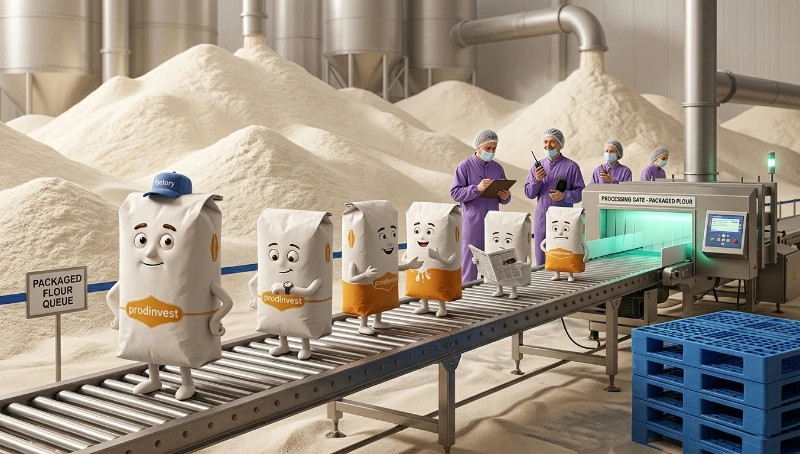
A filled bag twists on the roller conveyor, the mouth arrives at the sewing head skewed, the head pulls the seam off-centre, and the pallet fills with leaning bags. Whoever straightens bags at the end of the line is, in practice, the quality control of the whole bagging station.
Where Mipline takes over: flat bag to clamped mouth
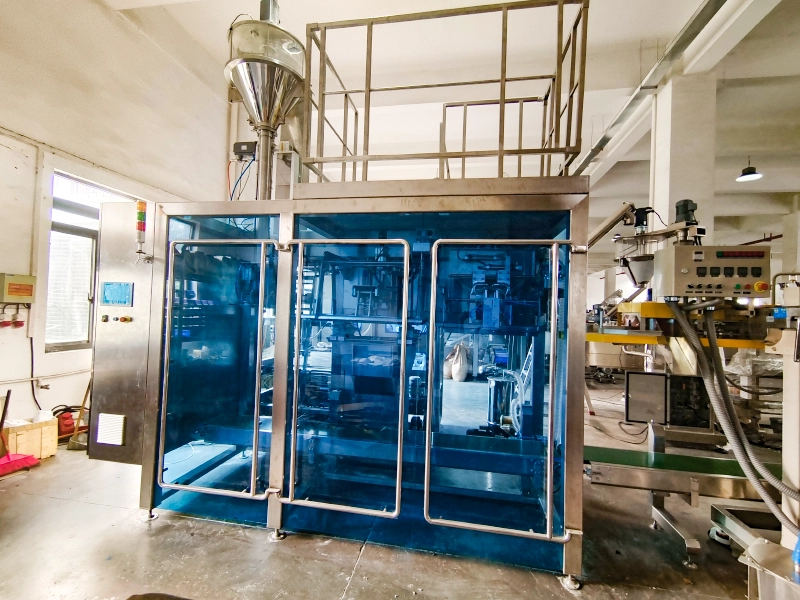
The front of the station is a bag magazine conveyor. Flat kraft bags are presented one at a time, picked, opened and placed on the filling position. The clamp closes on the mouth before any coffee enters, so the mouth geometry is set by a stainless steel clamp rather than by the weight of the product. Coffee dust lands on the clamp jaw, not inside a folded mouth. On a coffee powder packaging line this single detail decides whether the seam runs straight two metres later.
The filling zone sits inside an enclosed stainless steel bagging station with blue inspection windows and safety doors. Operators can watch the mouth, the clamp and the product stream without opening a guard, and the top of the station carries a maintenance platform with guardrails. A separate control cabinet with a touch-screen HMI and emergency stop keeps the whole coffee powder packaging line operable from one point, with the fault visible instead of guessed.
Field note: a 25 kg coffee bag that arrives at the sewing head crooked was already crooked three metres earlier, at the clamp. Fixing the clamp fixes the seam.
Guided transfer: belts, guides and rollers before the sewing head
After filling, the bag is released into a twin-belt transfer conveyor with adjustable side guides. Both faces are held, so the bag cannot twist or collapse while it moves, and the guides can be reset per bag width and paper grade. Roller conveyor sections carry it the rest of the way to the sewing head, and a weighing platform mounted on the conveyor frame checks the 25 kg fill in line. The conveyor runs on a stainless steel frame with adjustable feet, so the transfer height lines up with the sewing head instead of being shimmed on site. The same belt-and-guide arrangement is described station by station in this powder filling and bag sewing line walk-through.
The change that matters is not filler speed. It is fewer stops at the last metre: bags arrive square, the seam runs straight, bags stand up on the pallet instead of leaning, and the operator moves from straightening bags to checking weight. On a coffee powder packaging line packing 25 kg export bags, that is the difference between a line that needs a person standing at the sealer and a line that does not.
| Station | Visible evidence | What it changes for coffee |
|---|---|---|
| Bag magazine conveyor | Flat kraft bags presented one at a time | No operator peeling a bag off a stack |
| Bag clamp station | Mouth held open and square before filling | Mouth geometry fixed before product weight acts |
| Enclosed stainless station with blue windows | Fill zone visible without opening guards | Mouth checked without stopping the line |
| Twin-belt transfer with adjustable guides | Both bag faces held between belts | No twisting between filler and sealer |
| Roller conveyor handoff | Bag guided into the sewing head | Fewer manual straightening stops |
| Conveyor weighing platform | Weight check mounted on the belt frame | Over and under bags caught before pallet |
| Touch-screen HMI with e-stop | Single control point with emergency stop | Faster fault recovery, less restart scrap |
Specify the line around your coffee bag, not around a catalogue
Send the bag width, the paper grade, the 25 kg target weight and the sewing head position, and the coffee powder packaging line is laid out from the clamp outwards. BPMpack quotes the station mix as a drawing, so the transfer height, guide settings and control point match the coffee you actually pack.
Send your coffee bag sample English
 Русский