
Pellet Packaging Line: 25 kg Bags From Film Roll to Pallet
A pellet packaging line is judged after the seam cools, not at the dosing spout. BPM FFSline forms the bag from 350–450 mm PE film on the machine, fills 25 kg bottom-up, cools both seals and hands a square bag to the palletizer.
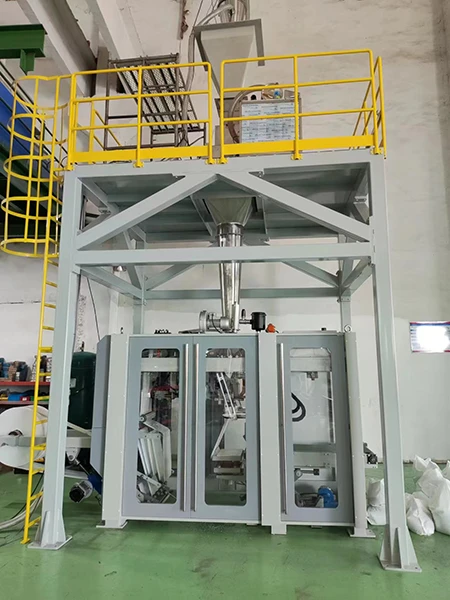
Where a 25 kg pellet bag actually loses its shape
A pellet plant moving from 50 kg open-mouth sacks to 25 kg film bags usually starts with the layout it already knows: a magazine of pre-made bags, an operator holding the bag mouth under the spout, and a sewing head at the end of a short belt. That layout works at low weight and low rhythm. Once the bag holds 25 kg of pellets, the mouth is clamped by a hand instead of a frame, so it is never square. The filled bag drops onto the belt, twists, and reaches the sewing head at an angle. The seam takes the full impact of the falling product, and by the third layer the pallet stack leans. Maintenance then spends the shift chasing leaks instead of running material.
FFSline takes the other route: the bag is made on the machine from a PE or PP roll — a common M-fold heavy film between 0.14 and 0.18 mm, film width 350–450 mm, roll outside diameter up to about 1,500 mm on a 150 mm core. Because the bottom seam is formed and cooled before the first pellet enters the bag, the impact of 25 kg lands on a seam that is already set, not on one that is still warm. That single detail is the structural difference between a form-fill-seal pellet packaging line and a magazine-fed bagger.
The clamp is a hand, the mouth is never square, the sewing head receives a bag at an angle, the pallet is rebuilt at the end of the shift, and the same crew also carries, labels and stacks the bags.
Why the FFS route fits pellets
Pellets flow well, so the risk is not dosing accuracy but continuity. A 3 m³ transition hopper buffers the front end; on materials that bridge or cake, it can be quoted with vibration or arch-breaking and a sampling point. Design output for the 2024 ammonium phosphate reference project was 500 bags/h, and the same line family is discussed in the 1,000–1,200 bags/h class for well-flowing granules. Both figures are design levels: a pellet packaging line is sized on bulk density, particle-size spread, moisture, feed continuity and the acceptance terms, not on a catalogue number.
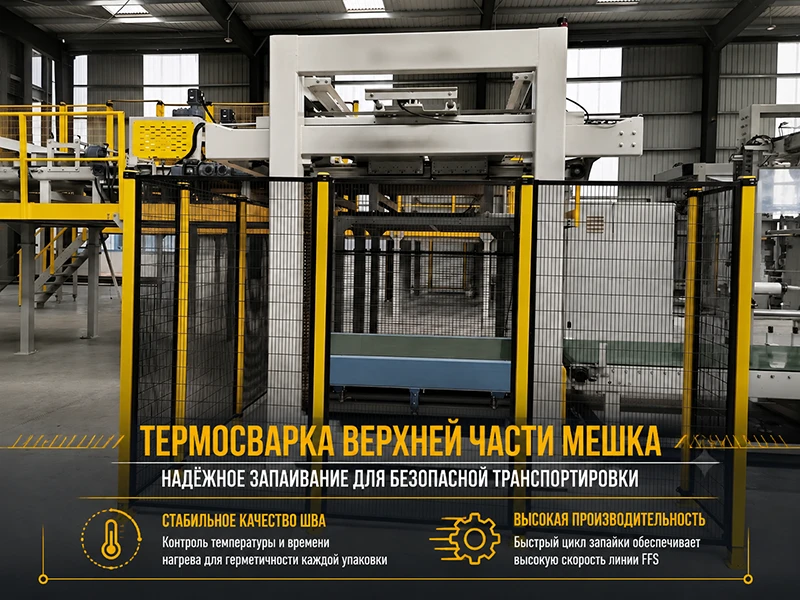
The seal is the second reason. The top sealing station closes the bag and holds it against a cooled plate, so the seam is set before the bag enters the first transfer. In the photo above, the upper-bag sealing unit sits inside its own fencing with the outfeed conveyor already aligned to the sealing plane. The bag is not lifted or rotated between sealing and transfer, and that is where most twisted bags in pellet and fertilizer plants come from.
Field note: Cooling is a structural station, not a cosmetic one. A warm seam meeting a 25 kg bag that falls onto a conveyor is the most common source of leaks we are asked to solve. Ask any supplier where the seam is cooled, and for how long.
What the bag meets between the spout and the pallet
A finished pellet packaging line does not end at the bagger. Weight is rechecked and out-of-tolerance bags are rejected, the bag is flattened and coded, and the pallet is labelled separately from the bag. Those are two traceability tasks: the bag label carries batch, date and shift that the buyer reads on the shelf; the pallet label carries the logistics identity of the whole load. One labelling station cannot do both jobs, and plants that try usually end up handwriting one of them.
Palletizing is selected by rhythm and floor space. Above roughly 1,000 bags/h a high-level palletizer keeps pace with a continuous stream without stopping the bagger; at lower outputs a robotic cell is enough and takes less room. The photo above shows the robotic end of a line, with infeed conveyor and fencing already tied into the bagging cell. Automatic pallet magazines, cold stretch hood and full-pallet labelling are added when the plant ships by pallet rather than by unit — and each of them changes the layout, so they belong in the first drawing, not in a later retrofit.
| Specification | Typical value / note |
|---|---|
| Bag material | PE or PP roll film, M-fold heavy bag |
| Film thickness | 0.14–0.18 mm typical, confirmed per supplier |
| Film width | 350–450 mm |
| Film roll | OD up to about 1,500 mm, 150 mm core |
| Bag weight | 20 / 25 / 50 kg by bag type and bulk density |
| Design output | 500 bags/h reference; 1,000–1,200 bags/h class — material and acceptance dependent |
| Main machine power | About 25–30 kW; line level about 40 kW class |
| Air demand | About 3,000–3,500 L/min at the main machine |
| Downstream options | Metal detection, checkweighing and reject, coding, bag and pallet labelling, palletizing, stretch hood |
Size a pellet packaging line against your bag and your material
Send the bag weight, film type, bulk density and target output. We come back with the forming section, filling and sealing stations, downstream check and palletizing layout drawn for your floor.
Send your bag details English
 Русский