
Bulk Product Sacks Need a Cleaner Handoff Before Palletizing
For a grain and bulk-products plant in Southern Russia, the real problem was not filling itself. The problem started after dosing: bags drifted, the discharge line looked uneven, and the pallet team had to keep correcting every stack by hand. A ppline line solves that weak point by keeping the workflow controlled from hopper feed to the final bag transfer.
What the line has to fix in the real workshop
The customer requirement was simple to say and hard to execute: fill bulk product sacks consistently, keep the bag mouth stable, and send each bag to palletizing without forcing operators to re-square the load. On paper, a standard bagging machine can promise output. In practice, many lines still leave the final transfer point exposed. Bags twist on the conveyor, the operator has to nudge them back into position, and the pallet layer becomes less uniform than it should be.
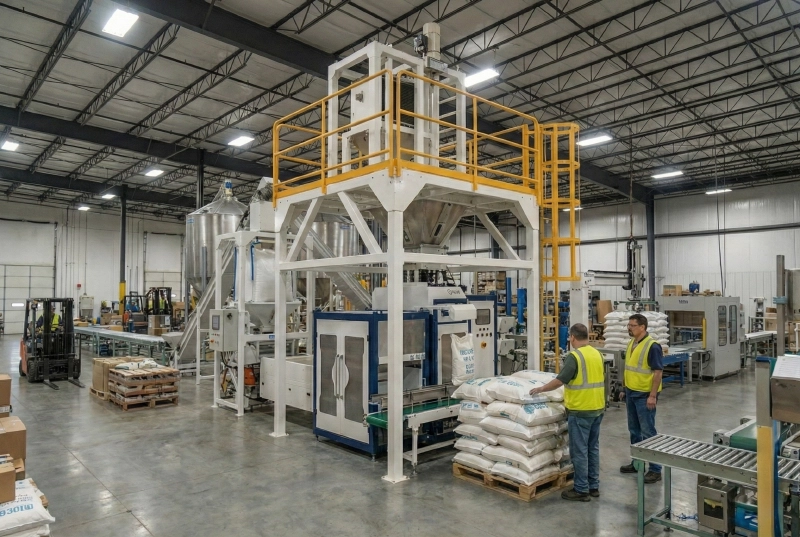
That is why the ppline setup matters. The first image shows a steel tower with a hopper-fed bagging body, enclosed service cabinet, and discharge conveyor already integrated into one industrial frame. This is not a loose collection of separate machines. It is one aligned route for product flow, so the bag leaves the filling zone and enters the transfer zone without a lot of manual intervention.
When the end-of-line bag transfer is not controlled, the operator becomes the correction system. That creates extra labor, more bag abrasion, and inconsistent pallet geometry. For bulk products, the weak spot is often not the fill accuracy itself, but the handoff after the fill is complete.
Why ppline fits this kind of bulk-product workflow
The line structure visible in the photos explains the fit. The elevated steel frame gives the system a clear working height and keeps the main bagging body separated from the floor traffic. The safety railings and tower layout support stable access for maintenance without turning the work area into a cluttered zone. Most importantly, the discharge conveyor is not an afterthought. It is part of the line logic, so the filled bag moves forward in a predictable direction.
The second image makes the downstream logic even clearer. The robotic palletizer is not just a separate automation add-on; it shows that the bagging line is designed to hand off to palletizing in a controlled way. For a plant that wants fewer manual corrections, that matters more than chasing a higher nameplate speed. A line that delivers a straighter bag to the pallet station often creates more real throughput than a faster line that needs constant human rescue.
bpmpack Engineering Insight: In bulk-product projects, the most expensive losses often happen after the product has already been filled. If the sack arrives to palletizing crooked, damaged, or badly spaced, the line pays twice: once in labor and once in rework. A rigid steel tower, integrated conveyor transfer, and palletizer-friendly discharge path reduce that hidden cost without adding complexity for the operator.
What the structure and support images prove
From a buyer’s point of view, the value is not just that the line can fill sacks. The value is that the machine layout supports a stable transition from dosing to transfer and then into palletizing. The visible steel structure supports the load, the enclosed body protects the working core, and the conveyor discharge keeps the bag moving in a managed path. Those are practical design decisions, not decorative ones.
If a bulk-products plant is still relying on manual bag correction at the end of the line, it should ask a different question: can the line keep the bag stable after fill and before palletizing? That is the real test. The ppline configuration shown here answers that test with a built-in transfer route, a rigid frame, and a downstream layout that is ready for automation.
| Workflow issue | What the ppline layout does | Business result |
|---|---|---|
| Bag drift after filling | Uses an aligned discharge path and controlled transfer height | Less manual straightening before palletizing |
| Uneven pallet layers | Keeps the end-of-line flow predictable for downstream handling | Cleaner stacks and better pallet quality |
| Operator overload | Moves the line from correction-driven work to machine-guided flow | Lower labor pressure and steadier output |
Need a bulk-product line that stays stable before palletizing?
If your current workflow still depends on manual correction after filling, bpmpack can help you map a cleaner route from hopper feed to final bag handoff. The goal is not just to pack product. The goal is to keep every sack ready for the next step.
Request a line review English
 Русский