
Bibpu Secondary Packaging Automation for Salt Bag Transfer, Compression, and Sewing Stability
When bags leave the filling machine, the real risk starts: a loose transfer, a bulging woven sack, or a misaligned mouth can slow the line and create rework. Bibpu secondary packaging automation is built to keep that handoff controlled from the conveyor to the sewing head, so the finished sack stays square, compact, and ready for shipment.
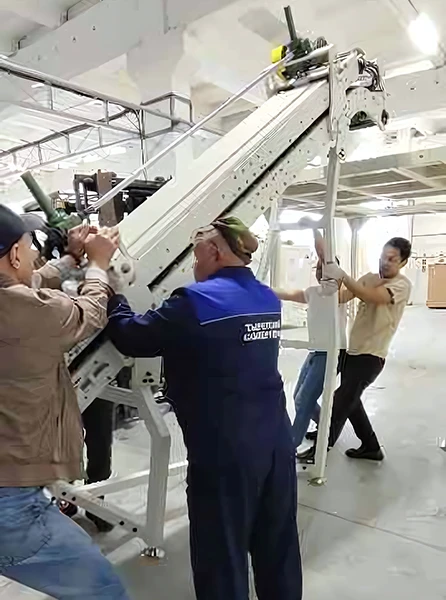
Why secondary packaging lines struggle at the transfer point
In a salt or bulk-products plant, the upstream machine may run well, but the handoff to the secondary bagging station often exposes the weakest part of the line. Bags arrive with trapped air, an uneven profile, or a small twist in the body. Once that happens, the sewing station has to fight the product instead of closing it cleanly.
Bibpu solves that problem with a line layout that keeps feeding, orientation, and operator access in one controlled flow. The workshop image shows the full system logic: conveyors, platform access, and centralized electrical control all positioned to reduce the distance between bag discharge and the next handling step.
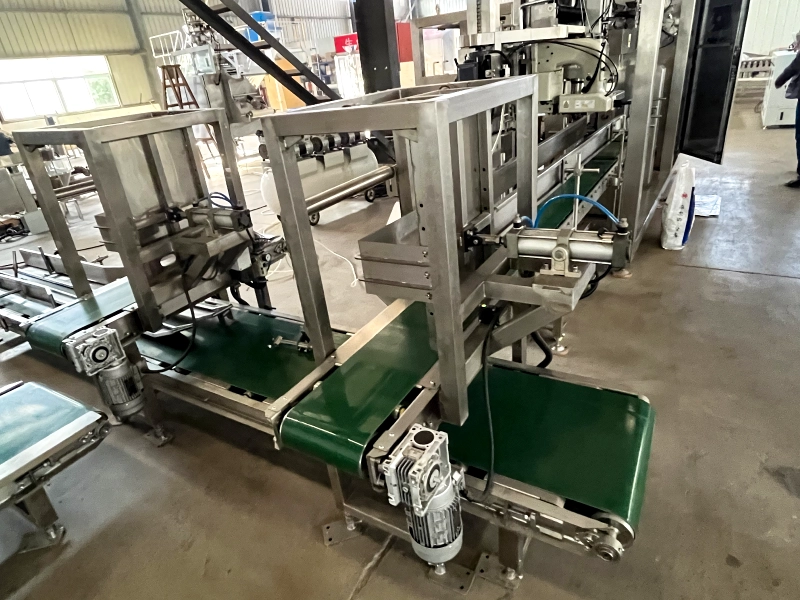
If the bag body is not squared up before sewing, the mouth folds, the stitch line drifts, and the sack leaves the station with a weak seal or poor stacking shape. That creates avoidable rework, especially when the customer needs stable pallets and clean warehouse handling.
How Bibpu keeps the sack centered before the sewing head
The transfer unit uses dual belt sections and a pneumatic pusher to correct direction before the bag reaches the next station. This is not cosmetic engineering; it is how the line removes random bag motion. The push-and-carry sequence gives the bag a repeatable path, which is the key to consistent secondary packaging output.
For woven-sack work, the machine must also control the volume inside the bag. That is why Bibpu includes a dedicated holding zone that opens the PP sack, accepts the product load, and then compresses the body before closure. The result is a flatter sack profile, cleaner sewing access, and less strain on the closure seam.
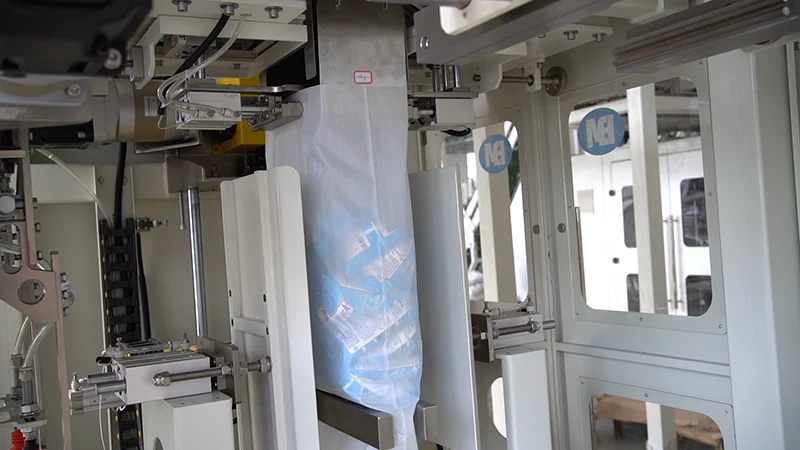
Compression and deaeration make the final stitch dependable
Once the sack is filled, the next challenge is not just to close it, but to close it on a stable shape. The side compression station pushes the bag walls into a more uniform geometry, which helps the air escape and keeps the mouth line from springing open under the needle.
This matters most for secondary packaging automation because a loose bag can look acceptable in process and still fail at palletizing. A compact sack stacks better, moves cleaner through warehouse handling, and reduces the chance of load shift in transit. The compression image is the proof point: the bag is being shaped before it reaches the sewing head, not after the damage is done.
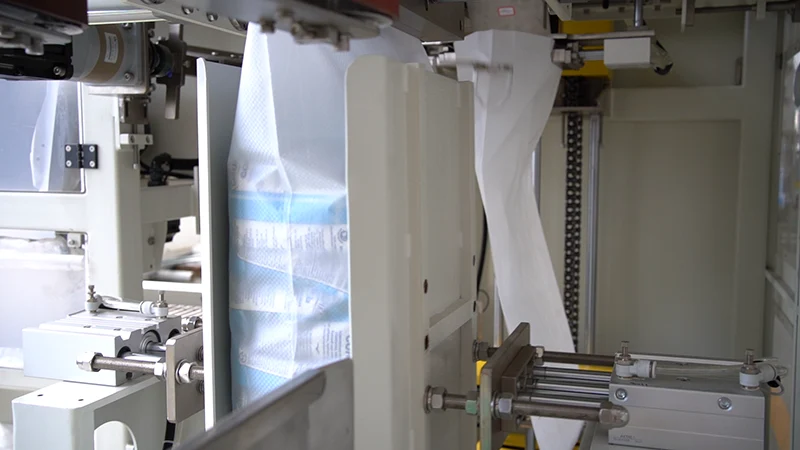
From controlled bag form to a clean stitched closure
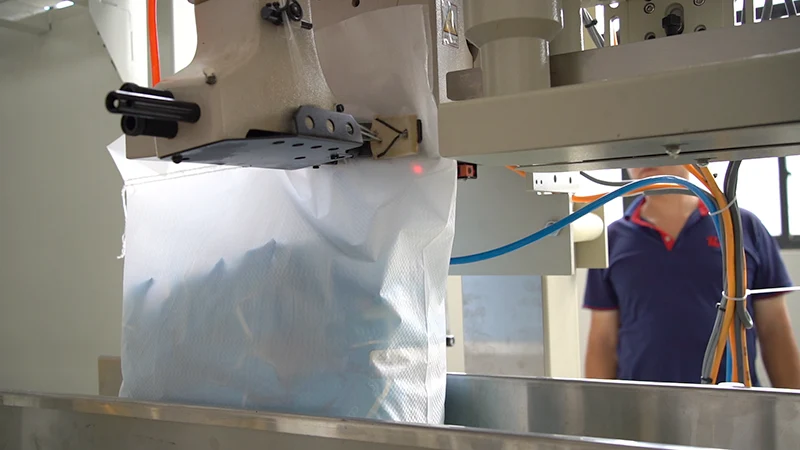
The final step is a sewing station that receives a predictable bag shape. Bibpu uses an industrial sewing head to close the mouth after transfer and compression are complete. At that point, the line is no longer dealing with a soft, shifting sack. It is working with a settled, aligned package that can be stitched faster and more consistently.
The outcome is simple: fewer jam points, fewer unstable bags, and less operator intervention. For salt, grains, resin pellets, and other bulk products, that means the secondary packaging cell can sustain throughput without sacrificing bag quality.
What this automation delivers in day-to-day production
In practical terms, Bibpu secondary packaging automation converts a fragile handoff into a stable process chain. The upstream bag is guided, the secondary sack is held open, the load is compacted, and the stitch is applied on a controlled mouth profile. That sequence is what keeps the line predictable.
For plants that care about shipment quality as much as output rate, the benefit is visible in the final pallet: bags sit flatter, corners stay cleaner, and the finished stack behaves better in storage and transport. The line stops depending on operator timing and starts depending on engineered motion.
Bottom line: Bibpu is a fit when the old problem is not filling capacity, but transfer quality. If the bag must move from machine to machine, stay square, and finish with a reliable sewn closure, the secondary packaging cell needs this kind of controlled mechanical sequence.
| Stage | What Bibpu controls | Production result |
|---|---|---|
| Transfer | Conveyor alignment and pneumatic push guidance | Less twisting and better bag orientation |
| Bag forming | Secondary bag opening and support clamps | Cleaner filling and easier closure access |
| Compression | Side squeeze and deaeration before sewing | Flatter sack profile and stronger stacking |
| Sealing | Industrial sewing head closure | Stable stitched mouth and cleaner finished package |
Need a cleaner secondary packaging handoff?
Talk to BPM if your line needs better control between filling, transfer, compression, and sewing. Bibpu is designed for the step where product quality is often lost and recovered only by rework.
Contact BPM English
 Русский