
Cement Bagging Line Price: What Really Drives the Cost of a 25kg Valve-Bag Packing Line
A 25 kg cement valve-bag packing line is not a single number on a price sheet. The delivered cost of a complete cement bagging line is shaped by throughput, valve-sealing method, dust handling, palletizing depth, and how the line is integrated with upstream mills and downstream logistics. This guide breaks down the price drivers so a cement producer can specify a line that matches the plant, not the brochure.
Why 25kg Valve Bags Still Dominate Cement Packaging
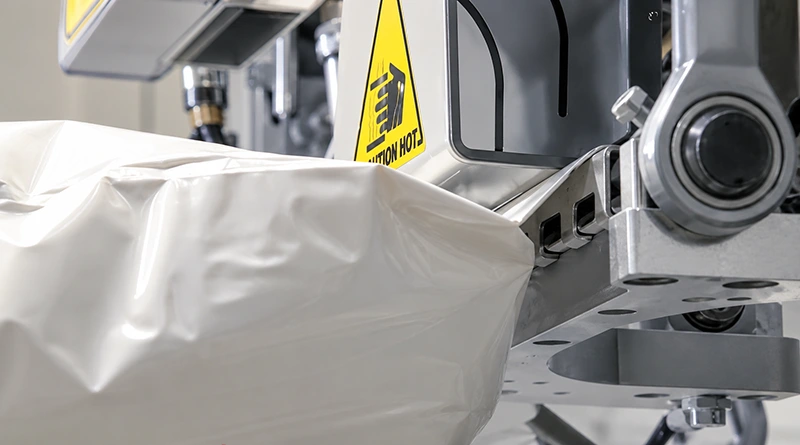
For Portland cement M400 and M500, the 25 kg paper valve bag remains the global workhorse. It stacks cleanly, survives rough handling at the building site, and pours without a funnel. A valve-bag packing line feeds that bag from the cement screw conveyor, fills it through the valve sleeve using pressurized air, and seals the valve with an ultrasonic head — no sewing thread, no needle dust, no bag mouth to fold.
The VPLINE valve-bag packing line is built around this exact workflow. The stainless steel filling nozzle and ultrasonic sealing head sit at the heart of the machine, with a contact-level sensor on the cement silo feed and an overpressure / negative-pressure air path that keeps dust inside the filling chamber rather than on the plant floor. For a mid-sized cement plant running two shifts, the typical throughput window is 400–1200 bags/hour at 25 kg, which is where the VPLINE configuration is benchmarked.
Most buyers compare the headline bagging machine price and miss the three cost drivers that decide whether the line is usable on day one: dust extraction integration, ultrasonic sealing reliability at high humidity, and pallet pattern stability for export shipment.
What Buyers Get Wrong About the Price Tag
A low advertised cement bagging equipment price often covers only the filling head and a short conveyor. The real price of a production-ready cement bagging line also has to absorb the automatic bag magazine, the ultrasonic valve sealer, the checkweigher with reject, the metal detector, the palletizer, and the stretch-hood or cold-stretch wrapping station. Each of these modules is a discrete engineering scope with its own motor list, PLC I/O count, and safety zoning — and skipping any one of them usually shows up as manual labor, rework, or rejected pallets within the first month.
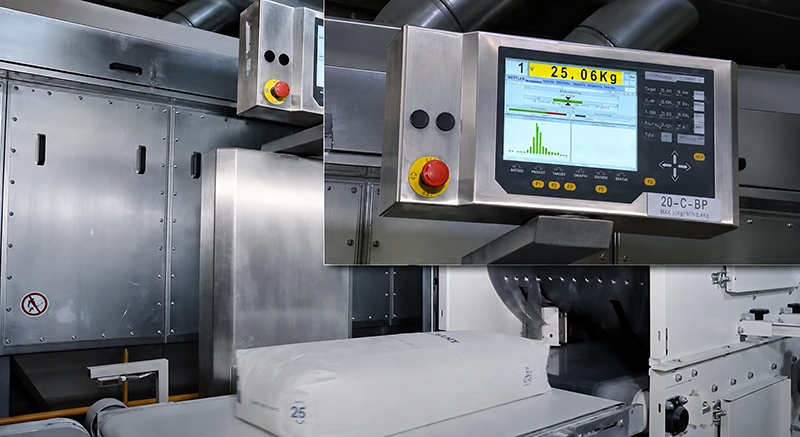
The VPLINE design pre-bundles these modules around a single control architecture. The dual-station filling machine keeps the line running while an operator reloads empty bags into the magazine. The checkweigher with auto-reject removes under- and over-weight bags before they reach the palletizer, so the robot stacks only verified-weight bags. The dust extraction ducting ties into the silo vent so the plant stays inside the cement dust exposure limits that inspectors actually enforce.
Practical specification insight: When requesting a cement bagging line price, always quote the target bag weight (25 kg or 50 kg), the target bags-per-hour, the available plant air pressure (typical 0.6 MPa), and the pallet pattern you need for export (e.g. 5-layer tie-stacked with interlayer sheets). A vendor who quotes without these four numbers is quoting a chassis, not a line.
Cement Bagging Line Configurations Compared
Below is a practical configuration map that drives the cement bagging line price you should expect. The VPLINE platform scales by adding modules, not by redesigning the filling head, so capacity and automation upgrades stay on a single mechanical and electrical baseline.
| Configuration | Throughput (25 kg bags/hr) | Sealing Method | Palletizing | Dust Control | Typical Operator Count |
|---|---|---|---|---|---|
| Semi-automatic (single-station) | 180–300 | Manual bag placement, ultrasonic valve seal | Manual pallet build | Local hood only | 3–4 per shift |
| Dual-station automatic (VPLINE core) | 400–800 | Robotic bag pick & place, ultrasonic valve seal | Robot palletizer, 5-layer tie stack | Ducted aspiration to silo vent | 1–2 per shift |
| High-output export line (VPLINE extended) | 800–1200 | Robotic bag pick & place, ultrasonic valve seal with humidity compensation | High-level robot palletizer + interlayer sheet dispenser + stretch-hood wrapper | Ducted aspiration + enclosed filling chamber + bag de-aeration | 1 per shift (supervised) |
| 50 kg variant (VPLINE heavy) | 300–600 | Reinforced ultrasonic valve seal, larger nozzle | High-level palletizer for 50 kg stack pattern | Reinforced aspiration for higher mass flow | 1–2 per shift |
How a Real VPLINE Line Is Laid Out on a Cement Plant Floor
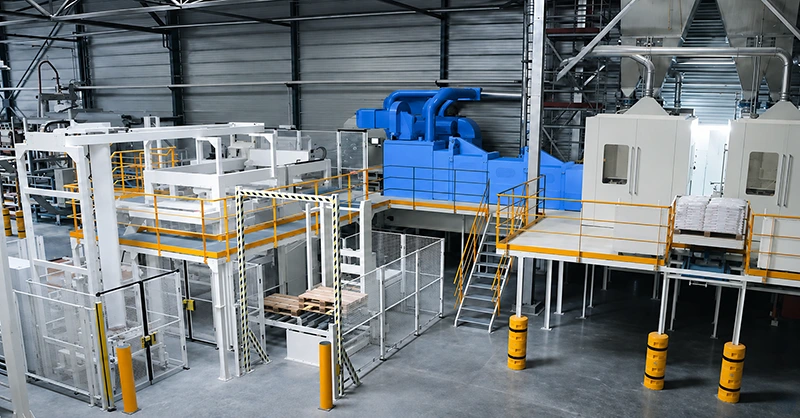
A factory-installed VPLINE run for a cement client typically starts with the cement silo discharge screw, feeds a buffer hopper with a contact-level sensor, and lifts the cement into the filling head via a pressurized air-conveying circuit. The filling head sits inside a stainless enclosure with the ultrasonic sealing station mounted on the same frame so the bag never leaves a controlled environment between fill and seal. From there the bag travels on a slat conveyor to the checkweigher, through a metal detector, and onto the high-level palletizer infeed.
The palletizer cell is fenced off as its own safety zone with light curtains and an emergency-stop loop tied back to the line PLC. Empty pallets are fed from an automatic pallet magazine so the operator only intervenes when the magazine is empty — usually once every 90 minutes at 600 bags/hr. A stretch-hood or cold-stretch wrapper seals the finished pallet before it rolls onto the dispatch conveyor toward the loading bay.
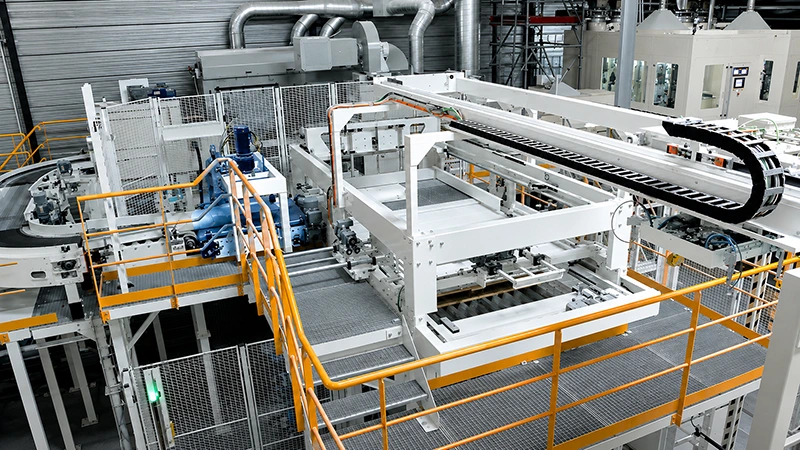
Because the same mechanical and electrical baseline is reused across configurations, scaling from a 400 bags/hr dual-station line to a 1200 bags/hr export line is a module addition rather than a redesign. That is the single biggest reason a cement bagging line price quoted on the VPLINE platform stays predictable as production grows.
Request a Cement Bagging Line Quote Built Around Your Plant
Send us your target bag weight, bags-per-hour, available air pressure, pallet pattern, and silo layout. We will return a VPLINE configuration with a transparent module-by-module price, an installed footprint, and a realistic ramp-up plan for your cement plant.
Request a Cement Line Quote English
 Русский