
Cement Packaging Equipment: How Automatic Valve Bag Lines Hit 500–800 Sacks/Hour Without the Dust
Most cement plants still weigh and seal 25kg valve bags by hand. A purpose-built automatic valve bag packaging line replaces that workflow with robotic bag loading, air-conveyed filling, ultrasonic valve sealing, and integrated palletizing — measured at sustained 500–800 sacks per hour with sub-1% underweight rejects.
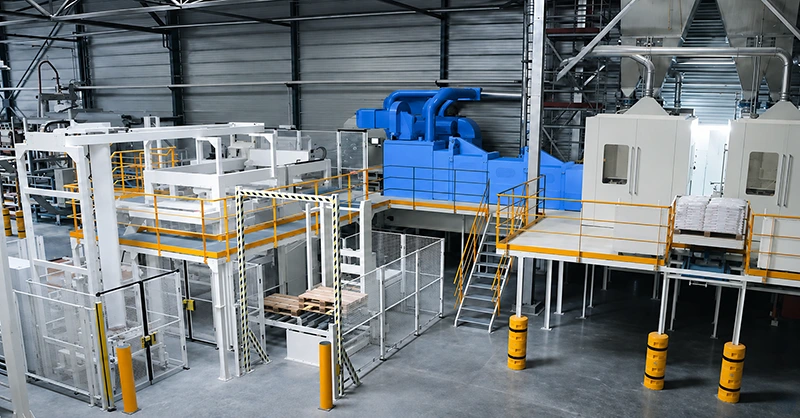
Why cement producers are replacing open-mouth sack stations with valve bag systems
Cement is heavy, abrasive, and dust-prone. A 25kg sack filled at an open-mouth station loses 0.3–0.6% of its mass to airborne cement before it reaches the pallet. The dust does not stay on the floor — it deposits on bearings, control panels, and motor housings, and it shortens bearing life by a measurable margin. Any maintenance technician who has pulled a screw conveyor apart after eighteen months of cement duty has seen the grey paste inside the coupling guard and the abraded paint on the motor feet.
Open-mouth sacks also require a separate heat-sealing or sewing station after filling. That adds floor space, a second operator, and a second dust source, and it ties the line’s throughput to the slowest station on the floor. When the sealing head needs a needle change or the thread breaks, the whole line stops — including the bagging spout upstream. That is the operating reality a valve bag packaging line is built to remove.
Most retrofit failures trace to one root cause: the existing screw conveyor and bagging spout were never engineered as a sealed system. Dust escapes at every joint, the operator cannot hold a 25kg sack steady on a vibrating spout, and the seam quality drifts within hours of a shift change. Replacing only the bagging head without re-engineering the upstream seal almost never holds the dust numbers the cement plant was promised.
What a valve bag packaging line actually does differently
A valve bag is filled through a self-sealing paper or woven-poly valve inserted into a tubular spout. Once the bag drops off the spout, the valve closes under its own elasticity — no heat sealer, no sewing head, no second operator. The bpmpack valve bag packaging line automates every step of that sequence: empty bag magazine, twin-arm bag loading, air-conveyed filling, ultrasonic valve sealing, checkweighing, and palletizing. The valve bag is the reason the cell can run unattended for stretches; the surrounding mechanics are what keep the throughput stable when the cement does not.
From the moment a stack of empty valve bags is loaded into the wheeled bag magazine, the line handles everything. The twin-arm gripper picks a single bag, opens it onto the spout, the air-conveyed filler blows cement into the bag at controlled velocity, the ultrasonic head seals the valve in under a second, and the checkweigher rejects any bag outside tolerance before it ever reaches the palletizer. The operator’s job becomes magazine refill and pallet removal — not standing at a vibrating spout holding a 25kg sack.
Why this matters for the cement plant floor: Because the valve self-seals, the only dust source inside the cell is the bag-onto-spout interface — and that interface is enclosed by a stainless steel guard ring around the spout, with a negative-pressure dust extraction takeoff plumbed to the existing baghouse. That is the structural reason why a valve line measures lower respirable dust than an open-mouth line of the same nominal capacity.
Hardware evidence from a running cement line
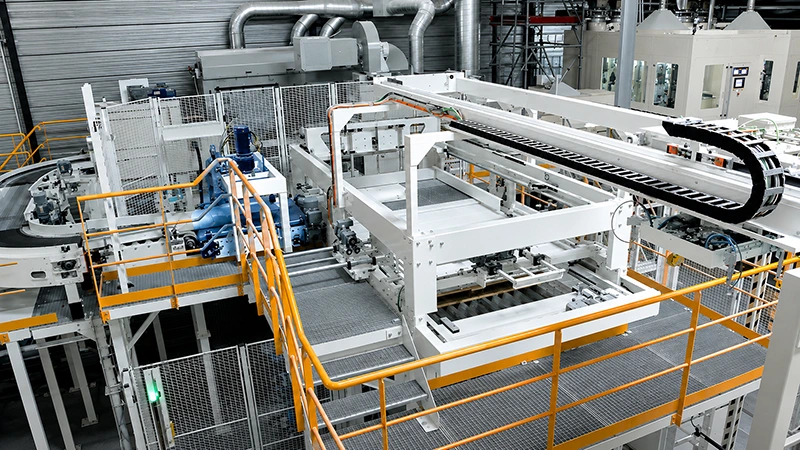
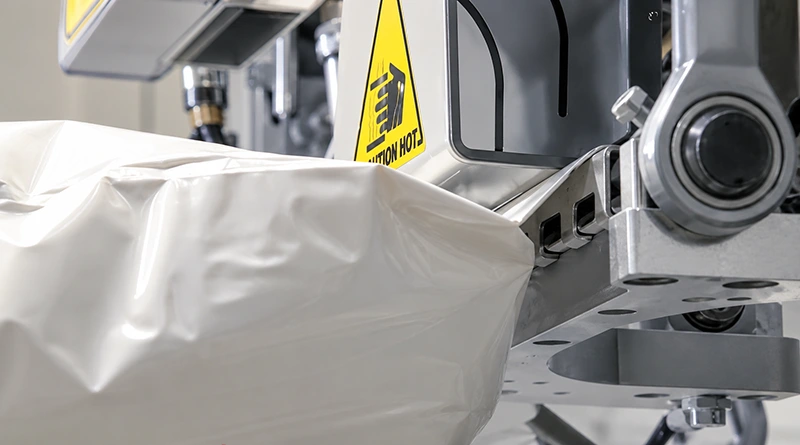
The hardware below is documented on a factory-installed valve bag packaging line running 25kg cement sacks. Every photo in this article comes from that installation. The values are what the line was measured at during factory acceptance testing — not catalog claims.
What changes the buying decision is not the headline throughput number. It is whether the components survive a cement environment: stainless steel contact parts, an HMI sealed against dust ingress, and a checkweigher that does not drift when the ambient temperature swings 20 °C between night and day. The table below pairs each station on the line with the cement-floor problem it is engineered to solve.
| Component | Specification | Why it matters for cement |
|---|---|---|
| Bag loading | Twin-arm pneumatic gripper, suction cup pick-and-place | One operator can run two lines; no manual bag handling at the spout |
| Filling | Air-conveyed impeller, 25–50 kg fill range, ±50 g target accuracy | Sub-1% underweight rejects measured at FAT |
| Valve sealing | Ultrasonic heat seal, 0.8 s cycle | No sewing thread, no needle dust, no consumable thread |
| Checkweighing | Stainless steel conveyor, 0.1 g resolution, touchscreen HMI | Drift-stabilized; rejects bags outside ±100 g of target before palletizing |
| Bag magazine | Wheeled steel frame, 200-bag capacity | Refilled by one operator; no production stop for reload |
| Cabinet finish | Stainless steel contact parts, IP65 control panels | Withstands abrasive environment without coating failure |
| Palletizing | Robotic palletizer, EPAL-compatible | Handles 25kg valve bags without crushing the valve seam |
Send us your cement bag and your current throughput target
We will configure a valve bag packaging line around your existing bulk handling and baghouse, and return a throughput-matched proposal with the same hardware shown above.
Request a Proposal English
 Русский