
How a Russian Polymer Warehouse Stabilized Granule Bagging and Dispatch with an FFS Line
For a Russian polymer warehouse handling granules, the real bottleneck was not only filling bags. The problem was the full handoff chain: hopper feed, bag forming, discharge, transfer to the conveyor, and final dispatch. An FFS line fits this scene because it keeps the workflow continuous, visible, and easier to control from the first fill to the last pallet move.
Why the old granule bagging setup kept creating friction
In many polymer warehouses, the old solution is a patchwork of manual bagging, short conveyors, and ad hoc transfer points. That kind of setup can work at low volume, but it usually starts to fail when dispatch rhythm becomes strict. Bags arrive unevenly, operators need more touch points, and the line becomes harder to keep safe around loading lanes and pallet movement.
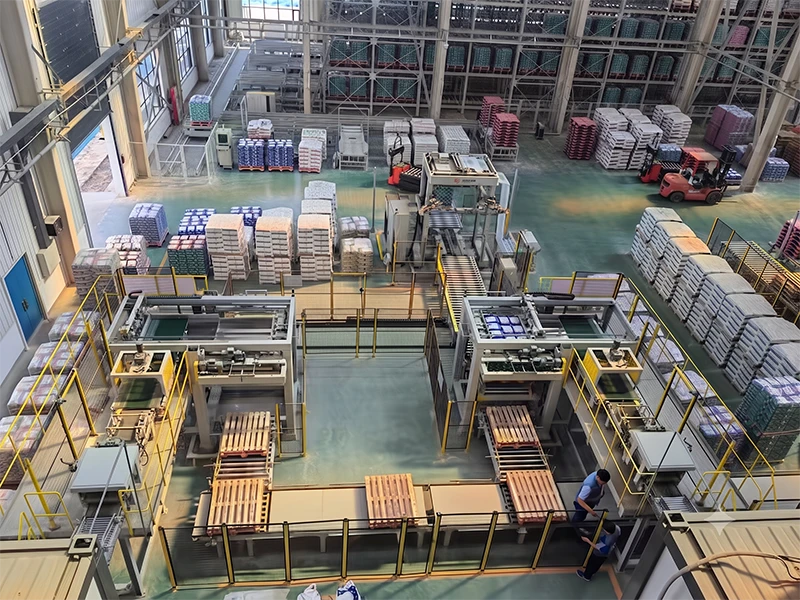
The first image shows the opposite direction: a planned FFS layout with clear conveyor routes, elevated working space, and room for forklift lanes. That is exactly why this kind of line suits granule packaging. The workflow is not improvised around the machine; the machine is arranged around the workflow.
When bagging, transfer, and dispatch are separated, the warehouse loses consistency. When operators must work around exposed equipment, safety and maintenance also become a daily concern.
Why this FFS line matches granule packaging in a warehouse scene
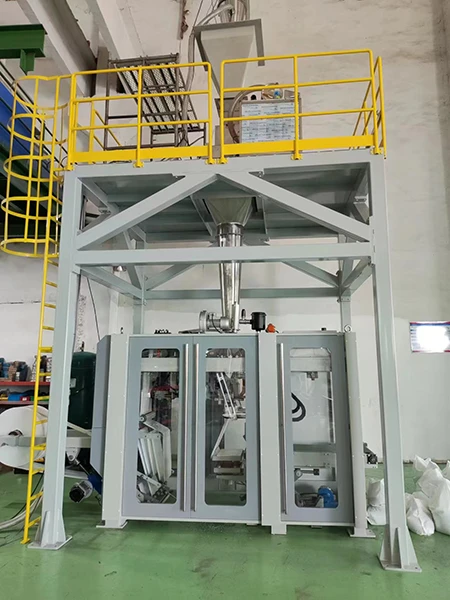
The front-view machine photo explains the core fit. A raised service platform improves access, the hopper keeps feed organized, the guard rails protect the operator zone, and the enclosed cabinet helps the line stay cleaner and easier to manage. For granules, that matters because the material flow needs to stay steady; otherwise, downstream packing and dispatch inherit the instability.
The second line image adds another proof point: the machine section, guard rails, conveyors, and downstream handling units are visually linked in one chain. This is not a stand-alone filler. It is a packaging system built for transfer continuity. In practical terms, that means fewer awkward handovers, clearer operator access, and a better base for stable dispatch planning.
What the pictures prove: the line is arranged as one controlled workflow, not a collection of isolated devices. That is the real reason it suits a polymer warehouse with granule output.
Structure, layout, and the result after integration
The overhead layout image gives the clearest evidence of the final result. The conveyors, platforms, palletized materials, and forklift lanes are all visible in one frame, which means the packaging line was planned together with the warehouse traffic. That reduces confusion at the packing station and makes dispatch easier to coordinate.
For granule producers, that is the practical value of an FFS line: stable feeding, controlled bag formation, clear transfer routes, and more predictable end-of-line movement. The result is not just faster packing. It is a cleaner operating rhythm, safer access, and fewer interruptions when the warehouse needs to keep orders moving.
| Image evidence | What it supports |
|---|---|
| Overhead layout with conveyors and forklift lanes | Shows the line was designed for warehouse traffic and dispatch flow. |
| Front view with hopper, platform, and safety rails | Shows organized feed, easier access, and protected operator space. |
| Section view with conveyors and downstream handling | Shows the packaging chain stays connected from filling to transfer. |
Need a steadier granule packaging line for your warehouse?
If your current setup still depends on too many handoffs, an FFS line can help convert granule bagging into one cleaner, safer, and more predictable flow from hopper to dispatch.
Request a layout discussion English
 Русский