
How a Russian Polymer Warehouse Stabilized Granule Bagging and Dispatch with an FFS Line
For a polymer warehouse handling granules, the problem is rarely the bag itself. It is the handoff: hopper feed that surges, bag forming that drifts, access that slows operators down, and an end-of-line flow that creates more rework than dispatch. A correctly arranged FFS line turns those weak points into a controlled sequence.
Why the old bagging setup struggled
The customer side was typical for a granule warehouse: bags had to move quickly from filling to sealing to dispatch, but the old workflow depended on too many manual transfers and too much operator timing. When granules are dense and free-flowing, even a small mismatch between feed, film handling, and discharge creates spill risk, dust, and uneven bag quality. The result is slower loading, more cleanup, and a dispatch lane that keeps waiting for the next stable batch.
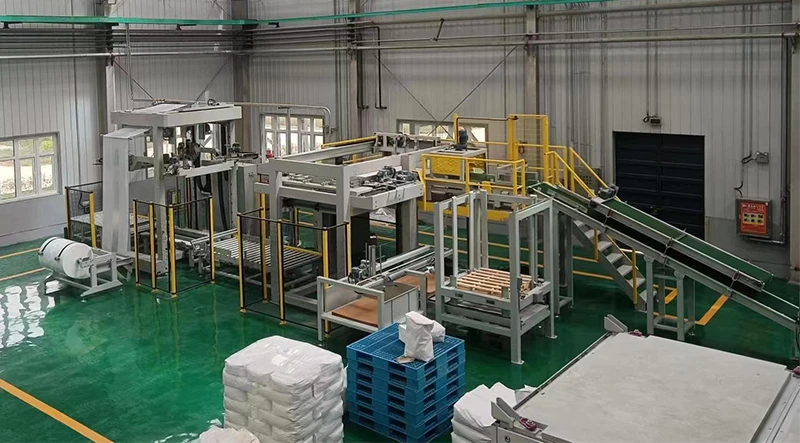
The production photo from the line shows why the issue cannot be solved by a single machine change. The process needs a linked structure: a clear bag forming and filling zone, protected access, continuous outfeed, and a downstream palletizing point that does not choke the line.
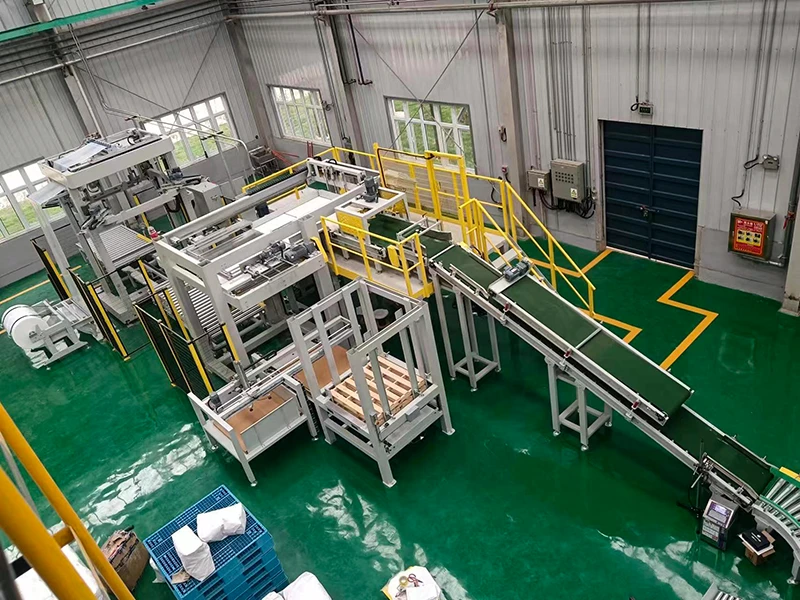
Granule filling is only stable when the hopper, bag-forming section, transfer conveyor, and palletizing area are designed as one flow. If any part is undersized or too exposed, the warehouse pays for it in dust, downtime, and rework.
Why this FFS line fits granule packaging
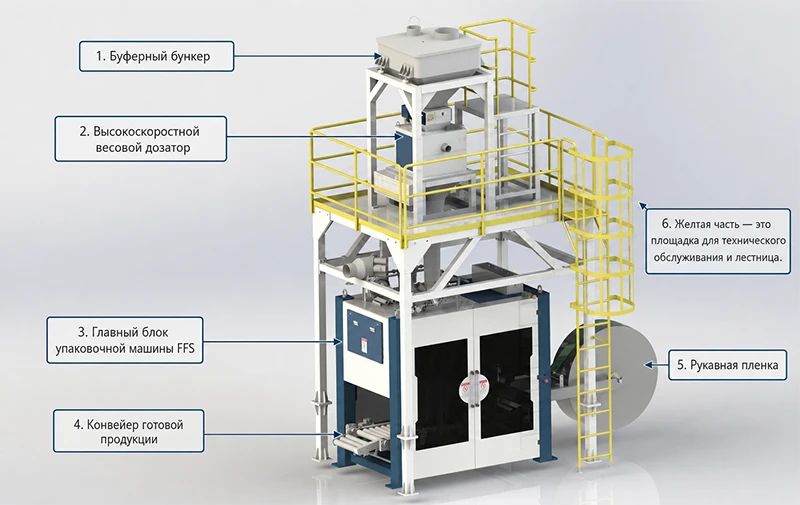
The pictured FFS line answers those problems with a straightforward industrial layout. The elevated working platform keeps the operator interface accessible without crowding the machine. The enclosed frame and safety rails reduce accidental interference. The machine module structure makes the bag-forming and filling section easier to control, while the downstream conveyor and robotic palletizing station keep filled bags moving instead of stacking up at the exit.
That is the main reason this setup is suitable for a polymer warehouse: granules need repeatable handling, not improvisation. The line supports a cleaner fill-to-dispatch path and gives maintenance staff enough access around the machine to keep the process stable during long shifts.
What the structure proves: the line is not just a packaging frame; it is a controlled system with platform access, guard protection, film-handling modules, and an end-of-line palletizing station built into the workflow.
Structure, parameters, and image evidence
The annotated diagram makes the machine logic easy to read: process modules, frame, control area, film handling, and service points are separated into distinct zones. That separation matters in granule work because the operator must see where the package is formed, where the bag is filled, and where routine checks are performed. It also helps when the line needs to be discussed with maintenance, production, and dispatch teams at the same time.
The robot palletizing image adds the final proof. Once the bags leave the filling section, they do not need to wait in a manual queue. Instead, they can be handed over to an automated downstream station. For a warehouse shipping polymer granules, this is where the line stops being just a bagging machine and becomes a dispatch system.
What the warehouse gained in the end
After the line was arranged around the granule flow instead of around manual convenience, the warehouse gained a steadier output rhythm, cleaner bag transfer, and a more predictable dispatch lane. The main change was not just speed; it was control. Bags moved through the line in a repeatable sequence, operators had safer access, and the downstream palletizing point reduced the chance of the exit area becoming a bottleneck.
For buyers in the same situation, the lesson is simple: if the material is granule, the packaging line must be judged by the full path from hopper to pallet, not by the filling head alone. An FFS line with clear structure and linked downstream handling is the safer way to keep output steady and dispatch on time.
| Area | Observed issue | FFS line response |
|---|---|---|
| Hopper feed | Surging material and unstable timing | Controlled feed path inside a full line layout |
| Bag forming | Manual drift and uneven access | Defined film-handling and service zones |
| Outfeed | Bag pile-up at the exit | Conveyor handoff to downstream handling |
| Dispatch | Warehouse bottleneck before loading | Robotic palletizing station for steadier output |
Need a granule bagging line that holds the flow?
If your warehouse is packaging polymer granules and the current process is still losing time at the handoff points, an FFS line with a clear structure, protected access, and downstream palletizing can make the whole shift easier to manage.
Request a packaging line discussion English
 Русский