
How a Siberian Salt Plant Reworked the Last Meter of Secondary Packaging
At this salt operation, the bottleneck was not the upstream VFFS bagger. The real slowdown sat in the last meter before the sewing head: bulging woven sacks, trapped air, and pallets that could not stay compact under transport vibration.
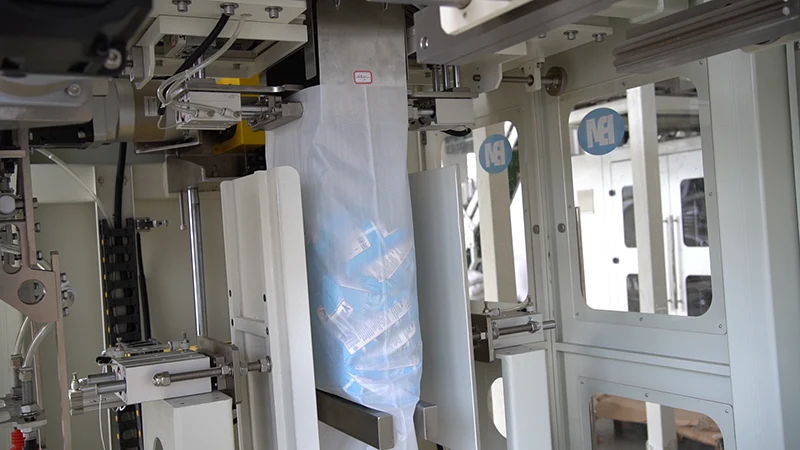
Before the upgrade, operators had to push soft salt packs into a secondary woven bag by hand, fight the air trapped inside the load, and compensate for poor bag shape with extra labor. The result was unstable stacking, more dust in the room, and a hidden giveaway problem that slowly turned into real profit loss.
Why this line needed more than a faster bagger
The customer did not need another generic conveyor. They needed a secondary-packaging section that could accept 200 g to 1 kg primary packs from the VFFS area, organize them, and deliver a compact 20 kg to 50 kg woven sack that would sew cleanly and hold its shape on the pallet.
That requirement became more urgent because the site works in a salt-heavy environment. Moisture, dust, and chloride exposure punish ordinary steel quickly. A line that looks fine in a brochure can still fail at the seams, in the guides, or at the forming collar once salt starts sticking and humidity rises.
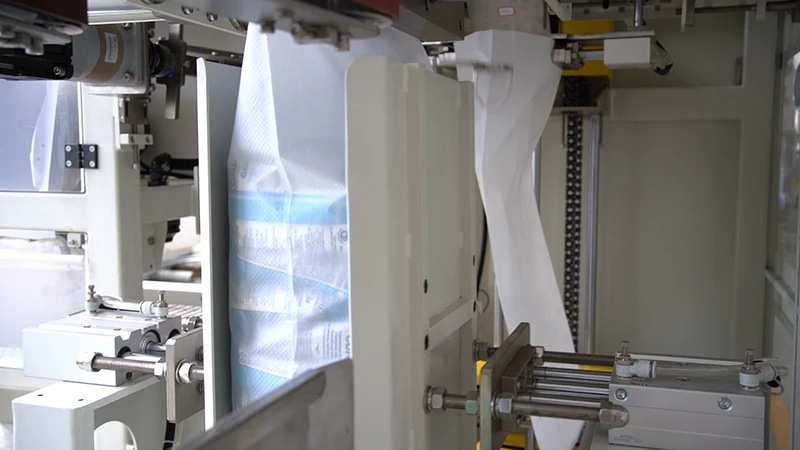
BPM Engineering Insight: The fix was not to force more speed through the line. The fix was to stabilize the handoff. Once the sacks are squeezed flat, aligned, and sent to sewing with less internal air, the whole downstream flow becomes easier to control.
The hardware answer: compression, anti-stick forming, and a reliable sewing endpoint
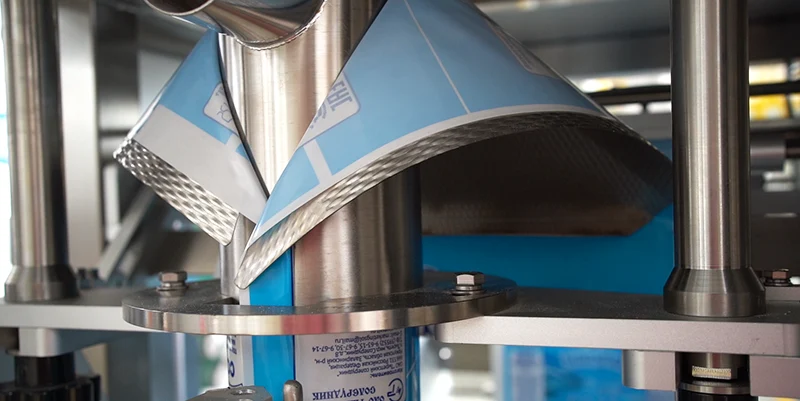
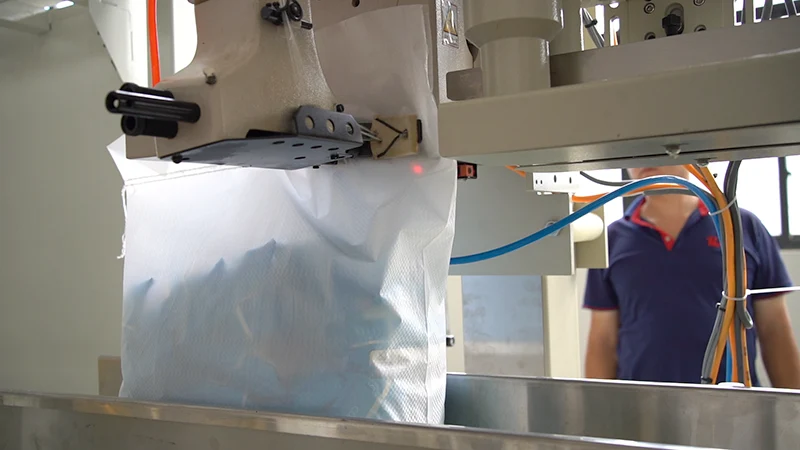
The line uses a dense sequence of physically simple but important modules. The forming shoulder is built with a dimpled surface to reduce film sticking in a humid salt room. The bagging and compression zone uses pneumatic side clamping plates to flatten the load before sewing. At the end of the line, the Newlong DS-9C sewing head closes the sack with a consistent stitch path instead of a hurried manual finish.
These details matter because the customer’s pain was mechanical, not abstract. Bulging sacks make pallet edges unstable. Unstable pallets waste truck space. Truck space loss shows up as freight cost. And if the operator adds extra salt to avoid customer complaints, giveaway quietly becomes a line item on the P&L.
| Field problem | What the line does now |
|---|---|
| Bulging sacks and trapped air | Pneumatic side compression turns a soft, uneven load into a flatter secondary pack before sewing. |
| Bag sticking in humidity | The dimpled stainless forming shoulder reduces drag where salt film and moisture would normally slow the web. |
| Loose or inconsistent closing | The Newlong industrial sewing head gives the site a repeatable stitch endpoint for woven PP sacks. |
| Pallet instability and freight waste | Compacted sacks stack more cleanly, helping the site move closer to 1.2-ton pallet loading instead of fighting 750 kg-style instability. |
What changed at output, and why the finance team cared
Once the secondary-packaging section stopped carrying excess air, the pallet became a logistics unit instead of a loose bundle of bags. That shift reduced handling damage, made the stack more predictable for transport, and gave the plant a more stable export-ready profile.
From a capacity point of view, the line can handle an upstream flow of 60 to 100 bags per minute and convert it into large-bag output at practical industrial rates. From a cost point of view, the bigger gain is not headline speed. It is the avoided giveaway, the lower labor count, and the freight efficiency created by a denser pallet.
The plant’s team also valued the maintenance side. A line built around 316L contact surfaces, corrosion-aware details, and a clearer sewing endpoint is easier to defend in a salt room than a cheaper 304-based machine that starts rusting, binding, or leaking around the wrong seams.
FAQ: what the plant needed to know before committing
Why not simply increase the speed of the upstream bagger?
Because speed alone would only deliver more unstable sacks to the same weak handoff point. The plant needed control at compression, forming, and sewing, not just a faster source of product.
Which specs mattered most in this project?
The most important numbers were the 316L corrosion-resistant contact surfaces, the compression behavior before sewing, the 20 kg to 50 kg woven-bag range, and the ability to keep the line compact enough for the site layout. Those are the features that directly support the process.
If your salt line is still losing rhythm at bagging, compression, or sewing, send us the product weight, bag type, upstream speed, and available floor space. We will map the secondary-packaging section around the real bottleneck, not the brochure bottleneck.
Request a line review English
 Русский