
How a Siberian Salt Producer Stabilized Secondary Packaging Before Sewing
A Russian salt producer needed a cleaner handoff between VFFS output, bag-in-bag loading, compression, and sewing. The answer was a BPM secondary packaging line built to remove trapped air, keep woven sacks square, and support stable palletizing.
At a salt site, secondary packaging is not just a wrapping step. It is the point where fragile primary bags are converted into a transport unit that can survive stacking, long haul logistics, and warehouse handling. In this case, the customer was running a demanding Siberian operation with high humidity swings, salt dust, and a steady flow of primary VFFS bags that had to be consolidated into woven sacks without losing rhythm.
The old method depended too much on manual handling. Operators had to keep the bags aligned, hold the woven sack open, push product inside, remove trapped air, and then feed the mouth to the sewing head. That chain sounds simple on paper, but in practice it creates three recurring problems: bag deformation, slow transfer, and stitch instability. Once the sack starts to balloon, the opening drifts. Once the opening drifts, the sewing head has to fight the load instead of sealing it cleanly. And once the line is forced to stop and reset, the whole end-of-line rhythm collapses.
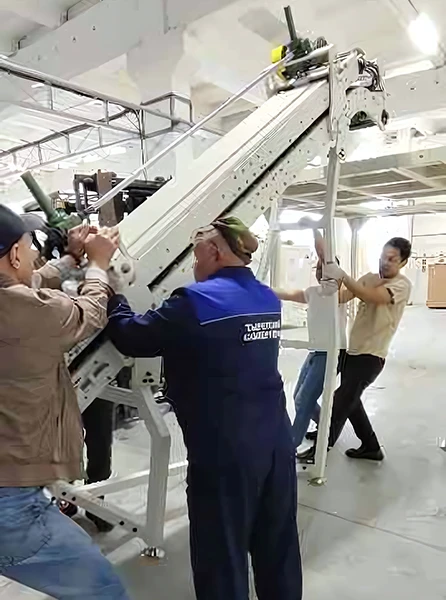
The first reason this BPM system fit the job was layout discipline. The line is built as a connected workflow, not a loose collection of machines. The workshop view shows how the inclined conveyors, platform access, and control cabinets are arranged as one production chain. That matters in salt, because every extra manual handoff adds exposure to dust, humidity, and operator variation.
For this type of project, the technical target is clear: move primary bags in the 200 g to 1 kg range into woven secondary sacks in the 20 kg to 50 kg class, then prepare those sacks for stable palletizing. The machine is not solving only packaging. It is solving the physical transformation from loose primary packages into a tight logistics unit.
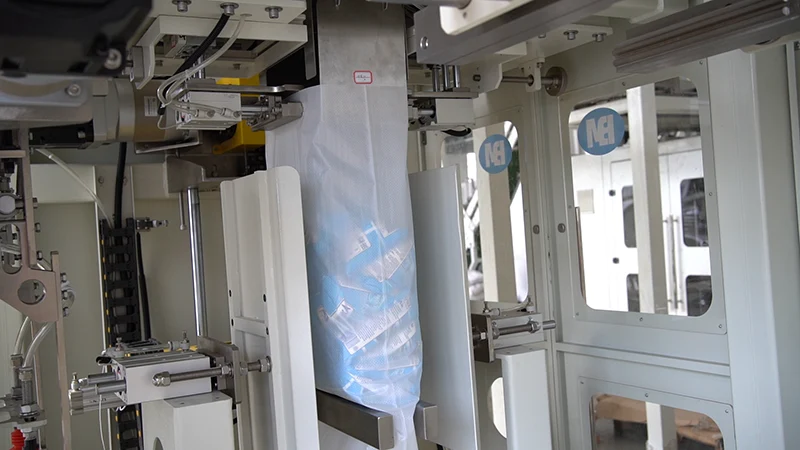
The second reason is the loading station itself. The fill zone uses pneumatic clamping to hold the woven PP sack open while the smaller bags drop in a controlled pattern. That is the moment where a line either stays smooth or becomes chaotic. If the opening is unstable, bags wedge sideways, the sack bulges unevenly, and the next station has to compensate for the mess.
This is where the product structure matters. The line was chosen because it supports the real behavior of salt packaging: the bags are not perfectly rigid, air remains inside, and the final sack can swell after filling if the material is not managed with enough restraint. By controlling the opening and the drop path, the system keeps the sack shape predictable before compression starts.
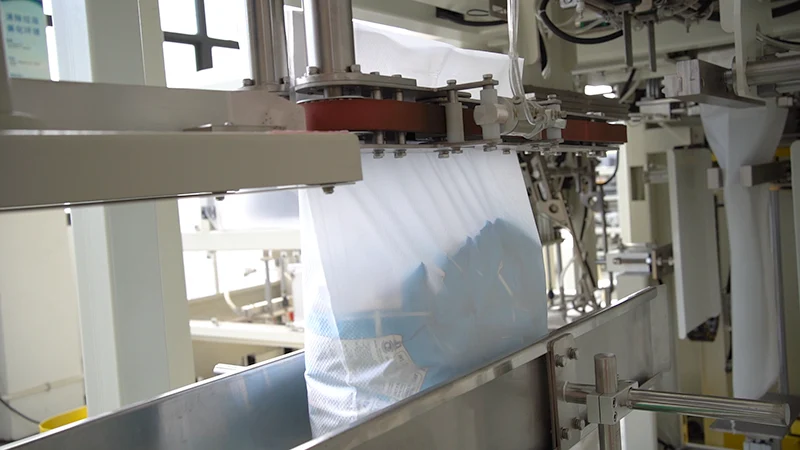
The third reason is the transfer-to-sewing zone. After filling, the sack is guided by dual belt feeders so the mouth stays aligned and ready for the sewing head. This is not cosmetic. The mouth position decides whether the bag closes flat or arrives twisted, overfilled with air, or shifted off center.
In the salt industry, that transfer zone is often the hidden bottleneck. Operators think the real problem is stitching speed, but the real problem is the geometry of the sack before stitching. If you compress too late, the bag remains puffy. If you compress too early without control, product settles unevenly. The correct answer is a controlled handoff: open, fill, compress, align, sew.
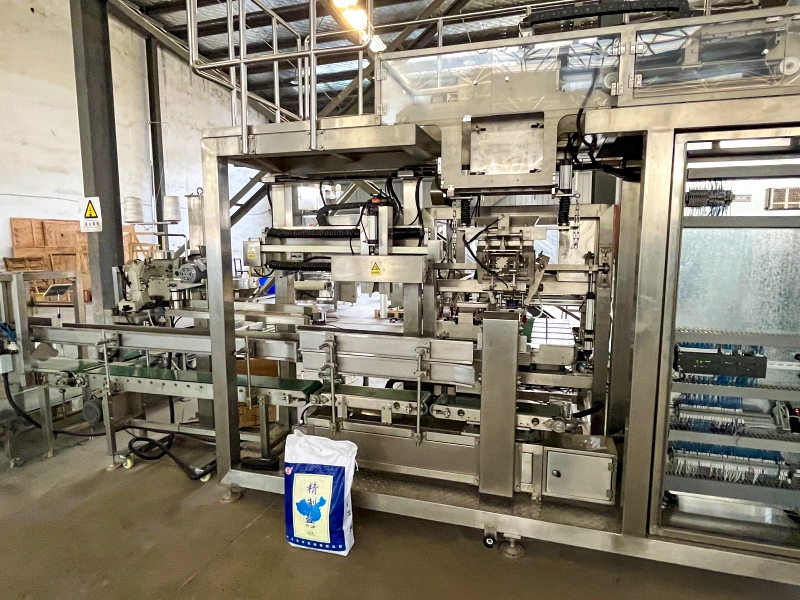
The fourth reason is the machine architecture. The internal mechanism image shows the pneumatic cylinder guides, chute geometry, and guarded access structure that make the system serviceable and repeatable. In a salt environment, that is essential. The customer is not buying a clever demo machine; it needs a structure that can tolerate dust, cleaning, and daily production without losing precision.
From the source specification, the important material and protection choices are straightforward: contact surfaces are built around UNS S31603 316L corrosion resistance, the electrical cabinet uses a protected positive-pressure concept, and wear-prone transfer points are treated as engineering surfaces rather than afterthoughts. That is exactly what a salt plant needs when chloride exposure and abrasive dust are part of the daily operating reality.
What changed after the line was put in place
The result was not only a cleaner-looking sack. The production rhythm itself improved. The customer moved away from high-touch manual loading and toward a line where the bag shape, mouth position, and sealing sequence are handled by the machine. That reduced the number of interruptions between VFFS output and outbound palletizing.
In practical terms, the plant gets a more stable output unit: fewer soft bulges, less product bounce during transfer, and a far better chance that the final woven sack will sit flat and stack cleanly. The payoff is visible downstream. Better shape control improves pallet density, reduces transport waste, and cuts the risk of load damage in storage and shipping.
For a salt producer, that is the real value of secondary packaging automation. It is not a single machine. It is a way to turn a sensitive, dust-prone, human-dependent end-of-line into a controlled packaging flow that supports the whole site.
Why this solution matched the site
- It fits the real product chain: primary VFFS bags first, woven secondary sacks second.
- It addresses the physical failure mode: trapped air and sack deformation before sewing.
- It uses corrosion-conscious construction for chloride-heavy salt conditions.
- It turns the last meter of packaging into a predictable, serviceable workflow.
- It supports the logistics goal: denser sacks, cleaner stacking, and more stable pallets.
That is why the line made sense for this Siberian salt producer. The customer did not need more theory. They needed a secondary packaging system that could keep up with real bags, real dust, and real production pressure. This BPM solution did exactly that.
Need a consultation on packaging equipment?
CONTACT US → English
 Русский