
How a Siberian Salt Plant Turned Bag Deformation Into a Stable Secondary-Packaging Flow
At a salt plant in Siberia, the real bottleneck was not filling. It was the unstable meter between the VFFS bagger and the pallet. Small salt bags arrived with trapped air, uneven edges, and moisture-sensitive film behavior. BIBPU was selected to turn that handoff into a controlled secondary-packaging flow instead of a constant source of rework.
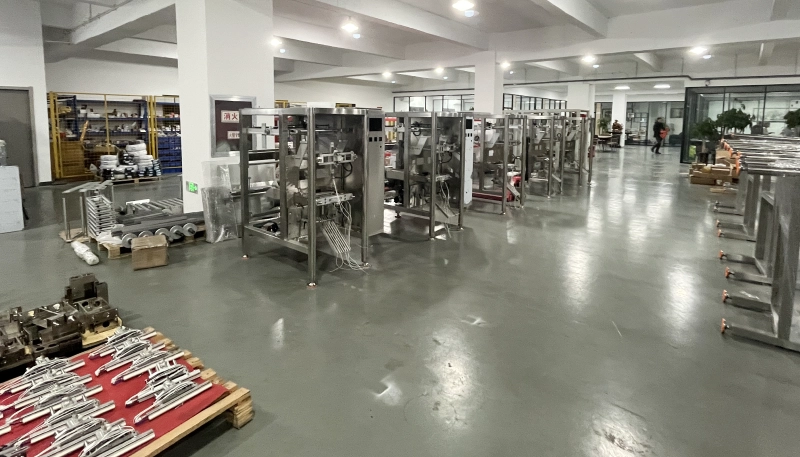
Manual intervention and a simple conveyor-only layout could move bags, but they could not control film sticking, bag breathing, or compression before sewing. In a salty, humid room, every uncontrolled bag inflated cost, took more volume, and made pallet stacking less stable than it should have been.
Why the line had to be engineered as a flow, not a machine
The customer’s old arrangement treated packaging as a sequence of isolated steps. The new BIBPU setup treats it as one continuous flow: VFFS output, bag conditioning, compression, sewing, and pallet-ready shaping. That matters in salt service because the weak points are rarely inside the bagger alone. They appear where the film touches metal, where moisture changes friction, and where bags lose their shape before the next transfer.
The forming shoulder and guide rollers are not cosmetic details. The dimpled stainless shoulder reduces sticky contact on humid film, while the tension rollers keep the web tracking stable when the room conditions are unforgiving. With corrosion-resistant contact surfaces and a protected control cabinet, the line is built for the reality of salt dust, not for a clean brochure photo.
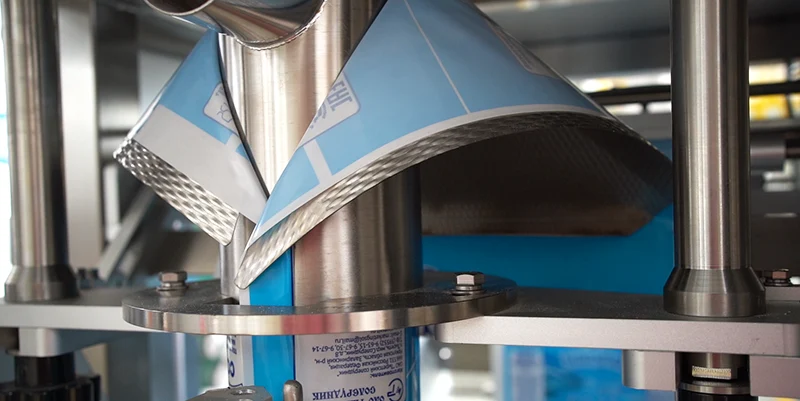
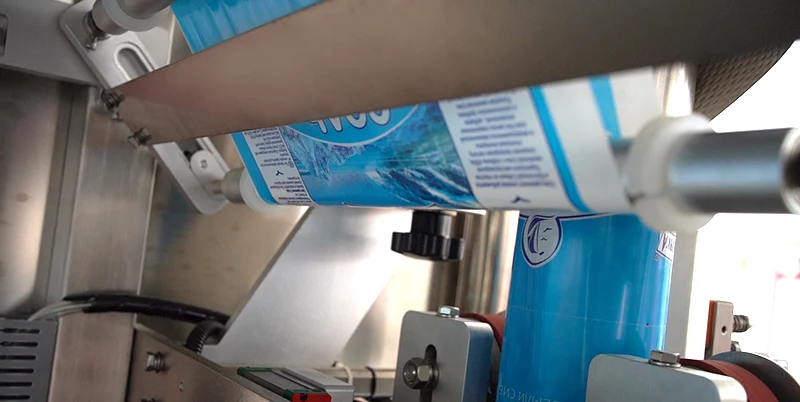
BPM Engineering Insight: In salt packaging, the biggest failures usually start where film, air, and corrosion meet. Once the bag shape drifts, the problem spreads downstream into sewing quality, stack stability, and pallet density. Fixing the transfer zone is often more valuable than chasing a few extra bags per minute.
Where the flow is restored before the sewing head
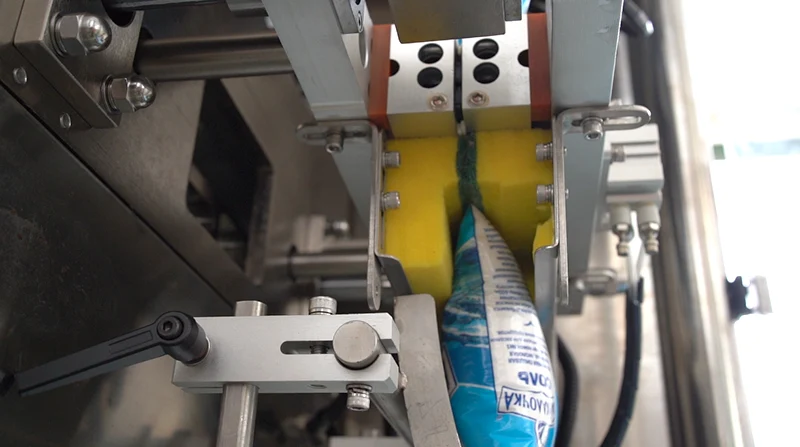
Once the primary bags leave the VFFS section, the line must remove trapped air and restore a square, predictable profile. That is where the foam guide and pneumatic compression station do real work. The foam pads soften the bag’s movement, while the side compression stage pushes the filled bags into a flatter shape before sewing. The result is not just nicer packaging. It is a bag that behaves consistently on the conveyor, at the sewing head, and on the pallet.
This is why BIBPU is not sold as a single machine. It is a secondary packaging system that connects primary packs to downstream logistics. The customer did not need another isolated piece of hardware. It needed a line that could absorb upstream variation and still deliver a stable, stackable output for palletizing.
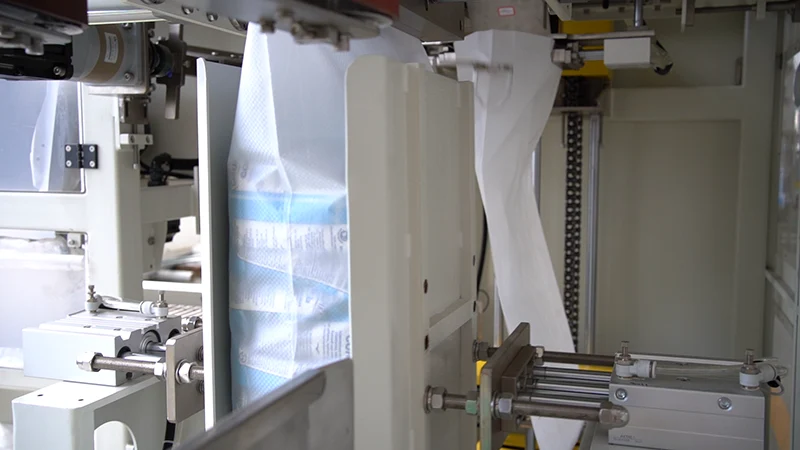
| Observed problem | BIBPU response |
|---|---|
| Bulging small bags before sewing | Foam guidance and pneumatic compression remove trapped air and reduce bag volume before closure. |
| Film sticking and unstable tracking in humid conditions | Dimpled forming shoulder and tension rollers stabilize the web and reduce friction at the forming point. |
| Pallet stacks wasting space and shifting during transport | Flattened bags and controlled orientation create denser, more stable loads for downstream logistics. |
What changed for the customer in practical terms
The visible improvement was not a single number on a brochure. It was the disappearance of random bag swell, fewer manual corrections, and a cleaner rhythm between filling and palletizing. For a salt plant, that matters because every bag with excess air takes up more space, behaves worse under compression, and makes the next handling step less predictable.
By treating the secondary-packaging area as an engineering problem, BIBPU gave the plant a way to control the last unstable meter before the pallet. That is the part that decides whether a line feels constantly interrupted or genuinely continuous.
Frequently asked questions
Why not use a simple conveyor and let operators correct the bags by hand?
Because transport alone does not solve film behavior, air retention, or corrosion exposure. A conveyor can move a bad bag faster, but it cannot make that bag flatter, cleaner, or easier to sew. BIBPU combines guiding, compression, and salt-ready materials so the line works as a flow, not as a handoff of problems.
What mattered most in this project specification?
The key was to control the transfer zone: stable film tracking, controlled bag shape, and reliable compression before sewing. Once those points are stable, the downstream stack becomes tighter and the line is easier to run with fewer interventions.
If your salt line is losing rhythm between filling, sewing, and palletizing, we can map the full flow and identify where the bag shape is breaking down.
Request a packaging flow review English
 Русский