
Mipline Flour Bagging Line for Stable 25 kg Bag Handoff Before Sewing
A powder packaging line for flour plants that need cleaner bag alignment, fewer manual corrections, and a controlled transfer from filling to sewing or sealing.

Why flour plants lose control in the last meter
For a flour mill or starch powder plant packing 25 kg kraft-paper or woven bags, filling is only one part of the job. The filled bag still has to reach sewing, heat sealing, palletizing, or warehouse handling in a predictable shape. When the bag twists, sags, or arrives with a skewed mouth, operators are pulled into the last meter to open, straighten, and reposition it.
A conveyor that only moves the bag does not necessarily provide a stable bag handoff before sewing. The line must coordinate bag supply, opening, clamp alignment, bottom-up filling, closure, and downstream transfer so that the next station receives a controlled bag rather than a moving correction task.
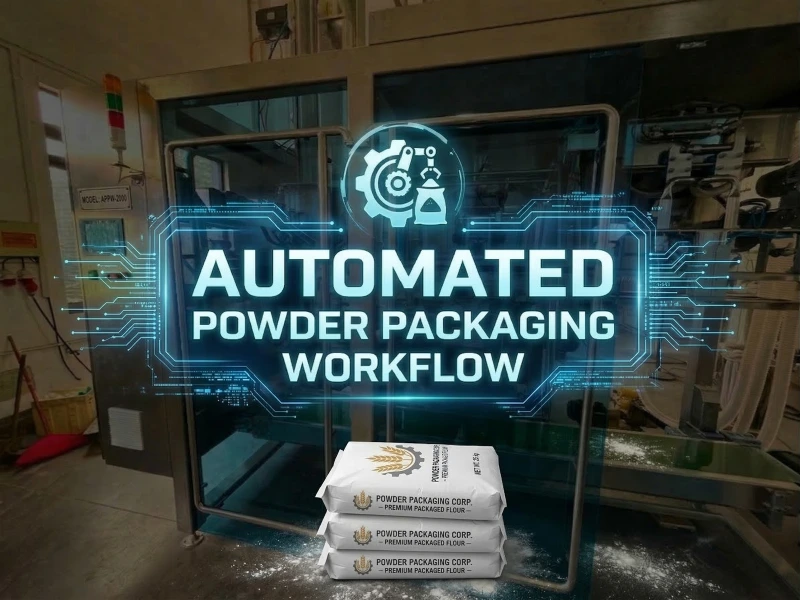
If the bag mouth is dusty or skewed, sewing becomes unstable. If the filled bag retains air or leaves the clamp without support, it can collapse during transfer. Manual bag straightening may hide the problem for a shift, but it keeps labor, hygiene, and closure quality tied to operator attention.
How Mipline is adapted to the flour bagging workflow
Mipline treats the automatic powder packing machine and its bag-handling path as one connected process. A bag magazine and pickup section prepare the bag; controlled opening and clamping hold the mouth; bottom-up filling keeps the fill point close to the material; and three-stage feeding—fast, medium, and slow—supports the final dose. Where configured, vacuum extraction or de-aeration can be used before closure.
After filling, the line can connect dust removal, trimming, inner-bag heat sealing, pressing, sewing, hot-melt paper tape application, and final pressing. Turning, settling, shaping, metal detection, checkweighing, reject, and roller discharge can then be arranged around the required layout. This is the difference between a standalone filler and a powder filling and bag sewing line designed for a controlled handoff.
Engineering note: the nominal application is 25 kg dry-powder bags. Published capacity depends on material behavior, bag construction, closure method, and configuration; reference sources include 1–2 bags/min and 1–3 bags/min variants, so the final target should be confirmed by project testing.
Visible structures that support cleaner bag transfer
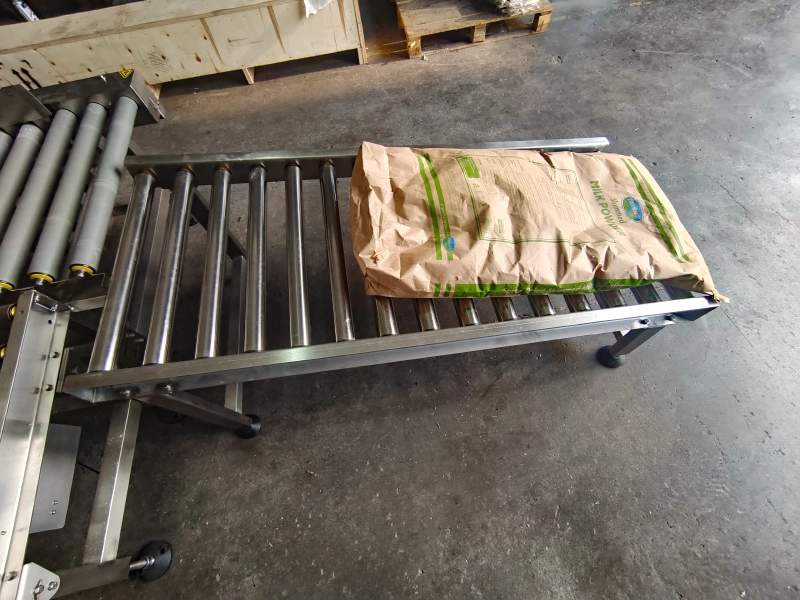
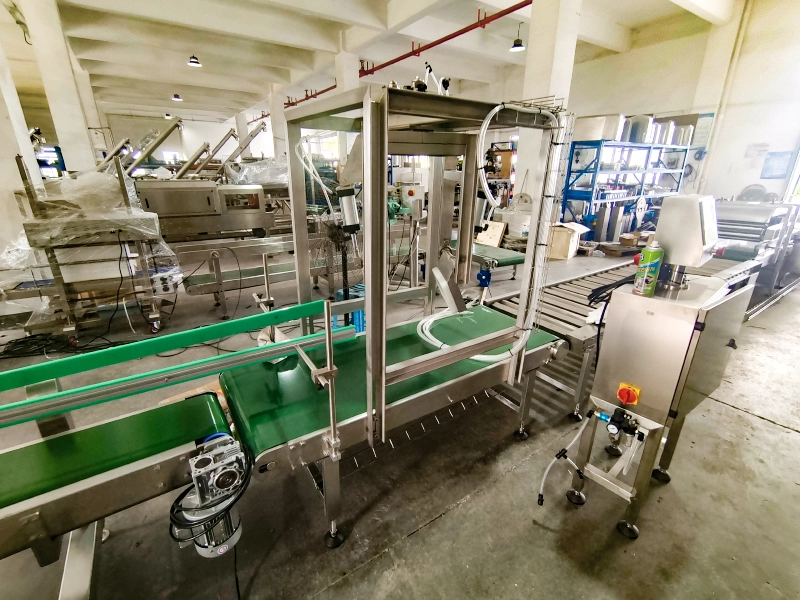
The production evidence shows an enclosed stainless steel bagging station with blue inspection windows, a bag magazine conveyor, green belts, roller conveyor sections, control cabinets, adjustable guides, emergency-stop controls, and access platforms. These are not decorative features: they show where the operator supervises the line, where the bag is guided, and where stations are joined.
For a flour bagging line, the correct specification still depends on bulk density, flowability, moisture, aeration, bag dimensions, target speed, and the chosen sewing or sealing method. The images confirm the machine architecture and transfer components; they do not by themselves establish a universal capacity or accuracy claim.
| Buyer concern | Mipline response to verify | Visible or documented evidence |
|---|---|---|
| Bag twists before sewing | Clamp alignment, guided transfer, roller or twin-belt handoff | Bag clamp, adjustable guides, roller conveyor sections |
| Dust reaches the closure area | Bottom-up filling, vacuum/de-aeration and configured closure sequence | Filling and closure modules; project configuration required |
| Filled bags lose shape | Settling, shaping and controlled discharge before palletizing | Green transfer belts and roller discharge path |
| Bad bags reach dispatch | Metal detection, checkweighing and reject after forming | Inspection modules available by selected configuration |
Specify the bag handoff, not only the filler
Share your flour or starch powder, bag material and dimensions, target weight, required bags per minute, closure method, air and power conditions, and palletizing layout. BPM can then match the automatic bagging machine for powder to the transfer, inspection, and final sewing requirements.
Discuss Your Powder Packaging Line English
 Русский