
Powder Bagging Line for Alabaster: 25 kg Bag Handoff
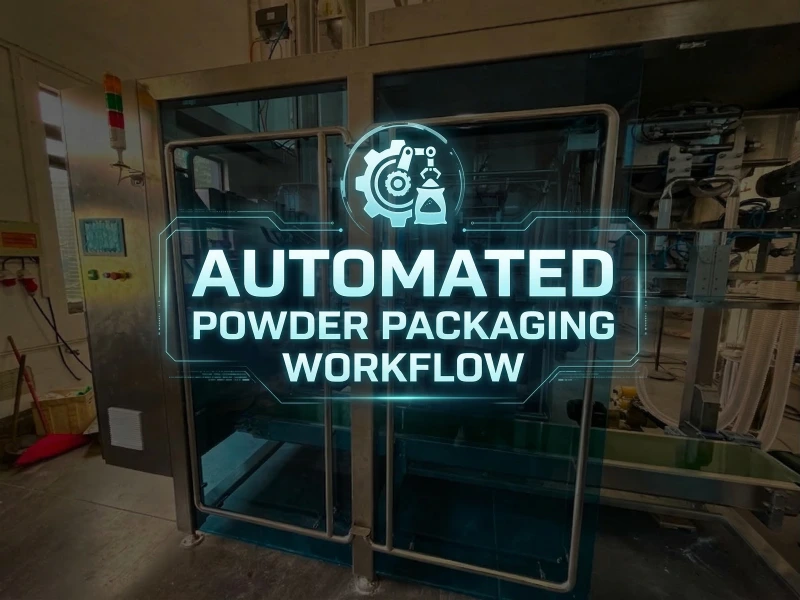
Alabaster, and the building gypsum ground from it, punishes a plant at the bag mouth rather than at the filler. A powder bagging line for this material has to clamp the empty 25 kg bag, dose from the bottom, pull dust out of the bag neck and hand the filled bag to the sewing head still square. When it does not, the last two metres decide the output of the whole shift.
Where an alabaster bagging job actually loses output
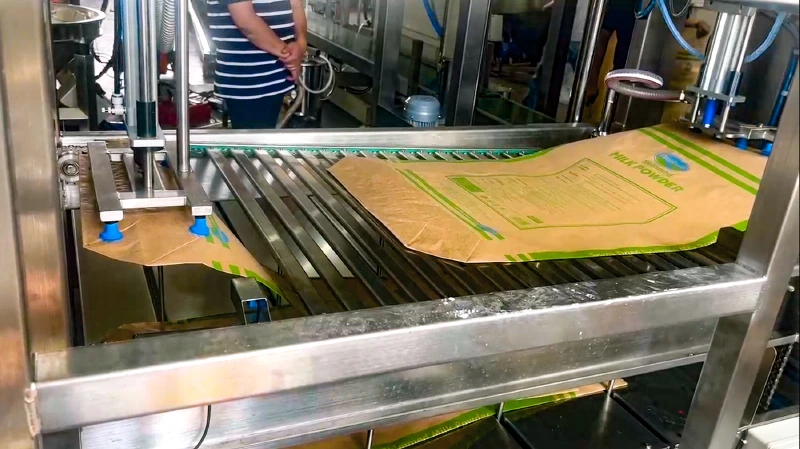
Ground gypsum plaster is fine, dry, light for its volume and full of air. Poured in free fall from a fixed spout, it throws a dust cloud up into the bag neck and across the sealing area, while the bag balloons around the product. The bag then reaches the sewing head with powder in the seam, a mouth that is no longer parallel to the head, and a body that slumps as soon as it is stacked. None of that is a weighing fault. The scale can be perfectly on target and the bag still fails.
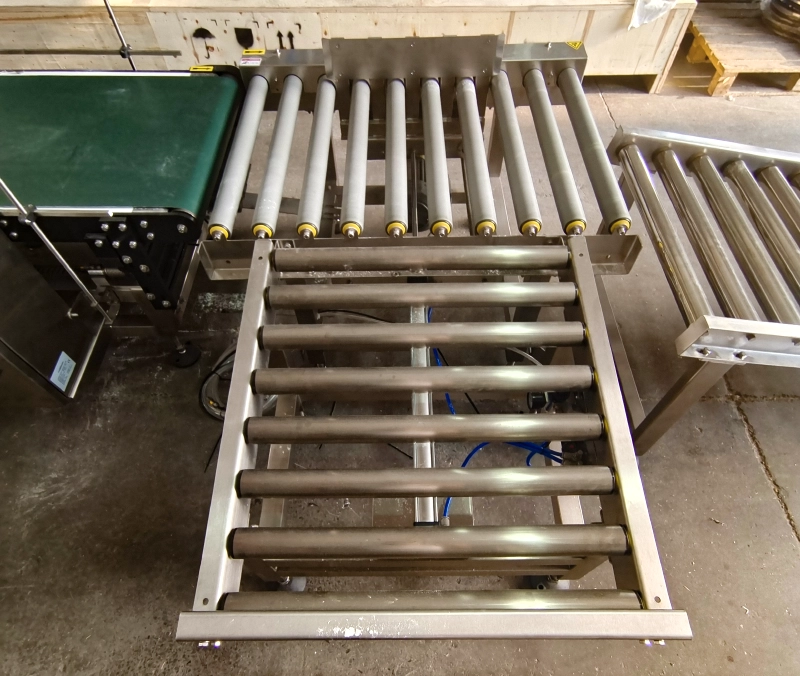
The failure compounds on the transfer. A 25 kg alabaster bag that leaves the clamp without support keeps drifting in whatever direction the belt is least able to correct, and operators end up at the last metre straightening bag faces by hand — the position that is hardest to guard and easiest to leave under-staffed on a night shift. On a powder bagging line the transfer belongs to the filling process, not to the gap between filling and sewing; if you are replacing a manual or semi-automatic layout, compare it against a 25 kg powder bagging line with a controlled bag transfer before sewing before you assume the filler is the limit.
Clean weighing, dirty bag mouth. The weigher reports in tolerance, the bag looks full and level at the clamp, and then the sewing head produces a skewed seam, a powder-contaminated seam or a torn bag neck within the first hundred bags of a shift. The cause is usually the air and dust leaving the bag at the moment the clamp releases, not the dosing system.
Clamp first, dose from the bottom, keep the neck clean
Mipline treats bag supply, opening, clamping, filling and closure as one process. The empty bag is taken from a flat magazine, opened at the mouth and clamped before any product enters, so the bag geometry is fixed by steel instead of by an operator’s hands. Dosing then runs on a lifting platform that follows the fill level, keeping a three-stage screw close to the powder surface: fast fill, medium fill, slow final trim. The closer the dosing point stays to the product, the less free fall there is to create dust inside a powder bagging line.
Before closure, vacuum extraction or de-aeration, where the configuration includes it, pulls air out of the bag so the filled body settles instead of breathing powder out through the seam. Closure then follows the bag you already buy: dust removal and trimming, inner heat sealing, sewing, hot-melt paper tape and final pressing on a paper-plastic composite bag, or a plain sewn kraft bag. Each option changes what the bag mouth must look like when it arrives at the head, which is why the clamp, guides and transfer have to be decided together with the closure rather than after it.
Field note: on alabaster, ask what happens in the first 30 cm after the clamp opens. If the bag body is unsupported there, no level of weighing accuracy will hold the seam straight.
Specification points that change the machine
Four inputs move the design: bulk density and flowability of the plaster, bag construction, closure method and the bags per minute you actually need. A light, aerated plaster needs more dwell and more extraction than a dense one; a paper-plastic composite bag needs dust removal and heat sealing that a plain kraft bag does not. The table below pairs each buying decision with the mechanical answer on a Mipline powder bagging line, so the response is a component and a setting rather than a promise.
For orientation, the reference range looks like this: the DS25K filling group covers 5–25 kg with a stated accuracy of ≤±0.2% at 1–3 bags/min, a dedicated 25 kg line is stated at 1.5–2 bags/min, the body is SUS304, and conveying references include a 5,000 mm PVC belt at 10 m/min and 0.75 kW, a 3,000 mm settling conveyor 600 mm wide at 15 m/min, and a 1,500 mm shaping section at 600 mm belt width. Inspection is project-specific: an ER6023 detector reference uses a 600×230 mm window at 28 m/min, and checkweigher accuracy must come from the selected datasheet rather than from a generic figure. Treat every number as a starting point to confirm against your plaster, your bag and your site.
| Buyer requirement | How the line answers it |
|---|---|
| Aerated 25 kg alabaster bag | Clamp-held bag, bottom-up lifting fill, three-stage screw trim before release |
| Dust in the bag neck and seam | Vacuum extraction before closure inside an enclosed stainless station with blue inspection windows |
| Bag skew at the sewing head | Clamp held to closure, twin-belt and roller transfer with adjustable side guides |
| Weight control before dispatch | In-line metal detection and checkweighing with a defined reject path |
| More than one bag construction | Kraft paper, paper-plastic composite and coated woven bags, with closure matched to the bag |
| Cleaning, inspection and access | SUS304 body, hinged blue viewing doors, maintenance platform with guarding and leveling feet |
Build the line around your bag, not around the filler
Send the bag size, the plaster bulk density and the bags per minute you need, and we will return a station-by-station powder bagging line proposal: clamp, bottom-up fill, de-aeration, closure, inspection and discharge.
Request a line proposal English
 Русский