
Sugar Bagging Line: Keeping 25 kg Bags Square Before Sewing
A sugar bagging line is not judged at the dosing spout. It is judged in the metre before the sewing head, where a 25 kg bag of granulated sugar either arrives square or arrives twisted. Mipline clamps the bag mouth before filling starts, holds both bag faces through guided belt and roller transfer, and hands a straight bag to the closure station instead of a collapsed one.
Where a Sugar Bagging Line Loses Its Rhythm
Walk the dispatch end of a sugar repacking plant and the filler usually looks healthy. The damage happens about forty centimetres after the spout. In a conventional layout an operator holds the empty kraft bag under the dosing head, the bag fills slightly off-centre, and then it is dropped onto a low belt. Granulated sugar is free-flowing and dense: the base sets hard within a second while the neck stays soft and open. The neck leans, one belt face drags faster than the other, and by the time the bag reaches the sewing head the mouth is no longer parallel to the seam line.
That is why a sugar bagging line is measured at the handoff rather than at the scale. A skewed mouth forces the operator to stop the belt and straighten the bag by hand. A twisted bag sews a wandering seam that fails a pallet check. A collapsed shoulder stacks badly on the pallet and splits in the truck. None of those failures appear in a filling accuracy report, which is exactly why they survive the audit and come back on the night shift.
On most 25 kg sugar lines the filler is stable and the palletizer is stable. What is not stable is the open stretch between the filling spout and the sewing head, where the bag is still aerated, still moving, and supported by nothing except a flat belt.
Why This Sugar Bagging Line Suits Granular Sugar
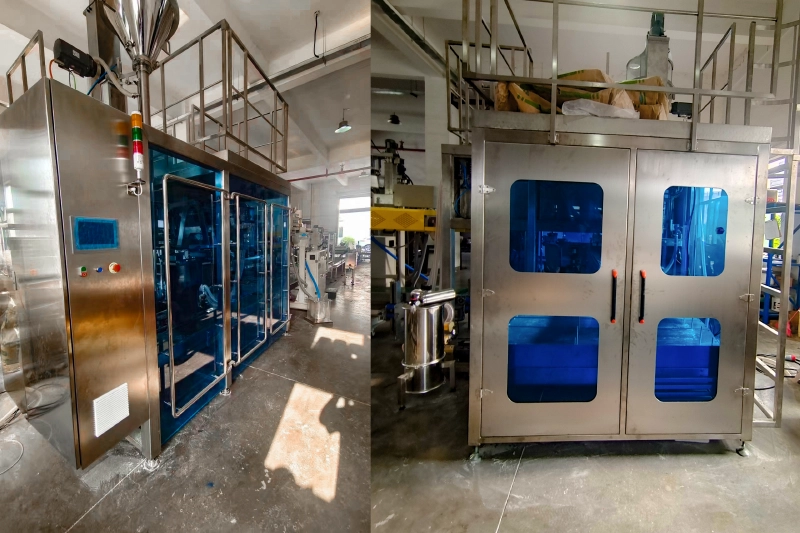
Granulated sugar is not flour and it is not milk powder. It is free-flowing, heavy per litre, and it settles the moment the bag stops moving. It also leaves a fine sticky film on frames and rails by the end of a shift. Mipline is laid out for that product: an enclosed stainless steel bagging station with blue inspection windows, a flat bag magazine feeding the clamp, and a transfer path long enough for the sugar to settle before closure. The product path is stainless, not painted mild steel, so a wash-down at the end of the shift does not start a rust line under the guides.
The bag mouth is clamped before filling begins, so the bag geometry is fixed while the sugar enters and while the bag gains weight. That grip is not released until the filled bag sits on the guided transfer, where adjustable side guides and twin-belt sections hold both faces parallel to the direction of travel. On a sugar bagging line built this way the sewing head receives a bag that is already the right width, so the seam follows the mouth instead of trying to correct it.
Engineering note: the side guides are adjustable, not welded to the frame. That matters when a plant runs 25 kg printed kraft bags for retail and 25 kg woven bags for bulk in the same week. Guide width belongs on the changeover list, and most bag-mouth skew we are asked about on site is a guide-width error, not a sewing fault.
Station by Station: What the Structure Has To Do
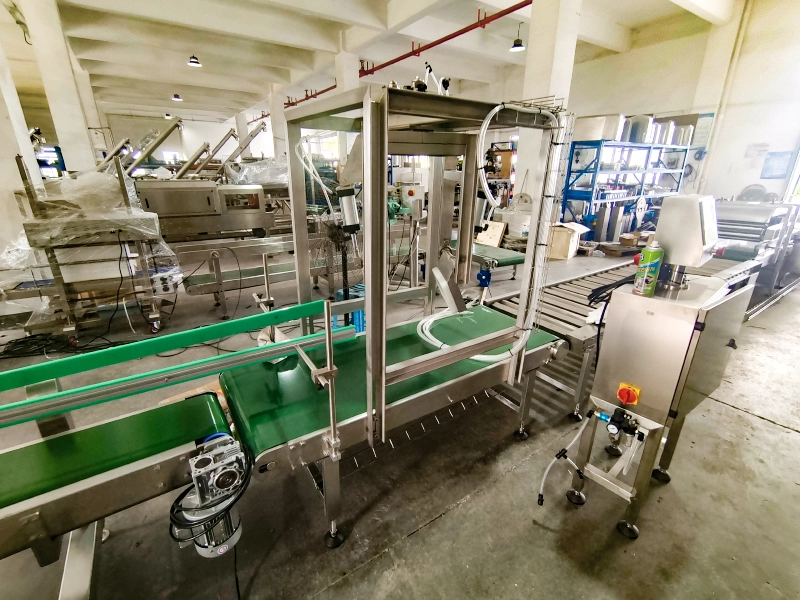
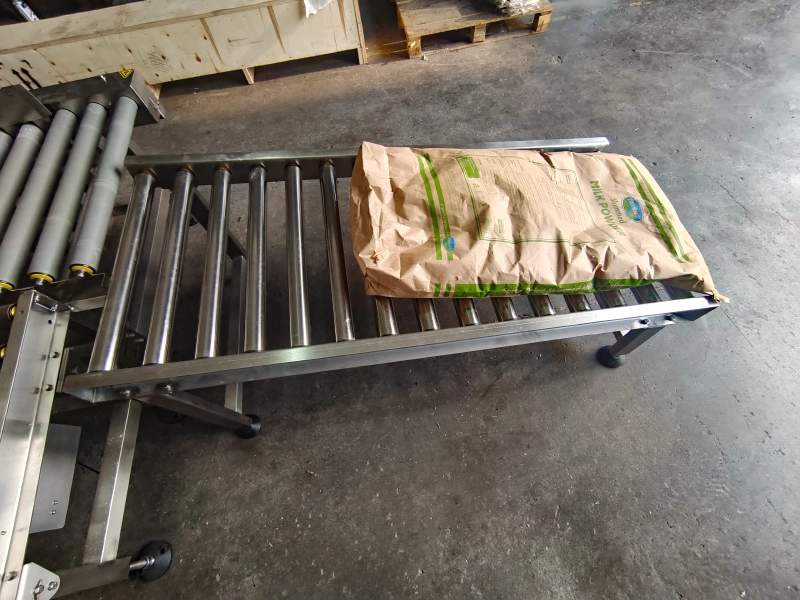
The photographs on this page come from the same machine family, so the parts described below are the parts you can actually see. The enclosed station carries the clamp and the filling head behind blue inspection windows, with double doors for maintenance access and a platform above the frame. Upstream, a green belt infeed conveyor with a vertical guide frame and an emergency stop box delivers the flat bag to the clamp. Downstream, a stainless roller transfer section carries the filled kraft bag to the closure station with the mouth still open, square and centred.
| Station | Visible component | Job before sewing | What to confirm |
|---|---|---|---|
| Bag feed | Flat bag magazine and green belt infeed conveyor | Delivers the kraft or woven bag to the clamp without skew | Bag length and width across every format you run |
| Filling | Enclosed stainless bagging station with blue inspection windows | Holds the mouth clamped while sugar enters the bag | Clamp opening matched to your bag mouth, not to an average |
| Settling and transfer | Twin-belt transfer conveyor with adjustable side guides | Keeps both bag faces parallel and lets the sugar settle | Guide width adjustable per bag format at changeover |
| Handoff | Stainless roller conveyor transfer section | Presents a square mouth at the sewing or sealing head | Handoff height and distance matched to your closure machine |
| Control | Touch-screen control box with emergency stop | One point of control for the transfer and check stations | Stop button reachable from the operator position |
If you are comparing suppliers, three questions separate the designs. Is the bag clamped before filling, or filled loose and straightened afterwards? Are the transfer guides adjustable for each bag format? Can an operator inspect the clamp and the bag mouth without opening a guard? On Mipline the clamp closes first, the guides adjust, and the inspection windows let a supervisor watch the mouth without stopping the line. Those three answers are what a sugar bagging line needs before it can hold seam quality at 25 kg, shift after shift.
Send Your Own Sugar Bag Before You Specify the Line
Two empty bags from your dispatch line tell us more than a specification sheet: bag material, mouth width, fill weight, and whether you sew or seal. Send them with your target output and we will match the clamp, guides and handoff to that bag. If you want the guide geometry explained first, read how the same layout keeps bags square on a powder packaging line.
Send your bag sample English
 Русский