
How ppline Handles 25 kg Bagging with Cleaner Transfer and Steadier Discharge
For plants packing 25 kg woven sacks, the real issue is not only filling speed. It is keeping the bag mouth aligned, the transfer stable, and the final stitch or seal consistent from the first sack to the last.
When 25 kg packing starts to slip, the line slows down
In a grain warehouse, feed mill, or bulk material packing room, 25 kg sacks are often handled in repetitive batches. The old workflow is usually a mix of manual bag holding, unstable feed, and loose handoff from filling to closure. That creates three common problems: bag-mouth misalignment, inconsistent discharge, and a higher chance of dust, spillage, or rework.
The machine set shown here is built for that exact pressure point. Instead of forcing operators to hold the sack position by hand, the line uses a hopper-fed filling structure, a controlled HMI interface, and a closure module that keeps the bag path more predictable. For 25 kg packaging, that stability matters more than raw speed alone.
Manual transfer often looks acceptable on a slow day, but once bag volume rises, the weak points show up fast: uneven filling, poor mouth alignment, slower stitching, and more time spent correcting each sack.
Why ppline fits a 25 kg woven-sack workflow
ppline fits this scenario because the line combines a top hopper feed, a controlled operator interface, and a structured discharge path. The machine is not trying to solve only the filling step. It is designed to keep the full handoff sequence cleaner: feed, fill, close, and move out. That is exactly what a 25 kg woven-sack line needs when the operator wants repeatable output and less dependence on manual correction.
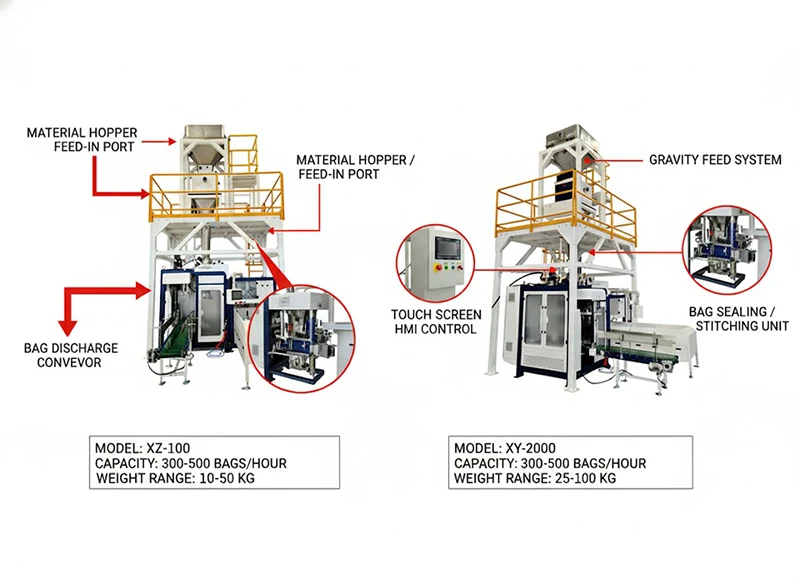
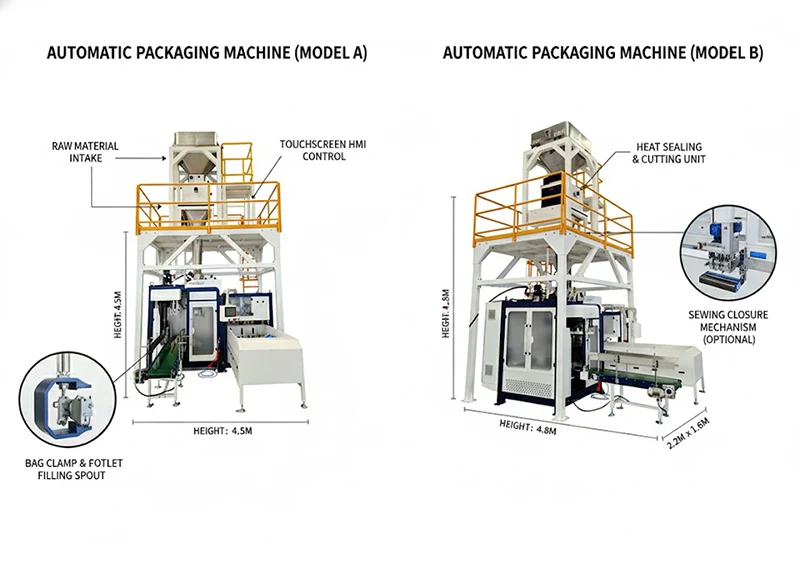
From the image set, the most relevant evidence is easy to see: the hopper-fed machine layout, the HMI touchscreen control, the optional sewing or sealing closure, and the outfeed conveyor. Together they form a line that is easier to manage in daily production, especially when the same sack size runs all day.
What this improves: steadier bag handling, cleaner transfer to closure, and less rework after filling.
Structure and evidence: the line is built around control, not guesswork
The first image shows a full industrial bagging machine with hopper feed, gravity dosing, HMI touchscreen, and bag stitching unit. The second image shows the same equipment family in a 3D configuration with heat sealing and optional sewing closure. The close-up detail image shows the internal bagging unit, vacuum suction cups, robotic placing arm, green conveyor, and woven sack positioning point.
For 25 kg packing, that matters because the weak link is rarely the product itself. The weak link is the transition between filling and closure. When the sack is not held consistently, the final closure becomes harder to keep neat. When the discharge path is unstable, the next sack starts late. ppline addresses that with a clearer mechanical flow and a more controlled operator interface.
| Item | What the images show | Why it helps 25 kg packing |
|---|---|---|
| Feed section | Hopper-fed machine layout | More consistent material supply into the bagging cycle |
| Control | HMI touchscreen operator interface | Easier setup and steadier operation during repeated runs |
| Closure | Sealing or sewing closure unit | Cleaner finish after filling, with less handling drift |
| Discharge | Outfeed conveyor and guided bag path | Faster transfer to the next station and smoother line rhythm |
What the customer gets in the end
A 25 kg bagging line that is easier to control, easier to repeat, and easier to keep aligned from filling to final closure. That means less manual correction, fewer sack defects, and a cleaner packing rhythm across the shift.
Talk to BPM about your 25 kg bagging line English
 Русский