
How a Rice Bagging Line Keeps Filling Stable, Bag Transfer Cleaner, and Warehouse Flow Steadier
For mills, grain warehouses, and packing rooms that handle woven sacks every shift, the real problem is rarely the bag itself. The weak point is usually the handoff: uneven filling, loose bag positioning, dust at the discharge point, and slow pallet movement. A proper rice bagging line solves that with a steadier feed path, a more controlled weighing frame, and a layout that keeps each bag moving in a predictable sequence from fill to pallet.
Why older rice packing methods usually break down first
In a rice packing room, the first failure is often consistency. Manual or semi-manual packing can work for a short run, but it starts to show problems as soon as volume rises: bags sit off-center under the fill spout, product flow changes from one shift to the next, and discharge becomes harder to line up with conveyors or pallet staging. That means more rework, more bag handling, and more time spent correcting the same small errors.
When rice is packed in woven sacks, the process also needs a cleaner transfer path. If the feed point is unstable, the bag mouth is harder to control, and the warehouse team ends up compensating with extra manual sorting. That is exactly where a dedicated rice bagging line adds value: it turns filling, transfer, and output into one controlled sequence instead of three disconnected tasks.
Dust, unstable bag positioning, and slow pallet movement turn a packing line into a bottleneck instead of a flow system.
Why this line architecture fits rice packaging better
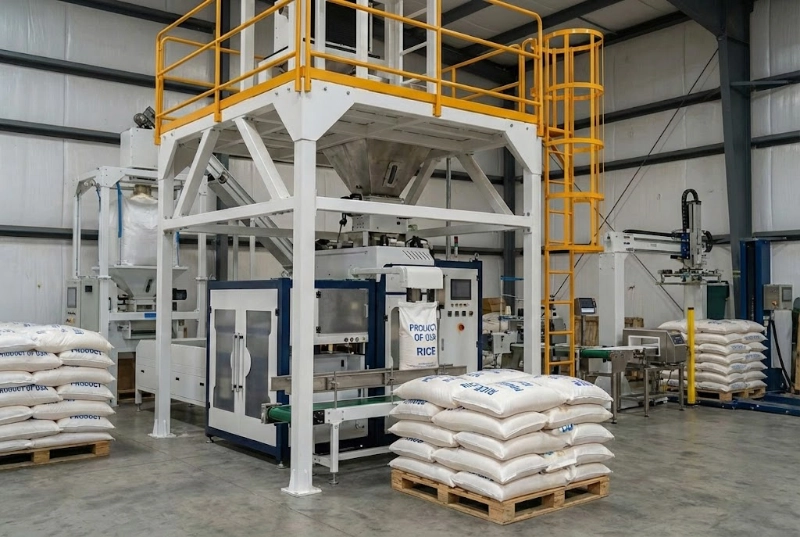
The reason a rice bagging line works is not just the filling head. It is the structure around it. A steel hopper and weighing frame give the operator a more stable material path. An elevated platform keeps the machine body and transfer section organized, so the discharge area stays clear for bags, conveyors, and pallet handling. In the factory photos, that layout also leaves room for forklifts and pallet staging without crowding the work zone.
For higher output operations, the line architecture matters as much as the machine speed. The machine has to support a predictable bagging rhythm while the warehouse team keeps the finished sacks moving. That is why the rice line should be judged as a full system: feed, weighing, bag clamp, discharge conveyor, and floor logistics all need to match.
Practical takeaway: the most useful rice line is the one that keeps the bag mouth aligned, the transfer path short, and the output stream easy to palletize.
Structure evidence that shows how the line is built
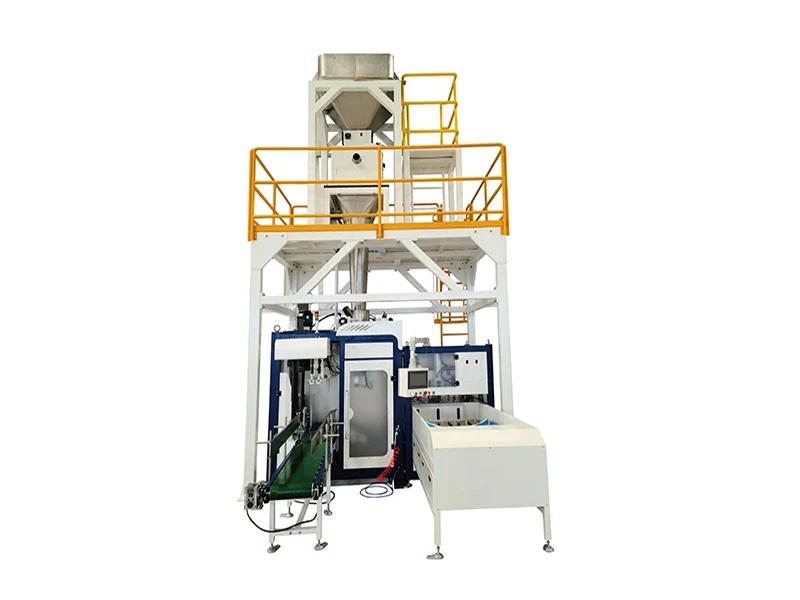
The machine view confirms the main elements you want in a rice packaging installation: a top hopper, a weighing frame, a protected steel platform, and a controlled discharge path to the pallet area. In the production hall, the same logic continues downstream, where the bagged product is staged for movement instead of being left to pile up randomly at the end of the line.
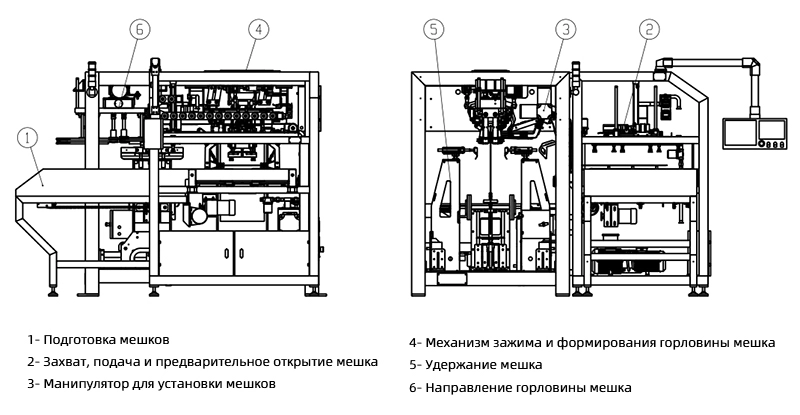
One reference machine in the image set shows a hopper feed, gravity dosing, HMI touchscreen control, and a bag sealing and stitching unit, with a stated range of 300-500 bags per hour and a 25-100KG class application. That kind of structure is useful when the rice plant needs a more flexible packing window without changing the whole line concept. A technical CAD view also helps confirm the internal bag magazine, bag guide, and operator interface layout before the machine is built into the floor plan.
| Line element | What it controls | Why it matters for rice |
|---|---|---|
| Top hopper | Stable feed into the packing sequence | Reduces irregular flow and keeps filling steadier |
| Weighing frame | Bagging accuracy and repeatability | Helps the plant keep sacks consistent from batch to batch |
| Elevated steel platform | Machine layout and access | Keeps service and transfer areas cleaner and easier to manage |
| Discharge conveyor / pallet area | Finished bag movement | Speeds up warehouse flow and reduces manual handling |
Need a rice bagging line that fits your bag size and floor flow?
If your current packing setup is losing time at the fill point, the discharge point, or the pallet area, the fix is usually a better line structure, not more manual labor. BPM can help you match the hopper, weighing frame, conveyor path, and station layout to the way your rice actually moves through the plant.
Discuss your rice bagging layout English
 Русский