
From Filling to Stitching: A Powder Line That Keeps Bags Square
For a Belarusian powder producer, the real bottleneck was not filling alone. It was the handoff after discharge: sacks drifting out of shape, extra manual straightening, and a sewing station that had to wait for the operator to fix each bag. This PPLINE layout solves that gap with a modular filling tower, enclosed transfer path, and conveyor support that keeps the sack stable all the way to stitching.
What the customer needed on the floor
The project background was straightforward: a powder packaging line had to run faster, but the sack still needed to arrive at the sewing head in a clean, square shape. In the old setup, the bag often sagged after filling, the bottom edge dragged across the transfer point, and operators had to make small corrections by hand before stitching. That sounds minor until it repeats across every shift.
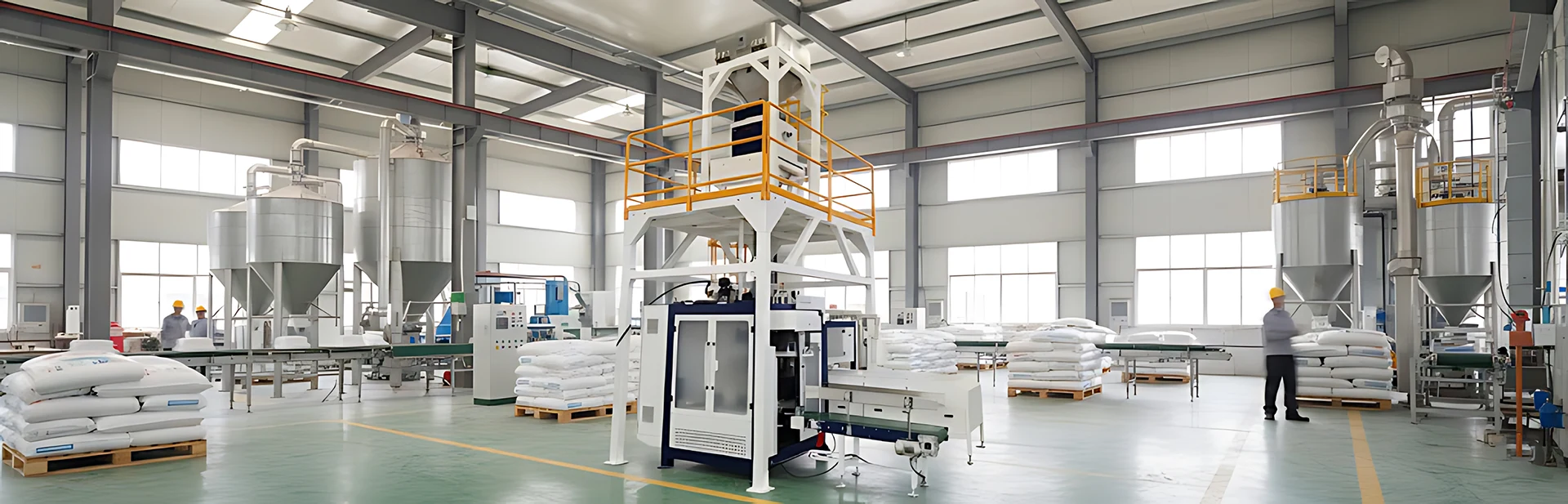
The line image shows why this matters. A powder plant is not only a filling machine; it is a sequence of support points. Once the product leaves the dosing area, the sack needs structure, guidance, and a predictable path. If the transfer path is unstable, the sewing station becomes the place where production speed is lost.
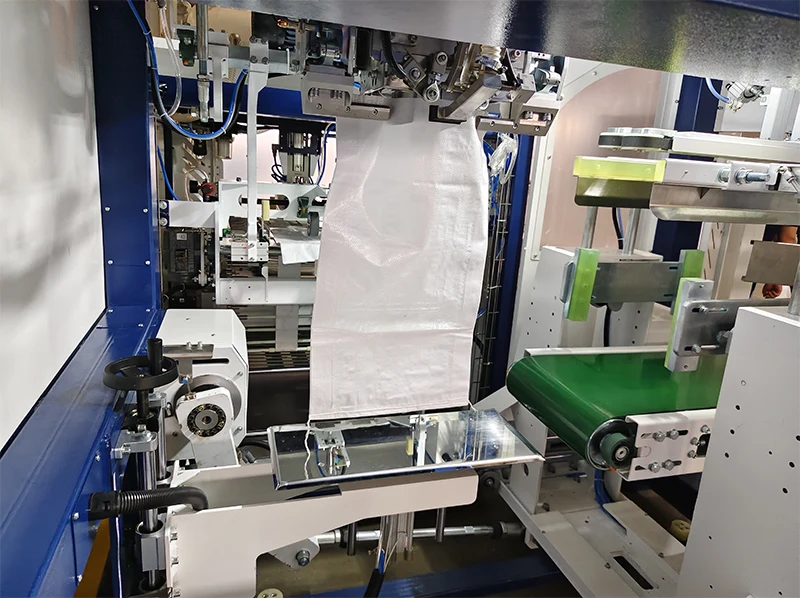
When the sack leaves the filling zone without enough support, it twists, leans, or bulges unevenly. That creates rework at the sewing point, slows the discharge rhythm, and increases the chance of a poor-looking final package.
Why this PPLINE layout fits the job
The first photo shows the full system logic: stainless steel storage silos, an elevated working platform, enclosed machinery, and conveyors arranged as one coordinated flow. That structure is useful because the bag is not left to hang freely after filling. It is supported by the line, guided by the transfer path, and moved toward the next process step in a controlled way.
The second photo gives the technical evidence. The internal bagging unit uses vacuum suction cups, a placing arm, and a conveyor-guided transfer area. In practice, that means the sack can be picked, positioned, and handed off with less distortion. For powder packing, this is exactly what the sewing station needs: a bag that arrives aligned enough to be closed cleanly without repeated manual correction.
bpmpack Инженерный взгляд: The best way to stabilize a powder bag before sewing is not to rely on the operator at the end of the line. It is to build support into the line itself: controlled discharge, guided transfer, and a layout that keeps the woven sack square after filling. That is why a modular packaging line with a stable conveyor path usually outperforms a loose, open transfer arrangement in real factory use.
What the structure solves in daily production
For a Belarusian powder producer, the benefit is not abstract. Less bag drift means less manual straightening. Less straightening means steadier output. Steadier output means the sewing unit can keep pace with the filling side instead of becoming the bottleneck.
This is also why the line is easier to explain in an engineering review. The photos show the structure, not just the promise: a modular tower, a supported transfer path, and a bagging unit built around controlled placement. The end result is a cleaner handoff from filling to stitching and a more consistent finished sack stack at the back end.
| Production issue | PPLINE response | Result on site |
|---|---|---|
| Bag drifts after discharge | Enclosed bagging layout with guided transfer and conveyor support | The sack stays closer to square before sewing |
| Too much manual straightening | Vacuum suction cups and placing arm help position the sack earlier | Operators spend less time correcting each bag |
| Sewing station becomes the bottleneck | Stable upstream flow keeps the bag moving in a predictable rhythm | Filling and stitching stay better synchronized |
Need a powder line that reaches the sewing head in shape?
If your current line wastes time on bag correction after filling, the next upgrade should focus on transfer stability, not only dosing speed. PPLINE can be configured around the bag handoff problem so the final sack arrives cleaner, faster, and ready for stitching.
Talk to bpmpack about your powder line English
 Русский