
BibPU Secondary Packaging for a Salt Plant That Stabilizes Woven Sacks Before Sewing
A Russian salt producer needed a cleaner way to move filled woven sacks from loose, bulging bags to a tight, sew-ready package. BibPU solves that transition with pneumatic holding, controlled compression, and corrosion-resistant contact parts built for harsh packaging floors.
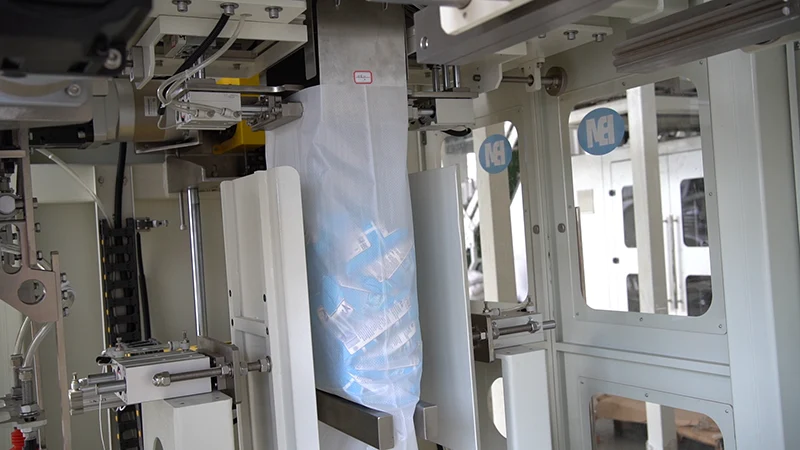
From loose filled bags to a controlled sewing station
The application here is straightforward: a salt plant fills secondary woven PP sacks with small salt packs, but the bag does not arrive at the sewing head in a stable shape. The top opening shifts, the body expands unevenly, and the seam line becomes harder to control. In a busy line, that means more manual correction and less consistent output.
BibPU addresses that handoff at the exact point where the bag needs to become a transportable unit. The line holds the sack open during filling, keeps the stack aligned, and then prepares the loaded bag for sewing by flattening the bulged body before closure. The result is a bag that is easier to stitch, easier to stack, and easier to move downstream.
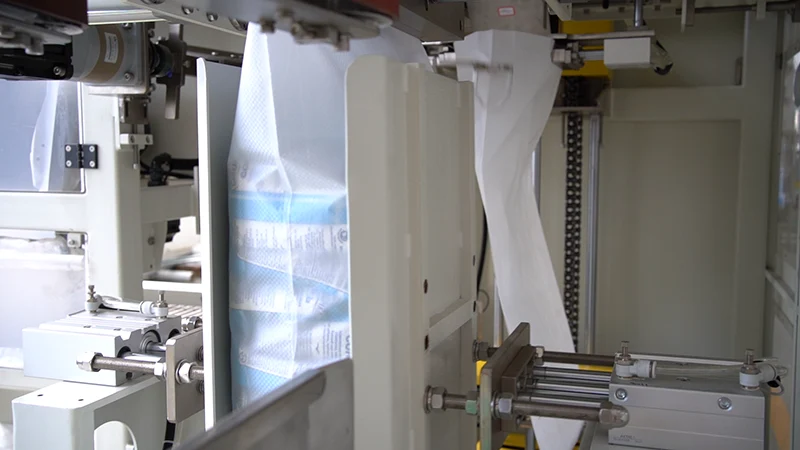
When a filled sack is left to settle on its own, it keeps the air trapped inside the woven body. The opening is harder to align, the bag profile changes from piece to piece, and the sewing operator has to compensate for the shape instead of running a stable process. That creates a real bottleneck at the end of the packaging line.
Why BibPU fits salt packaging work
BibPU is not just a conveyor transfer point. It is a controlled secondary packaging stage designed around the physical behavior of filled woven sacks. The clamping mechanism keeps the bag positioned while product is being loaded, and the side compression section tightens the sack body before sewing so the final bag shape is more uniform.
For salt production, material contact reliability matters as much as movement control. The line uses UNS S31603 (316L) corrosion-resistant stainless steel on contact parts, which is important in chloride-heavy environments where ordinary steel surfaces can suffer. That makes the system more suitable for salt plants that want long-term uptime without frequent surface degradation.
bpmpack Инженерный взгляд: The key improvement is not only speed. By combining pneumatic holding with post-fill compression, BibPU reduces shape inconsistency before the sewing head sees the bag. That means fewer adjustments, better seam alignment, and a cleaner handoff from filling to final closure.
What the structure proves on the floor
The support image shows the loaded woven sack being compressed by side clamping plates. That detail matters because it proves the unit is built to manage bag volume, not just move bags from point A to point B. The compression step turns an inflated, hard-to-handle sack into a flatter unit that can be presented to the sewing station more consistently.
The first image shows the fill stage: small salt packs drop into the open secondary bag while pneumatic clamps keep the bag mouth controlled. Together, the two images document the process logic of the line: stabilize the bag, fill it, compress it, and then sew it. That sequence is what makes the system practical for a salt plant that wants a repeatable end-of-line workflow.
| Элемент линии | What it does | Why it matters for the salt plant |
|---|---|---|
| Pneumatic bag clamps | Hold the woven PP sack open during fill | Reduces mouth shift and improves loading control |
| Side compression plates | Flatten the loaded sack before sewing | Makes the bag shape more uniform for the sewing head |
| Контактные поверхности из 316L | Protect the line against chloride corrosion | Better durability in salt packaging environments |
| Controlled secondary packaging flow | Moves the bag from fill to sew with less manual correction | Improves consistency and lowers end-of-line handling loss |
Need a secondary packaging line that keeps sacks ready for sewing?
For salt, resin, and other bulk products that arrive in woven bags, BibPU is built to control bag shape, protect contact surfaces, and make the sewing stage more predictable. If the main problem is bulging sacks and unstable handoff, this is the part of the line that fixes it.
Talk to bpmpack English
 Русский