
How a Russian Dry-Bulk Plant Kept Woven Bags Stable Before Palletizing
A mid-size dry-bulk processor needed a cleaner handoff from filling to transport. Bags were arriving at the pallet area skewed, loose, and harder to stack than the logistics team wanted. The new line focuses on controlled bag capture, stable discharge, and a layout that lets the plant move sacks from the filling head to pallet staging with less manual correction.
What the old setup was struggling with
The plant’s earlier discharge path worked, but it did not protect bag shape well enough. Once a woven bag left the filling point, the next transfer relied too much on operator timing and on how straight the bag landed on the conveyor. That created a familiar pattern: bags twisted slightly, edges caught during transfer, and the pallet crew had to re-square the load before stacking.
This is exactly where bulk-material lines lose efficiency. The issue is rarely the fill itself; it is the handoff. If the bag mouth, bag body, and outfeed line are not coordinated, the downstream team pays for it in extra touch labor, slower pallet building, and a higher risk of damaged sacks.
When woven sacks come out unstable, the plant loses control over stack quality, forklift rhythm, and floor space. The problem becomes visible only after the line is already running, which makes it expensive to fix with labor alone.
Почему данная компоновка ppline подходит для задачи
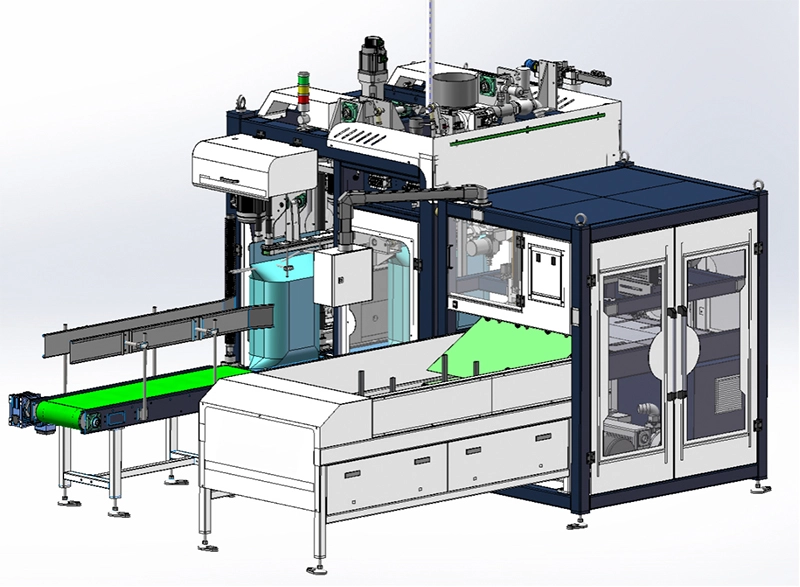
The ppline bagging line is a better match because it treats transfer stability as a mechanical problem, not a manual one. The close-up view shows the internal bagging unit using vacuum suction cups and a robotic placing arm to hold the bag at the correct position while the green conveyor carries it forward. That kind of guided motion matters when the goal is a straighter bag body and a more predictable discharge path.
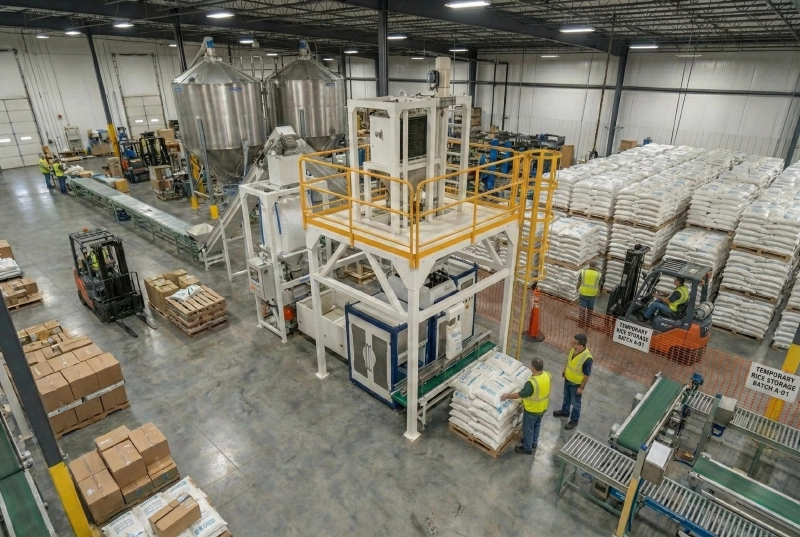
The second image confirms the broader plant logic: twin stainless steel storage silos, conveyors, and active forklift logistics. In other words, the line is not only filling product; it is supporting the whole material flow from storage to pallet area. That is the right structure for a dry-bulk site that needs to keep sacks aligned before stacking and shipping.
bpmpack Инженерный взгляд: For dry-bulk packaging, the best results usually come from controlling the transfer geometry, not from asking operators to correct every sack by hand. A stable filling head, guided bag handling, and a clean outfeed path reduce deformation before the bag ever reaches the pallet.
What the evidence on the machine tells you
The hero photo is useful because it shows the important internal parts instead of only the outside frame. The vacuum suction cups, the robotic placing arm, and the green conveyor are all visible, which means the line is built to hold and move bags in a controlled way. That is the first requirement for better stack quality.
The overhead plant photo adds the second layer of evidence. The twin silos support a steady supply of product, while the conveyors and forklift lanes show that the line is designed for real warehouse movement, not just a laboratory demonstration. For a Russian dry-bulk plant, that combination matters: stable discharge, predictable logistics, and enough physical structure to keep the flow organized during busy shifts.
| Observed issue | Line feature | Operational result |
|---|---|---|
| Bag twist during transfer | Vacuum suction cups and robotic placing arm | Straighter bag handoff |
| Weak pallet staging rhythm | Green conveyor and organized outfeed path | Fewer manual corrections |
| Inconsistent plant flow | Twin silos and conveyor-connected layout | Smoother material movement |
| Forklift congestion near loading | Defined warehouse lanes | Cleaner pallet logistics |
Need a bagging line that keeps sacks square before palletizing?
If your bulk-material plant is fighting bag deformation, unstable discharge, or slow pallet building, we can help you map the transfer path, compare line structures, and build a packaging layout around the real warehouse workflow.
Запросить аудит линии English
 Русский