
How a Bulk-Products Packing Line Reduced Sack Rework in a Southern Grain Warehouse
A southern grain warehouse operator needed a cleaner way to move woven sacks from filling to sewing without crooked bags, handoff delays, or forklift congestion. The ppline setup combines a steel bagging tower, guided outfeed, and enclosed controls to keep the flow steady from the first fill to the final pallet.
What was going wrong on the old line
The warehouse had a familiar problem: once the bags left the filling point, they were no longer easy to control. Some sacks arrived at sewing slightly twisted, some lost shape during the short transfer, and the team spent time straightening them by hand before the next station could continue. That extra handling slowed the shift and created avoidable wear on the bags.
Forklift traffic made the issue worse. When filled sacks were moved in batches instead of a stable stream, the aisle around the packing area became crowded, and the crew had to choose between speed and order. The result was not a machine failure; it was a transfer problem between filling, guiding, and stacking.
The bags were not failing at filling. They were failing at handoff. If a line cannot keep sacks square and predictable after discharge, the whole packing area turns into a rework station.
Why the ppline structure fit this job
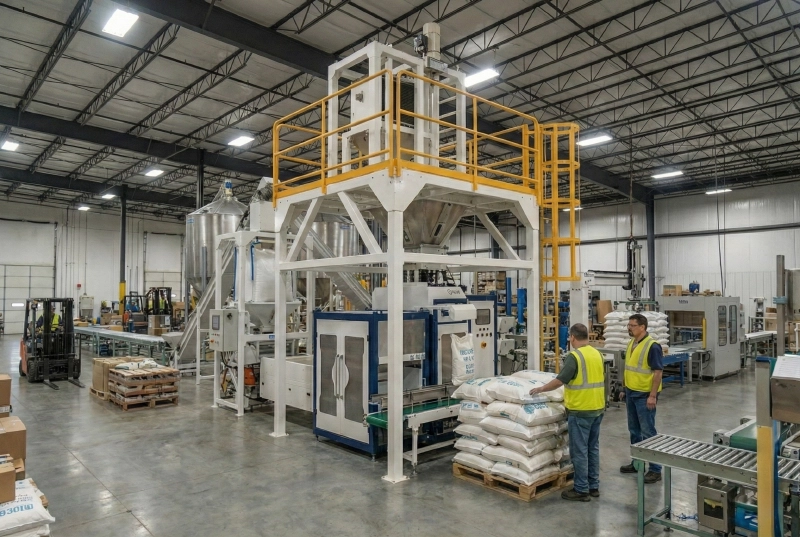
The ppline layout matches this kind of bulk-products workflow because it gives the packing area a rigid frame, a controlled discharge path, and a compact operator side. The bagging tower keeps the machine body stable, the enclosed cabinet protects the electrical side, and the swing-arm control position lets operators monitor the run without crowding the transfer zone.
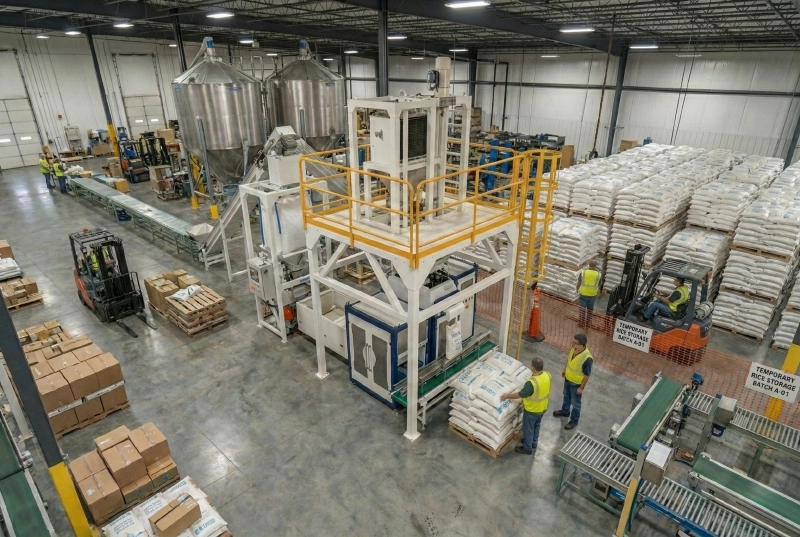
Inside the unit, the bagging mechanism uses guided holding and suction-assisted positioning to keep each woven sack aligned before it leaves the station. That is the difference between simply filling a bag and delivering a bag that is still ready for the next process. The photo of the operating station shows the safety cage ladder, conveyor path, and live work area together, which is exactly what a warehouse team needs when continuity matters more than cosmetic appearance.
Practical takeaway: when the discharge path is stable, the team spends less time correcting bag shape and more time moving finished product.
What the structure, parameters, and images prove
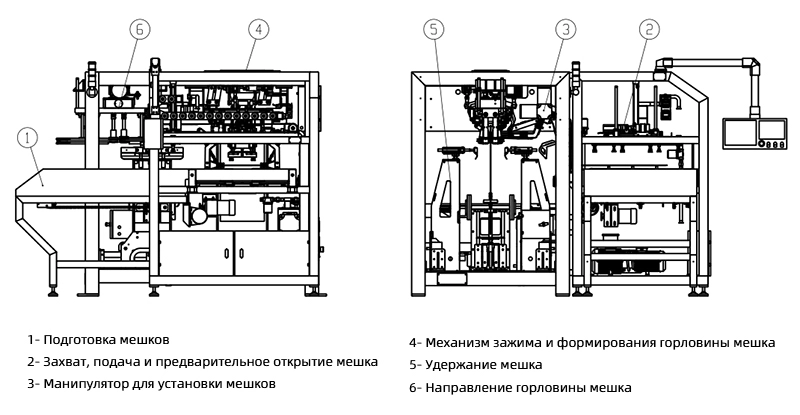
The design evidence is visible in the drawings and in the field shots. The CAD view shows the bag magazine, the transfer arm, and the discharge arrangement as one controlled assembly. The factory photo confirms that the line is not a concept-only layout; it is built for real warehouse movement, with pallet handling, conveyor routing, and operator access all planned into the same space.
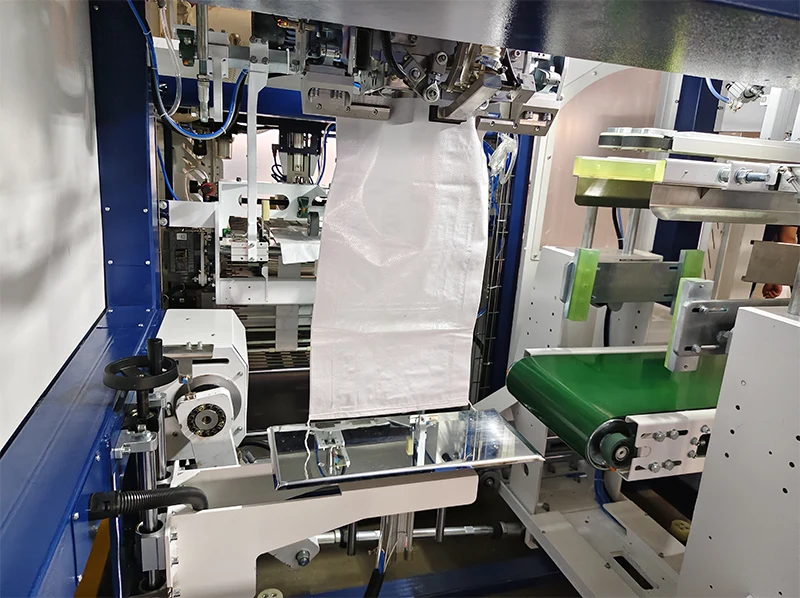
This matters for bulk products because the packaging area has to do three things at once: keep the bag shape intact, avoid unnecessary manual straightening, and maintain a clean handoff to sewing or palletizing. The close-up internal image shows the suction cups, the positioning arm, and the conveyor relationship in one frame, which is the clearest proof that the system is designed around controlled transfer rather than loose discharge.
| Warehouse problem | ppline response | Operational result |
|---|---|---|
| Crooked sacks before sewing | Guided discharge and controlled bag holding | Cleaner handoff with less manual straightening |
| Congestion around filling and stacking | Rigid tower layout and planned conveyor flow | Clearer aisle control and smoother material movement |
| Inconsistent transfer quality | Vacuum-assisted positioning and enclosed control zone | More stable process repeatability across shifts |
Need a steadier bulk-products packing line?
If your warehouse is still correcting woven sacks by hand after filling, the next step is to tighten the transfer structure, not just the filler. A ppline layout can be matched to your product, bag type, and downstream sewing or palletizing flow.
Запросить аудит линии English
 Русский