
Sugar Stick Packet Filling: Is a Premade-Bag Zpacker the Right Machine?
Sugar producers comparing stick sachets with premade paper bags need to start with the package, not the machine name. Zpacker is an automatic paper bag packing machine for powder-focused applications, including flour packaging lines and selected premade bag formats. Its fit for a narrow sugar stick packet must be confirmed from the actual bag sample, material behavior, and target output.
Start with the customer’s sugar package format
A sugar plant may describe its requirement as a stick packet for sugar packing, but that phrase can cover two different production concepts. A conventional stick-pack line forms narrow sachets from roll film. Zpacker, by contrast, is designed to take premade paper or paper-plastic bags, open them, fill them, reshape the top and close them with hot-melt glue. The package format therefore determines whether the machine is relevant.
For a producer using premade M-fold, square-bottom bags, Zpacker can cover the connected sequence from bag feeding and opening to dosing, settling, dust removal, edge folding, glue application and top pressing. For a narrow roll-film stick sachet, the project should not be treated as a standard Zpacker order. The bag sample, dimensions, sugar flow characteristics and sealing method must be reviewed first.
Manual filling creates repeated weighing, bag positioning and closing work. A semi-automatic machine can improve dosing but still leave operators to open bags, remove settled air, fold the M-edge and prepare packs for inspection or secondary packaging. A conventional powder filler also cannot automatically handle a premade M-fold bag’s full transition from flat pack to sealed finished bag.
Where Zpacker fits the process
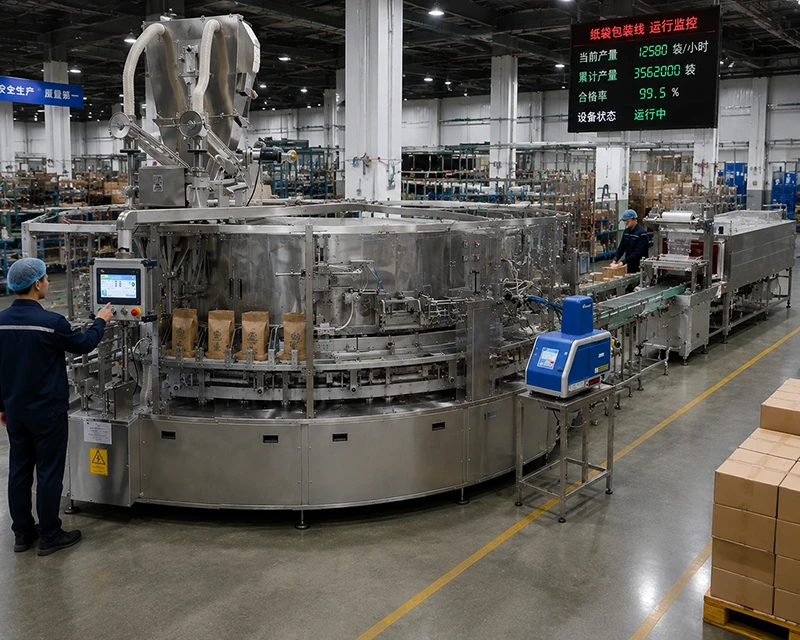
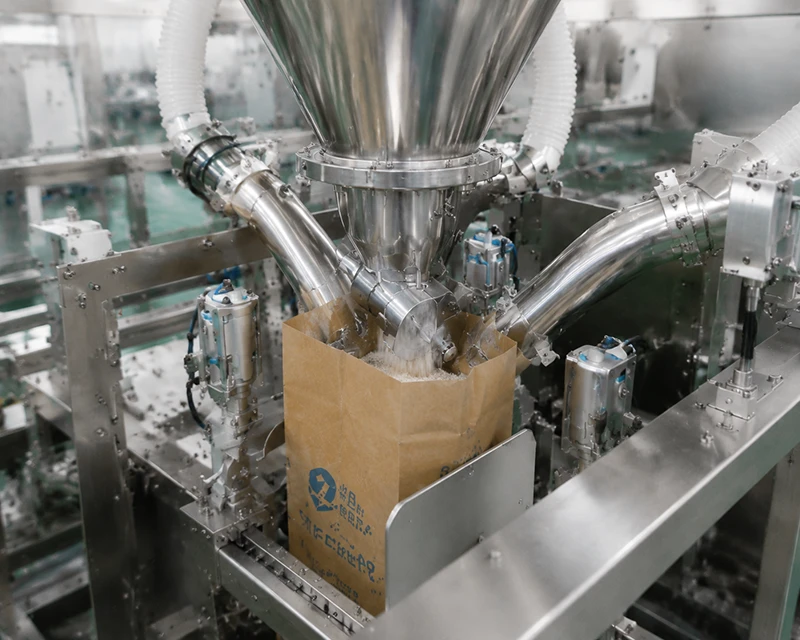
Zpacker is built around a dual-station, in-line premade-bag process. A belt-fed bag system takes the prepared bag from the magazine; the bag is opened and held at the filling position; a screw dosing unit delivers the product; and downstream stations support vibration, settling and dust removal before the top is formed and glued. The indexed machine images show the bag clamps, conical hopper, dosing outlet and touchscreen at the relevant workstations.
For sugar, this is a qualification question rather than a guaranteed application claim. The team should test whether the sugar is free-flowing or dusty, whether the bag is paper or paper-plastic, and whether the requested “stick packet” is actually a premade M-fold bag. Paper-plastic bags also require confirmation of layer adhesion and glue compatibility. If the format is accepted, the same line can be arranged with checkweigher, metal detector, date printer, pack arrangement and secondary wrapping or manual bagging.
Engineering checkpoint: Do not compare only the advertised filling speed. Compare the complete package path: bag presentation, dosing, air release, closure, inspection and downstream handling. This is the difference between a machine that fills product and an automatic packaging line that produces a shippable pack.
Evidence and reference parameters for a project review
The product brief records Zpacker as a powder-focused, fully automatic dual-station paper bag packing machine. Reference configurations cover approximately 1–2 kg and 2.5–5 kg bag ranges, with packaging speed depending on product, feeding and site conditions. These ranges are relevant to retail flour and powder bags, but they do not automatically describe a narrow sugar stick sachet. Final acceptance must follow the approved bag sample and test plan.
The line can use a 10.4-inch touchscreen, PLC-based control, 304 stainless steel on product-contact parts, approximately 15.5 kW connected power, and about 0.5–0.8 MPa compressed air depending on the final configuration. The reference air consumption is about 0.76 m³/min. These are planning values, not a substitute for the final BOM. Safety logic includes no-bag protection, pressure alarms and glue-temperature alarms.
| Project question | What the Zpacker review should confirm |
|---|---|
| Is it a true stick sachet? | Confirm whether the pack is roll-film formed or a premade M-fold paper bag. |
| What retail weights are required? | Check the 1–2 kg or 2.5–5 kg reference range against the actual sugar pack. |
| How will the bag close? | Confirm top folding, hot-melt dot or line spraying, and glue compatibility. |
| What quality controls are needed? | Define checkweighing, metal detection, coding and the secondary-pack route. |
| What must be supplied for testing? | Provide sugar, filled bag samples, bag orientation, dimensions and target rate. |
Confirm the sugar bag before selecting the machine
Send the actual empty bag, target weight, sugar specification and required output. BPM can then determine whether the application belongs to a Zpacker premade paper bag packaging line or requires a different stick-pack process, and define the appropriate dosing, dust removal, inspection and closing configuration.
Discuss your sugar packaging format English
 Русский