
25 kg Powder Bagging Line for Stable Bag Transfer Before Sewing
For milk powder, flour, starch, and other dry-powder plants, the difficult point is often not filling the bag—it is handing a heavy, filled bag to the sewing or sealing head without twisting, sagging, or manual straightening. Mipline connects controlled filling, bag clamping, guided transfer, shaping, and inspection into one powder packaging line.
Why the last meter creates trouble in a powder filling and bag sewing line
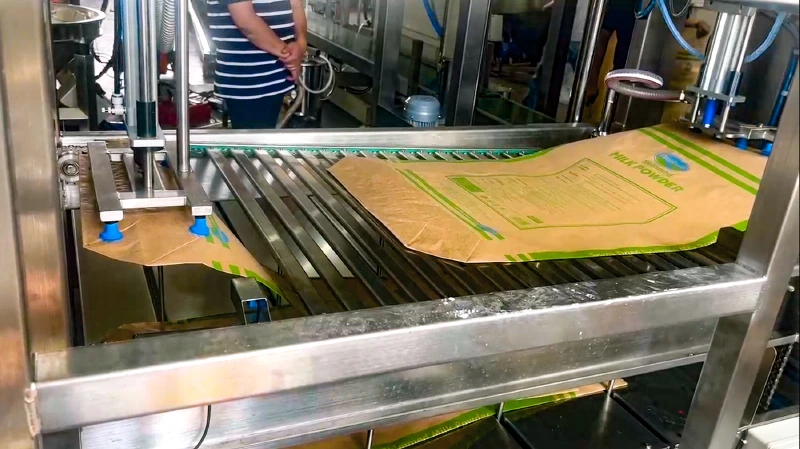
A dairy powder or flour plant may already have a filler and a conveyor, yet still rely on an operator to pull the bag square before sewing. A filled 25 kg kraft paper or woven bag can rotate as it leaves the filling point, retain air, or arrive with a dusty and skewed mouth. A conveyor that only moves the bag forward does not necessarily create a stable bag handoff before sewing.
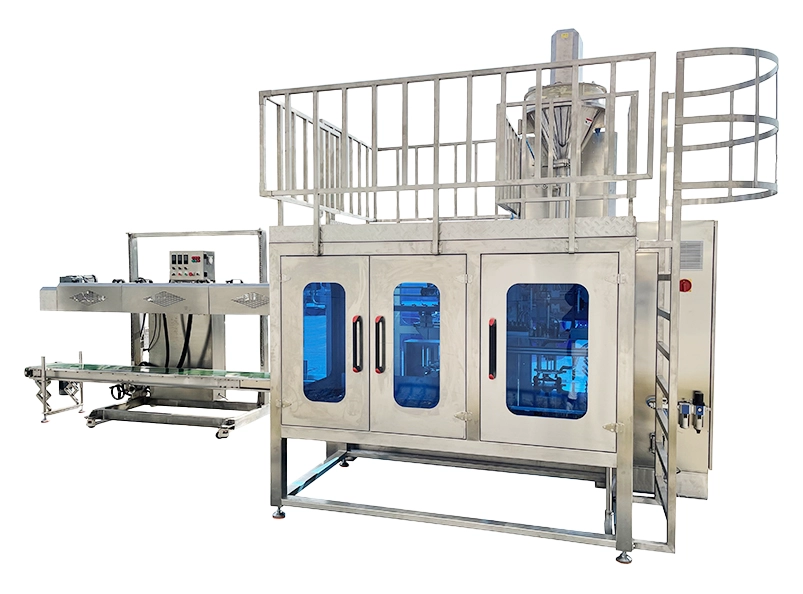
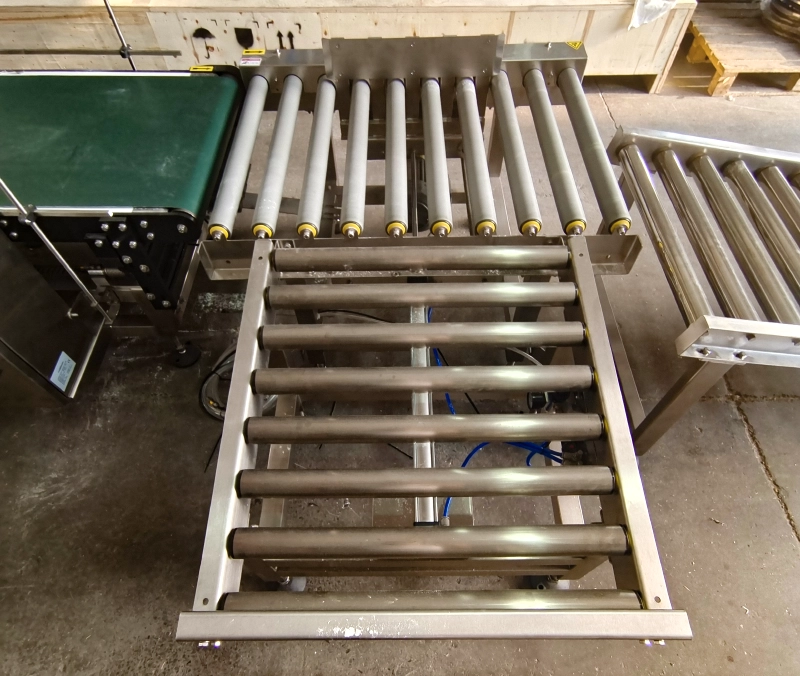
Mipline treats this transfer as part of the process. The bag magazine and pickup section feed bags to the bagging station; the clamp holds the bag during bottom-up filling; downstream roller and belt sections guide the filled bag toward closure, settling, shaping, inspection, and discharge. The exact line layout is configured around powder behavior, bag construction, closure method, and palletizing requirements.
If the filled bag mouth reaches the sewing head skewed, dusty, or unstable, the operator becomes the alignment device. That adds a manual touch exactly where powder plants need repeatable handoff and cleaner closure.
How Mipline adapts the automatic bagging machine for powder
The filling stage uses a bottom-up lifting concept to keep the fill point close to the powder as the bag rises. A three-stage screw-feeding sequence—fast filling, medium filling, and slow final dosing—is described in the product brief for controlled weighing. Where configured, vacuum extraction or de-aeration supports the next closure step. These functions address the old free-fall approach directly: less uncontrolled drop distance, better control of the bag during filling, and a more predictable handoff after the bag is full.
The visible machine evidence matches that process logic. The enclosed stainless-steel station has blue inspection windows, a connected bag magazine conveyor, and an elevated access platform. This is not a standalone automatic powder packing machine; it is a configurable powder bagging line linking bag supply, clamping, filling, closure, transfer, and final-bag checks.
Engineering view: Stable transfer is produced by the combination of bag clamp alignment, controlled filling, side guidance, roller conveyor bag transfer, and the selected closure sequence—not by a conveyor motor alone.
Structure and data points to verify before selecting a 25 kg powder packaging line
The right specification depends on bulk density, flowability, moisture, aeration, bag dimensions, target weight, closure method, and site utilities. The following reference points show how Mipline should be evaluated without turning variant data into a universal promise.
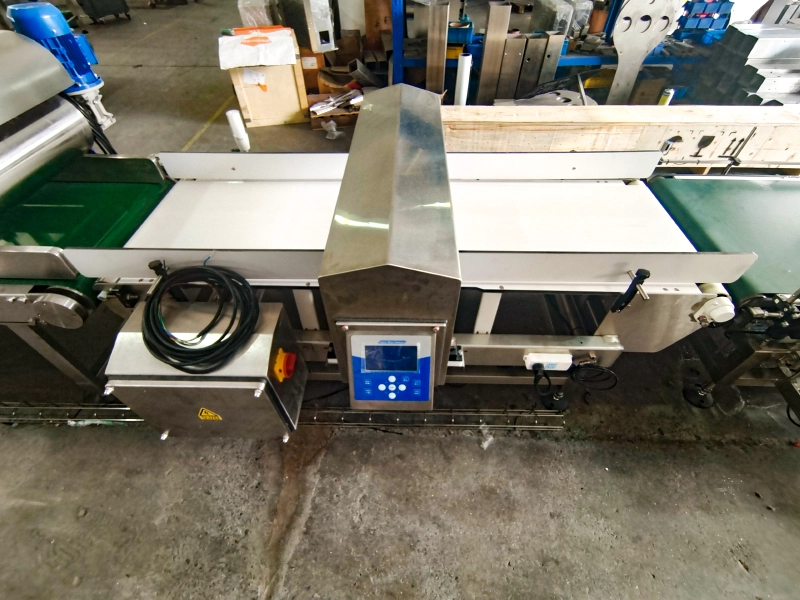
After closure, the line can be arranged with turning, settling, shaping, metal detection, checkweighing, reject, and roller discharge. That sequence answers a common old-line weakness: filling accuracy alone does not confirm that the finished bag is safe, square, correctly closed, and ready for palletizing.
| Элемент линии | Reference evidence | Problem addressed |
|---|---|---|
| Bagging and weighing | 25 kg application; bottom-up lift; three-stage screw feed; PLC/HMI control | Reduces manual holding and improves control of the filling handoff |
| Closure preparation | Vacuum extraction or de-aeration where configured; dust removal and trimming options | Helps present a cleaner, more stable bag mouth to sewing or sealing |
| Transfer and shaping | Roller sections, green belts, adjustable guides, settling and shaping modules | Supports stable bag transfer and reduces last-meter straightening |
| Inspection and reject | Optional metal detector, checkweigher, reject path, and final discharge | Catches selected quality risks after forming and closure, not only at filling |
Plan a cleaner handoff for your powder bagging line
Share the powder type, bulk density, bag material and size, target weight, required bags per minute, closure method, utilities, and palletizing layout. BPM can then match the automatic powder packing machine, transfer conveyor, inspection, and sealing configuration to the actual line.
Discuss Your Powder Packaging Line English
 Русский