
How a 5 kg Limestone Flour Line Stabilizes Bag Transfer in Sverdlovsk Oblast
For a regional limestone flour producer in Sverdlovsk Oblast, Russia, a Mipline automatic powder packing machine can be configured around 5 kg bags, controlled filling, clean closure, and a guided handoff before sewing or sealing. The key is to treat filling and bag handling as one powder packaging line rather than as a standalone filler.
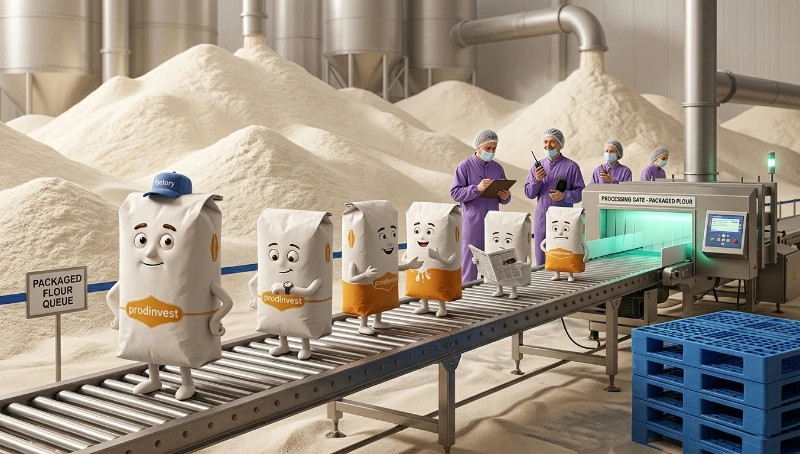
From a 5 kg mineral powder requirement to a controlled bagging process
A limestone flour plant does not only need a device that puts powder into a bag. It needs the bag to arrive open, stay positioned during filling, close without an unstable mouth, and leave the line in a condition that is practical for storage or palletizing. Fine mineral powder can be dusty and aerated; its bulk density, flowability, moisture, particle distribution, and bag construction should therefore be confirmed before the final configuration is approved.
Mipline is suited to this type of project because its process logic connects bag supply, bag opening, clamping, filling, closure, transfer, shaping, inspection, and discharge. The DS25K reference covers 5–25 kg bags, while speed and accuracy remain configuration- and material-dependent. For a 5 kg limestone flour bagging line, the correct design brief should include the target bag, filling rate, dust extraction, closure method, downstream sewing or sealing, and available plant space.
On a manually corrected line, operators may open and hold each bag, straighten a leaning package, remove powder from the mouth, or reposition it before the sewing or sealing head. A twisted bag can arrive with a skewed mouth; retained air can make the package settle unevenly; and a conveyor that only moves the bag forward does not guarantee a square, repeatable handoff. These problems become visible at the closure and dispatch stages, even though their cause started at filling or transfer.
Why Mipline fits the limestone flour bagging scenario
The product adapts the filling and handling sequence to the material and bag instead of forcing every powder through one generic cycle. A vertical screw feeding system with weighing control can be arranged with fast, medium, and slow dosing stages. Bottom-up tracked filling keeps the fill point close to the material and is designed to reduce dust escape compared with open free-fall filling. A lifting platform can follow the fill level, while the bag magazine, pickup, opening, clamp, and holding mechanisms reduce the need for operators to manually reposition a heavy or flexible bag.
After filling, the selected closure route may combine dust removal, trimming, inner heat sealing, sewing, paper-tape wrapping, pressing, or other project-approved steps. Settling and shaping sections can prepare the bag for final handling. Where specified, metal detection, checkweighing, alarms, and reject handling inspect the finished bag after forming and closure. This is important for a limestone flour line: filling control alone does not confirm the condition of the closed package.
Engineering view: For a 5 kg automatic bagging machine for powder, the transfer path is part of the quality system. Confirm the bag dimensions, powder behavior, closure equipment, detector effect, checkweigher range, and required handoff before selecting the final line configuration.
Structure and parameter evidence to verify before commissioning
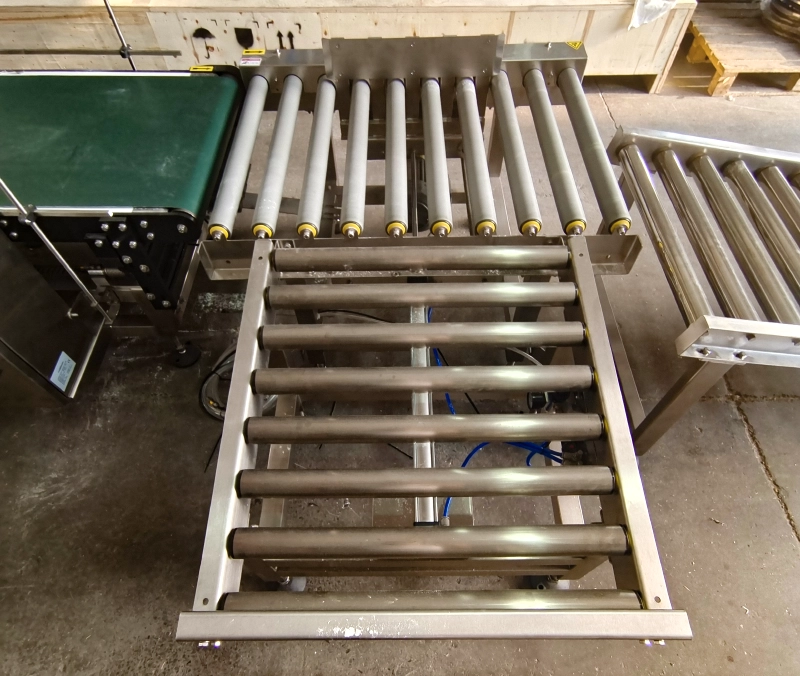
The production references show the type of mechanical evidence expected from an integrated powder packaging line: enclosed stainless-steel stations, inspection windows, bag magazine conveyors, green belts, roller transfer sections, adjustable guides, control cabinets, emergency stops, and maintenance access. The roller conveyor image above is especially relevant to the handoff before sewing or sealing. It shows an angled transfer section and supporting frame intended for stable industrial bag handling; it does not, by itself, prove a project speed or final alignment result.
For this 5 kg application, the specification should be frozen only after a material and bag test. The table separates reference values from items that need project confirmation, so the limestone flour producer can compare the proposed powder bagging line with the actual plant conditions rather than relying on a generic capacity promise.
| Item | Reference or design point | Project check |
|---|---|---|
| Bag range | DS25K reference: 5–25 kg | Confirm the 5 kg bag dimensions and construction |
| Filling method | Vertical screw feeding with weighing control and bottom-up lifting fill | Test limestone flour flowability, aeration, and dust behavior |
| Bag handling | Magazine, pickup, opening, clamp, holding, and guided conveyor transfer | Confirm the handoff geometry before sewing or sealing |
| Inspection | Optional metal detection, checkweighing, alarms, and reject path | Approve detector effect and checkweigher data for the finished bag |
| Utilities | DS25K reference: 380/220 V, 50–60 Hz; 5 kW; 6 kg/cm² air supply | Verify the selected configuration against the plant supply |
Specify the right 5 kg powder bagging line for your plant
Send the limestone flour bulk density, bag drawing, target output, closure method, dust-control requirement, and layout constraints to BPM. The Mipline team can then define the filling, bag clamp alignment, roller conveyor transfer, inspection, and final discharge configuration around verified project data.
Discuss Your Powder Packaging Line English
 Русский