
How Flour Is Packed at a Pasta Factory: The Zpacker Automatic Packaging Line
How Flour Is Packed at a Pasta Factory: The Zpacker Automatic Packaging Line
At a pasta factory, packing flour into 1 kg, 2 kg, and 5 kg paper bags requires more than accurate dosing. The line must handle a premade M-fold bag, control flour dust, close the bag cleanly, and connect with downstream inspection. Zpacker combines bag feeding, screw dosing, dust removal, sealing, and product transfer in one automatic packaging line.
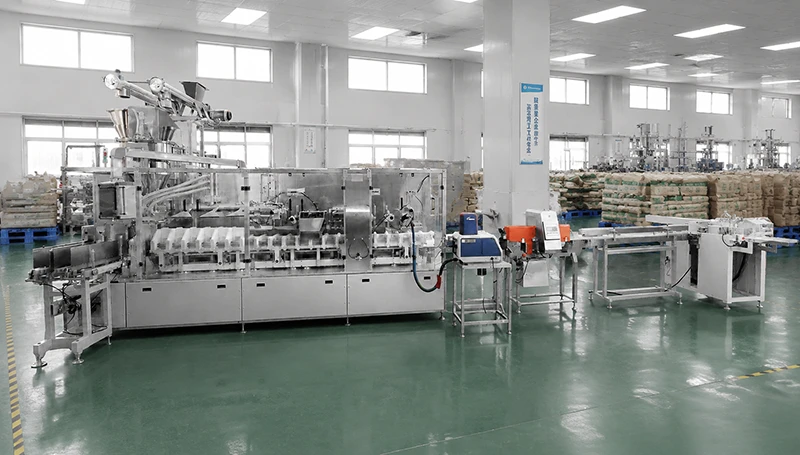
From flour storage to a finished paper bag
A typical flour packaging line starts with a flour storage silo or buffer hopper. A screw conveyor transfers the product to the dosing section, where a twin screw dosing system is configured for powder filling. The premade kraft bag then enters the horizontal paper bag packaging machine. This is a key distinction: Zpacker handles a finished paper or paper-plastic bag rather than forming a bag from roll film.
For a pasta factory, this format supports common retail sizes. One configuration covers approximately 1–2 kg, while another covers approximately 2.5–5 kg. Reference output is about 30–35 bags per minute for the 1–2 kg range and 15–20 bags per minute for the 2.5–5 kg range. Final speed depends on flour properties, the feeding system, and agreed acceptance conditions.
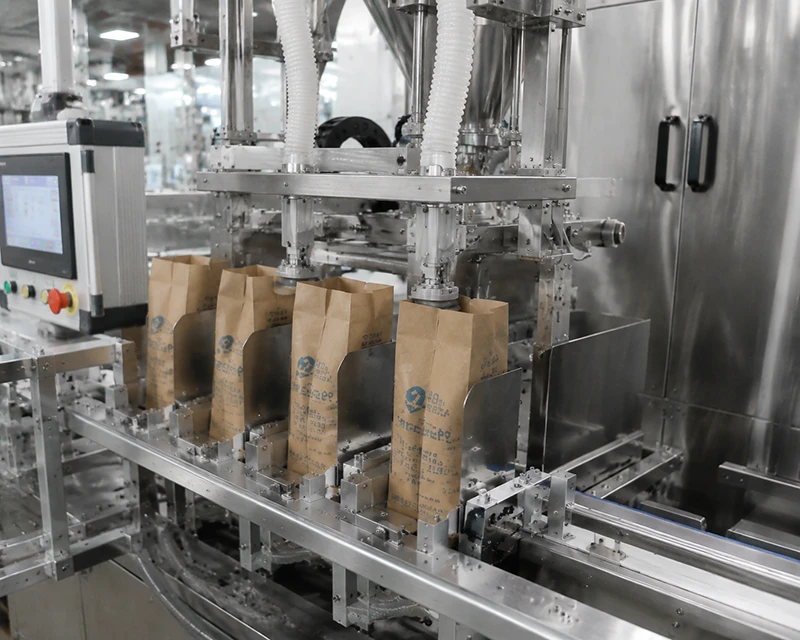
In a manual process, operators must pick up a flat bag, open it, hold it during filling, and then form and close the top. Flour dust can reach the sealing area, the product may not settle evenly, and extra handling is needed before checkweighing. A semi-automatic machine removes some labor, but it can still leave a gap between filling the premade bag and connecting inspection, conveying, and secondary packaging.
How Zpacker processes an M-fold premade bag
A belt feeder transfers each bag from the magazine to the gripping station. The bag with side gussets is opened into its stable shape, positioned, and held beneath the filling point. After automatic screw dosing, vibration and dust removal help the flour settle and reduce material around the bag mouth. The line then reforms the M-fold, trims and rolls the edge, applies hot-melt adhesive by spot or line spraying, and presses the top closed.
This sequence covers the full process that a standard machine for filling ready-made bags may not provide without dedicated forming operations. When no bag is available, the system does not open, fill, or seal. Air-pressure errors, open safety protection, drive faults, and abnormal glue temperature can trigger a stop and operator alarm.
Production insight: When evaluating powder packaging equipment, check more than target weight. The bag sample, feed direction, side-gusset size, flour behavior, and available feed capacity determine whether the automatic packaging line will run consistently.
Which line functions create the final result
The visible modules connect flour filling with the next logistics steps. Product-contact areas use 304 stainless steel, while the touchscreen supports recipe and operation control. A PLC controller coordinates gripping, dosing, settling, dust removal, and sealing. After the main machine, the line can be connected to a checkweigher, metal detector, date printer, conveyor, bag arranger, and secondary packaging equipment.
This gives a pasta factory a practical choice between grouped shrink-film packaging and manual bagging or case packing, depending on warehouse requirements and the desired automation level. Before engineering, confirm the paper bag format, 1–5 kg product range, target speed, air consumption of approximately 0.76 m³/min, 380 V ±10% and 50 Hz power supply, and available installation area. These are reference values and must be confirmed in the final specification.
| Item to confirm | Zpacker reference | Customer input |
|---|---|---|
| Bag material and form | Premade paper or paper-plastic M-fold bag with square bottom | Bag samples, feed direction, and layer bonding |
| Filling range | Approximately 1–2 kg or 2.5–5 kg | Target SKUs and allowable weight deviation |
| Dosing | Twin screw dosing; approximately ±0.5% reference accuracy | Flowability, dust behavior, and test flour |
| Downstream process | Checkweigher, metal detector, date printer, arranging, and grouped packing | Inspection and warehouse logistics requirements |
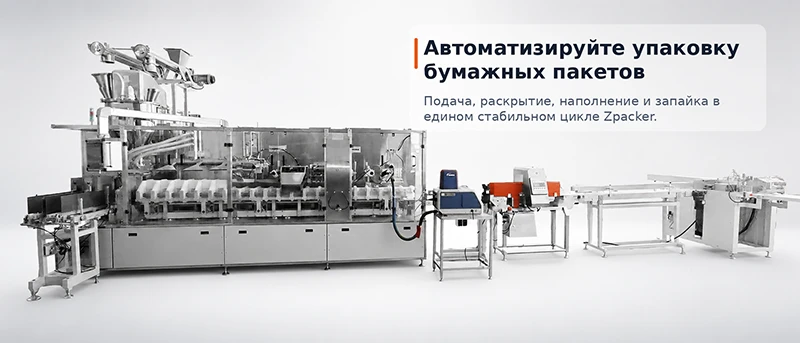
Specify a flour packaging line for your paper bags
Prepare a bag sample, 1 kg, 2 kg, or 5 kg SKU requirements, flour characteristics, target speed, and downstream inspection needs before requesting a configuration. BPM can match the screw dosing system, dust removal, sealing process, and equipment after the Zpacker packaging machine.
Request a packaging line review English
 Русский