
Mipline powder packaging solution
25 kg Powder Bagging Line for Stable Bag Transfer
For dairy powder, flour, starch, and other dry-powder plants, the last metre before sewing often decides whether a filled bag reaches the closure station square, stable, and ready for a consistent seam. Mipline combines automatic bag handling, guided conveying, and enclosed stainless-steel equipment to create a cleaner handoff from filling to sewing or sealing.
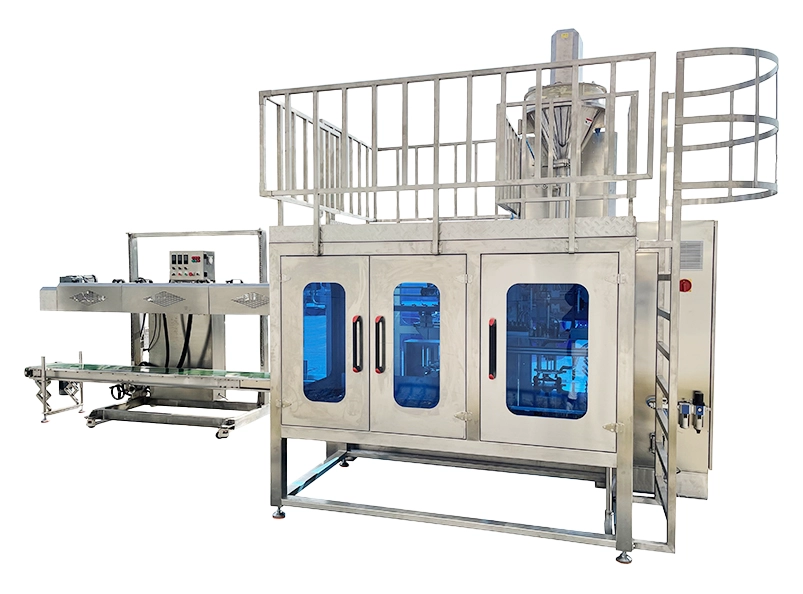
When a 25 kg bag arrives at sewing out of square
A powder plant buying a powder bagging line is not only looking for a filling machine. The complete route must move a flexible kraft paper or woven bag through bag placement, clamping, transfer, and final closure without allowing the bag body to twist or collapse. This is especially important in a milk powder packaging machine, dairy powder bagging line, flour bagging line, or starch powder packaging line where filled bags must continue through the line at a repeatable rhythm.
With a basic conveyor arrangement, the filled bag can lose its orientation during the last transfer. Operators then straighten the bag by hand, compensate for inconsistent alignment, or slow the sewing head to avoid a skewed bag mouth. That manual correction consumes attention, creates an uneven handoff, and makes the sewing station more dependent on operator timing than on the equipment layout.
Why Mipline is adapted to the handoff before sewing
Mipline is configured as an automatic powder packing machine for industrial bags, with the bag path treated as one connected process rather than a series of isolated machines. The enclosed stainless steel bagging station provides a controlled area for bag loading and handling. In any powder bagging line, a stable bag at this stage protects the downstream sewing quality. Blue inspection windows make the active zone visible, while the bag magazine conveyor gives the upstream bag supply a defined entry point.
After filling, the transfer route can use clamping, side guidance, belt conveying, and roller conveyor sections to keep the bag supported while it changes direction or passes between modules. The result is a more stable bag handoff before sewing: the bag has a guided path, the mouth is less likely to arrive skewed, and operators have less need to perform manual bag straightening at the final metre.
Visible machine evidence in the powder bagging line
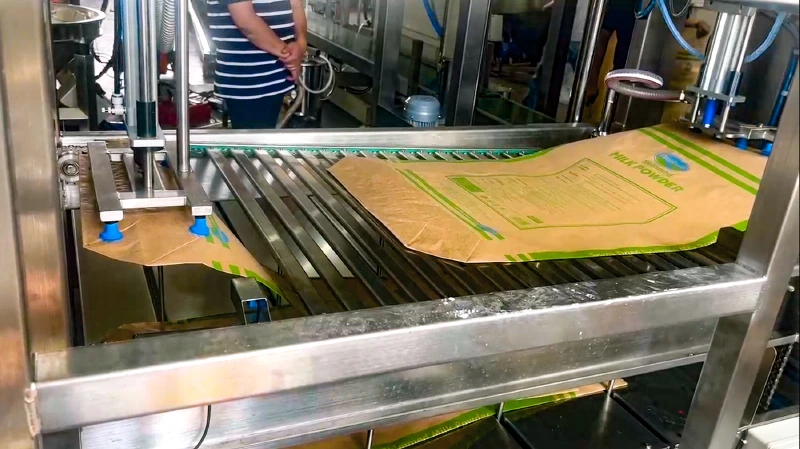
Bag placement and clamping
The bag-contact equipment is visible rather than hidden behind a generic line description. Vacuum grippers handle the kraft paper bag at the loading and transfer point, while the surrounding stainless steel frame provides a defined working envelope. This arrangement supports the practical requirement of an automatic bagging machine for a powder bagging line: place the bag, hold it, and hand it into the next movement without relying on an operator to recover its position.
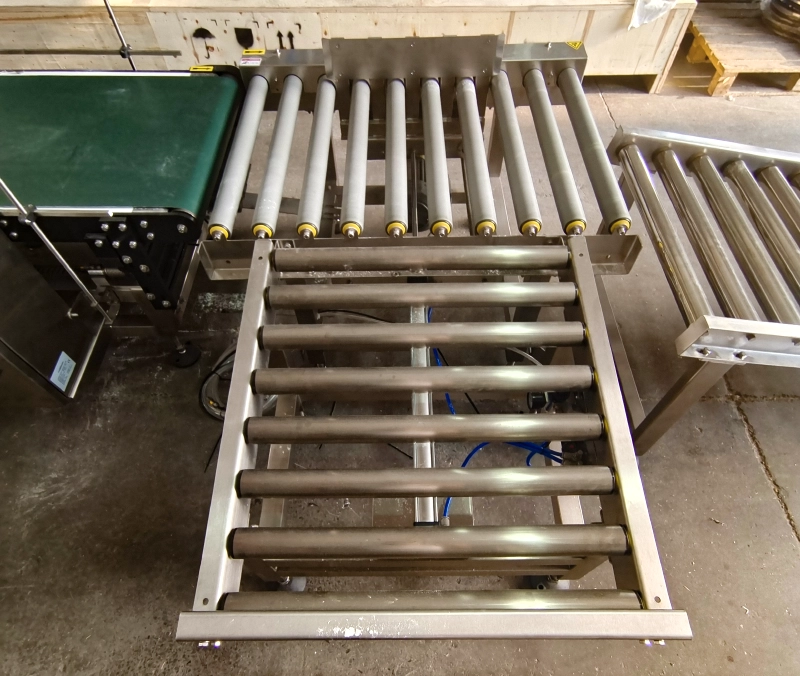
Roller transfer and alignment
The stainless steel roller section is suited to the portion of the line where a filled bag must remain supported while transferring between conveying directions. Angled rollers and the supporting frame help define the bag route, providing a more repeatable approach to sewing or sealing than an open, unsupported gap. For plants handling 25 kg bags, this is the physical link between filling performance and closure consistency.
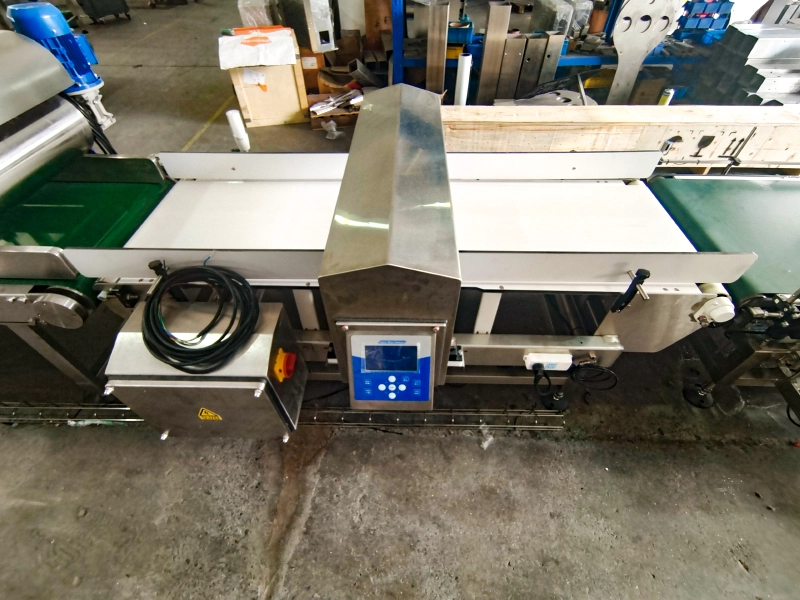
Guided transfer before closure
The twin-belt transfer conveyor adds side guidance and a central control housing to the conveying path. These visible elements address the common buyer concern in a powder bagging line that a filled bag twists or arrives collapsed before the sewing head. By keeping the bag supported and guided through the transfer, the line is designed to reduce correction work and provide a cleaner interface with downstream sewing or sealing equipment.
From filling to a more predictable final result
The practical outcome is not simply a more automated conveyor. A properly connected powder filling and bag sewing line gives the plant a clearer process: the bag is supplied from the magazine, handled at the enclosed station, transferred on supported conveyor sections, and guided toward closure. Stainless steel construction, inspection access, bag clamping, roller conveyor transfer, and adjustable side guidance are all visible parts of that process.
For a buyer comparing a 25 kg powder bagging line, the key question is whether the machine addresses the last handoff as carefully as the filling step. Mipline is built around that requirement. It helps keep bags square before sewing, supports stable bag transfer, and gives dairy powder, flour, starch, and other dry-powder operations a cleaner route from filled bag to finished, closed package.
 English
 Русский