
Secondary Packaging Machine: Stable Salt Bag-in-Bag Output
A salt producer can use a secondary packaging machine to group finished small pouches, load them into a woven bag, remove excess air and close the larger logistics unit without relying on stop-start manual handling.
Why a secondary packaging machine matters after primary filling
The typical customer is a salt, flour, seed, detergent or milk-powder plant receiving 200 g to 1 kg pouches from one or more primary VFFS lines. The pouches may already be weighed and sealed, but they still have to become a larger 20–50 kg transport unit. That is where the secondary packaging machine belongs: after primary filling, before sewing, palletizing and warehouse transfer.
The old solution is familiar. Operators collect pouches at the end of each primary line, count them by hand, hold open a woven sack, arrange the contents, press out air and carry the filled sack to a sewing machine. Counting drifts when several lines discharge together. Pouches overlap or arrive in the wrong orientation. A full sack becomes difficult to handle, and inconsistent air removal leaves a swollen package that is harder to stack. The result is extra rework at the exact point where the plant is trying to increase output.
Manual grouping creates three linked risks: the count can be wrong, the outer bag can be poorly shaped, and an underweight or damaged pouch can be hidden inside a finished sack. Each error becomes more expensive after sewing and palletizing. A stable secondary packaging line therefore needs controlled grouping, bag support, compression and a clear reject or checkweighing interface—not just a faster conveyor.
How a secondary packaging machine turns loose pouches into one logistics unit
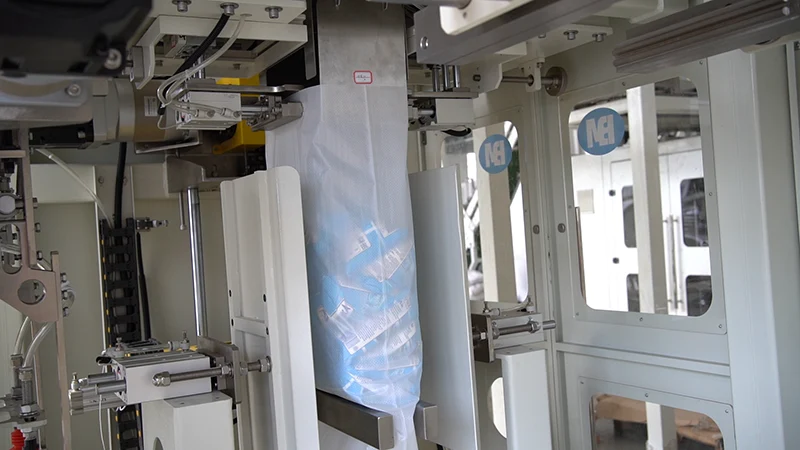
BIBPU is designed as a bag-in-bag system rather than a stand-alone primary vertical packaging machine. Pouches arrive from the upstream packaging line, are merged and arranged in a defined single- or double-row pattern, and are counted before the outer woven or laminated bag is opened and held. Pneumatic grippers keep the bag mouth stable while the grouped pouches fall through the loading zone. A following compression stage squares the filled bag and prepares its mouth for closure.
The arrangement is useful on a multi-floor packaging layout as well. Inclined or transfer conveyors can connect primary baggers, a grouping station and the secondary packaging machine, while the discharge side can be prepared for checkweighing, reject handling, a bag turner, robot palletizing or a pallet store. The exact interface depends on pouch dimensions, material flow, bag fabric and the required takt, so the final configuration should be confirmed against samples and the signed project specification.
Engineering point: the documented reference values describe small-pouch speeds of about 90–102 bags per minute and a typical 50 kg output of 1.6–2 bags per minute. These are configuration references, not a universal acceptance guarantee; pouch size, filling material, outer-bag dimensions and downstream handling must be checked together.
Secondary packaging machine checks before commissioning
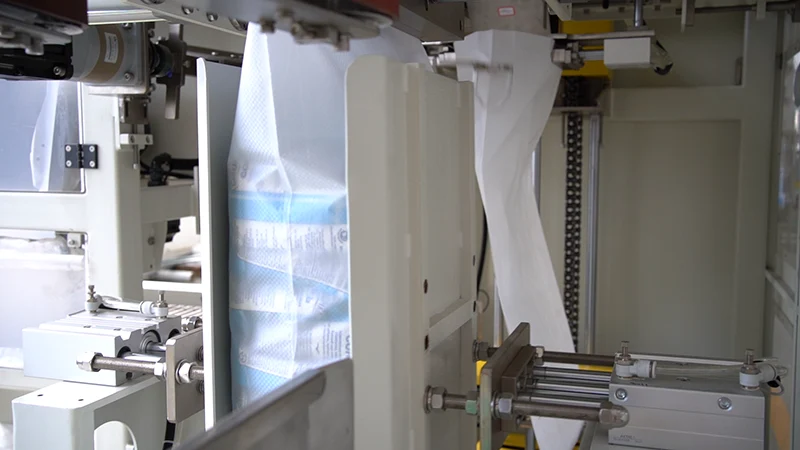
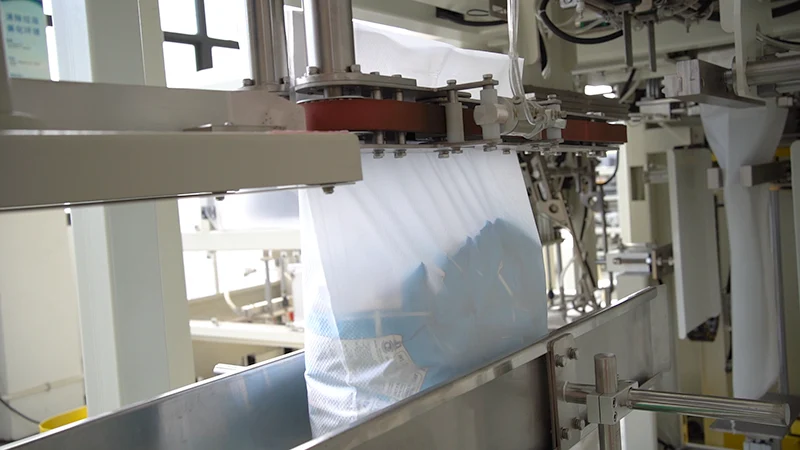
The machine should be evaluated as a sequence of controlled handoffs. The filling photograph shows the central fit: small salt pouches are loaded into a pneumatic-held woven PP sack. The compression photograph supports the next step: side plates shape the full sack before closure, with a documented 150 mm cylinder stroke in the referenced configuration. The guide-belt photograph shows how the flattened mouth is supported and conveyed toward sewing rather than being carried by an operator.
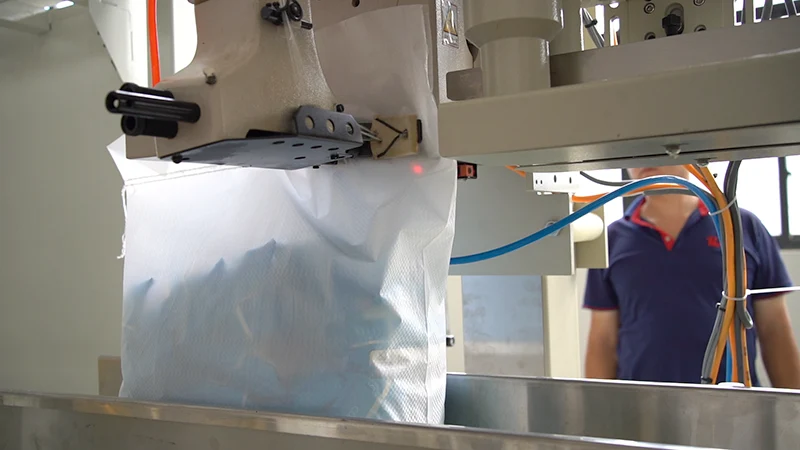
At the final station, the Newlong DS-9C sewing head shown in the indexed image provides a concrete closure reference for the woven-bag route. Together, these images support the intended result: a counted group, a more regular outer bag and a repeatable path to stitching. They do not replace FAT or SAT data, and they should not be read as proof of one fixed speed or accuracy for every product.
| Checkpoint | Reference value or interface | Почему это важно |
|---|---|---|
| Small-pouch feed | About 90–102 bags/min | Sets the grouping and accumulation requirement |
| Outer-bag range | Typical 20–50 kg project scope | Defines bag support, compression and closure design |
| 50 kg output | About 1.6–2 bags/min in the reference | Links the line to sewing and palletizing takt |
| Air supply | 0.5–0.7 MPa; up to 0.8 m³/min reference | Supports grippers, clamps and pneumatic movement |
| Electrical supply | 380 V ±10%, 50 Hz reference | Must match the plant utility and controls plan |
For a buyer, the practical result is less manual counting and lifting, a clearer inspection point before the outer bag is closed, and a more predictable handoff to sewing and palletizing. The right specification starts with the small-pouch size and arrangement, then confirms the bag material, target output, air supply and downstream interfaces. That is how a secondary packaging machine becomes a complete automation step instead of an isolated piece of equipment.
Plan a stable bag-in-bag packaging line
Share your pouch dimensions, material, outer-bag format, target bags per minute and palletizing layout. BPM can review the grouping, compression, sewing and transfer sequence for a project-specific BIBPU configuration.
Запросить аудит линии English
 Русский