
Automatic Secondary Packaging Machine: Bag-in-Bag Flow
An automatic secondary packaging machine connects sealed salt, flour, seed, detergent, or milk-powder pouches to a controlled woven-bag logistics unit. BIBPU groups small packs, loads the outer bag, shapes the filled sack, and prepares it for sewing, checkweighing, conveying, and palletizing.
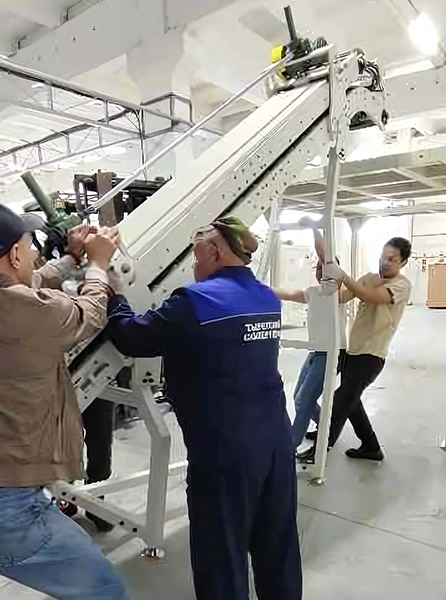
When primary packs become a secondary-packaging bottleneck
A salt or dry-powder plant may already have several VFFS machines producing 200 g to 1 kg sealed pouches. The difficult step starts after the pouch leaves the primary packaging machine: packs accumulate, operators count them into groups, and the group must enter a 20–50 kg woven or coated outer bag without losing the intended arrangement. This is the working context for an automatic secondary packaging machine, not a replacement for the upstream filling and sealing equipment.
The old manual route creates several linked problems. Pouches overlap on a belt, counts are corrected by hand, and an incorrectly filled outer bag is discovered only after labor has been spent on loading and sewing. Residual air and uneven placement can make the finished sack bulge, weaken pallet stability, and increase the chance of rework during transport. A practical line therefore needs controlled merging, counting, bag opening, holding, compression, closure, and a clear reject path before the bag reaches the logistics area.
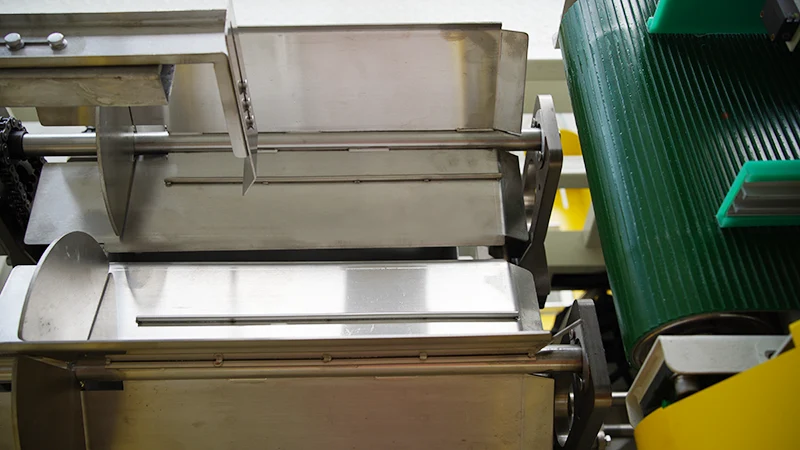
For a plant considering a salt bag-in-bag line, the grouping station is the first visible control point. It turns an unstructured pouch stream into a repeatable handoff to the outer-bag section, while the project team can still define the number of pouches per group, single- or double-row arrangement, and downstream inspection requirements.
Manual bagging adds counting errors, inconsistent sack shape, lifting work, and stop-start flow between floors. If an underweight pouch or damaged seal enters the group, the whole outer bag may need to be opened and rebuilt. The result is lost line availability as well as extra packaging material and handling.
Why BIBPU fits the bag-in-bag job
BIBPU is an automatic secondary packaging machine built around the actual post-pouch sequence: receive finished pouches, merge and arrange them, count the group, open and hold the outer bag, drop the pouches into it, compress or shape the filled sack, then transfer it to sewing or another closure station. This continuous chain removes repeated manual transfers while keeping the primary VFFS machines and their dosing format unchanged.
The equipment can be arranged around a food, chemical, or pharmaceutical packaging floor. Inclined conveyors, high-speed transfer sections, temporary storage, bag magazines, pneumatic grippers, and a sewing interface can be selected according to the pouch dimensions, outer-bag material, target rate, and floor-to-floor route. PLC, photoelectric sensors, pneumatic devices, and a touch HMI support sequence control, alarms, interlocks, and recipe changes; final component brands remain project-specific.
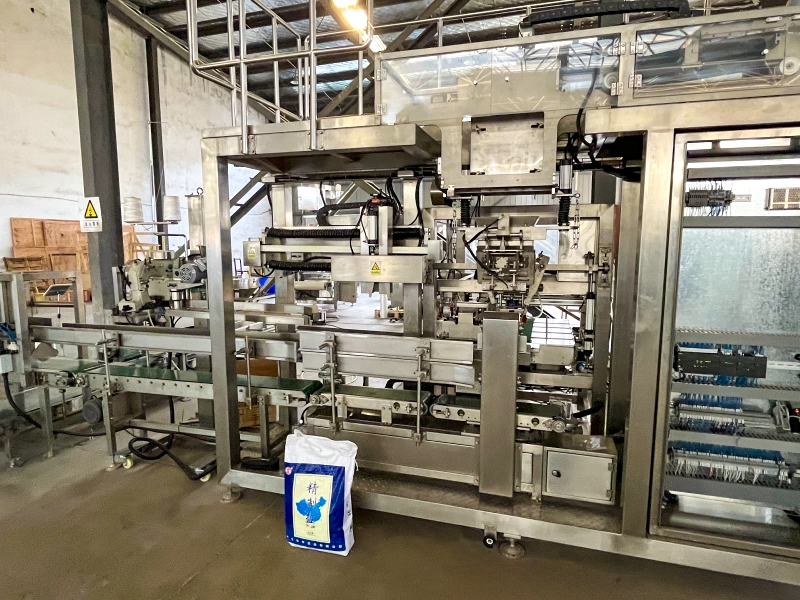
Engineering checkpoint: do not specify an automatic secondary packaging machine from outer-bag weight alone. Confirm the small-pouch dimensions, pouch count per group, pouch seal condition, outer-bag width and height, material flow, air supply, closure method, and the available conveyor and palletizing interfaces. Those inputs decide whether the grouping, opening, compression, and sewing modules will run as one stable system.
Structure and parameter checks before approval
The photographs show the kind of evidence that should be reviewed during a project discussion. The grouping and conveyor sections establish the flow; the internal guide, chute, and transparent door show how the machine contains and directs the bag; and the control cabinet shows where operators manage the automatic secondary packaging machine. These images prove visible structure and layout only. They are not a substitute for a signed FAT or SAT record.
Reference documents describe a typical 50 kg secondary-bag output of 1.6–2 bags per minute, with a small-pouch packaging speed around 90–102 packs per minute. Other project versions use 20 kg bags or different pouch arrangements. Checkweighing can be configured around a documented 500–1500 g small-pouch range and a 25–50 kg large-bag range, but accuracy, speed, material behavior, and reject logic must be confirmed against the final machine configuration.
| Project checkpoint | Reference value or interface | What to confirm |
|---|---|---|
| Small-pouch infeed | Typical 200 g–1 kg pouches; single or double grouping | Pouch dimensions, seal, count, and arrangement |
| Secondary output | Typical 50 kg output: 1.6–2 bags/min | 20 kg or 50 kg target, cycle time, and bag material |
| Utilities | Compressed air 0.5–0.7 MPa; maximum reference use 0.8 m³/min; 380 V ±10%, 50 Hz | Plant air quality, connected load, and final BOM |
| Inspection | Small-pouch and large-bag checkweigher ranges are project-configured | Accuracy, reject location, data traceability, and acceptance test |
| Downstream | Sewing, conveyors, spiral or incline transfer, robot palletizing, and pallet storage | Heights, clearances, handshakes, and floor-to-floor layout |
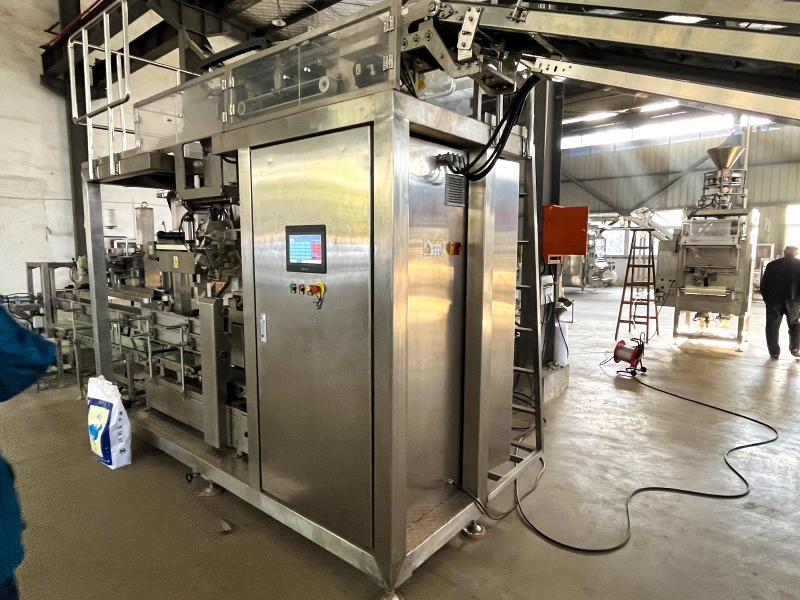
In the final review, compare the measured pouch and sack samples with the proposed guides, grippers, and closure head. Then confirm whether the line needs a rejector before grouping, a spiral descent between floors, a Newlong-style sewing head, or a robot palletizing handoff. This evidence-based process keeps the automatic secondary packaging machine matched to the material and the plant rather than to a generic catalogue promise.
Specify your automatic secondary packaging machine
Send the pouch size, pouch weight, group count, outer-bag sample, required output, utilities, and plant layout to BPM. We can review the BIBPU bag-in-bag sequence, checkweigher and reject points, sewing or closure interface, and palletizing connection before the configuration is finalized.
Запросить аудит линии English
 Русский