
50 kg Cement Valve Bag Packing Line: M400 Closed-Cell Bagging
M400 grade cement is finer and more dust-prone than ordinary Portland. Once it leaves the cement mill, every gram that escapes from a 50 kg valve bag becomes a packaging defect, an EHS incident, and a rejected pallet. A purpose-built 50 kg cement valve bag packing line keeps that bag mouth inside a sealed boot from pickup through ultrasonic seal — so the cell runs as one continuous, closed-loop workflow rather than a string of standalone stations.
Why M400 Cement Pushes 50 kg Valve Bags Harder
M400 is a 400 kg/cm² compressive grade, ground finer than ordinary Portland to speed early strength. The same fineness that makes it set faster also makes it dusty, aerated, and hungry for moisture. On a 50 kg cement valve bag packing line, that shows up as cement dust hanging at the bag mouth, valve pockets puffed up with entrained air, and pallets that lean on the dispatch floor.
None of those are mechanical problems. They are symptoms of a half-open bagging layout that lets the bag mouth breathe while it is being filled and sealed. Three failure modes follow. First, dust leakage at the spout during air-conveyed filling, which raises respirable load around the operator station and fouls the conveyor bearings downstream. Second, underweight bags because the filler cannot reach the target weight when the air column inside the bag is unstable. Third, bag-to-bag variation that only shows up at the palletizer, where the robot drops bags that do not match the programmed pick pattern. A 50 kg cement valve bag packing line that treats filling and sealing as separate, open-mouth stations cannot fix any of these at the root.
M400 plants report that on a half-open layout, fugitive cement dust at the bag mouth is the number one cause of bag rejections — not underweight fill, not seal failure, but the dust that accumulates inside the sealer and forces line stoppage every shift.
What a Closed-Cell 50 kg Cement Valve Bag Packing Line Looks Like
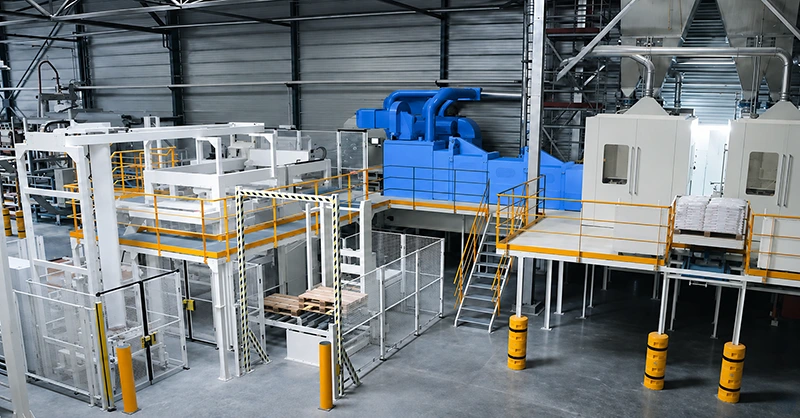
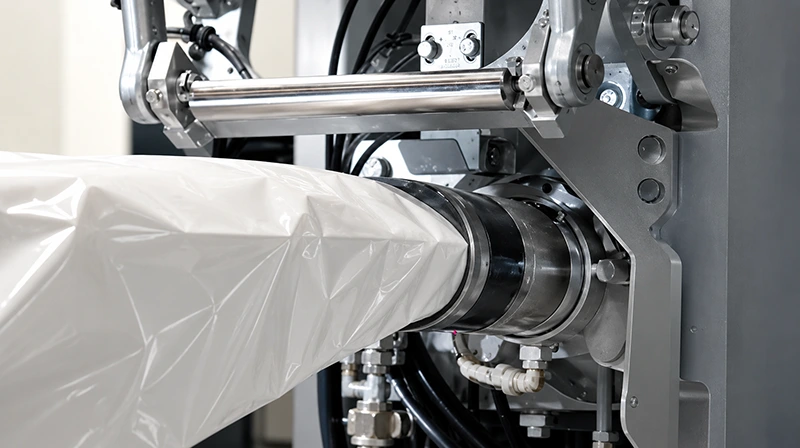
A closed-cell layout puts the bag mouth inside a sealed fill boot from the moment the twin-arm gripper picks the bag out of the magazine to the moment the ultrasonic head closes the valve. The fill boot is mechanically clamped around the filling nozzle and the bag neck — there is no open seam, no manual touch, no breathable gap. The robotic loader does not set the bag on a table and walk away; it indexes the bag onto the nozzle and holds it there until the ultrasonic seal is complete.
Inside that sealed volume, the filler runs on an air-conveying principle: a large-bore inlet duct feeds the cement into the bag, a smaller-bore return duct bleeds displaced air back to a filter. That double-channel geometry is what allows the filler to push a dense 50 kg charge into a valve bag without puffing the bag or choking the sealer. Once the ultrasonic head has welded the valve flat, the bag drops onto a checkweigher and into a metal detector, both positioned close enough that no bag reaches the palletizer without passing through both gates.
From the BPMpack field team: On a M400 50 kg cement valve bag packing line, the upstream silo is sized for steady head pressure, the air supply is stabilized at 0.5–0.7 MPa, and the contact surfaces are 304 stainless steel — those three are the baseline conditions that turn a closed-cell layout into a reliable production cell rather than a demo machine.
How a 50 kg Cement Valve Bag Packing Line Is Stacked
The cell is sequenced in six linked stations, not eight standalone machines. A wheeled bag magazine feeds empty 50 kg valve bags to the twin-arm loader. The loader indexes each bag onto the expanding filling nozzle inside the sealed boot. The air-conveyed filler discharges 50 kg of cement through the large inlet duct while the return duct evacuates displaced air back to the bag filter. The ultrasonic head welds the valve flat. A checkweigher verifies the 50 kg target, a metal detector scans the bag, and the bag transfers to a robotic palletizer that builds the dispatch stack.
Throughput at 50 kg follows from the cycle time at the filling station, not from the loader or the sealer. The 50 kg cement valve bag packing line is therefore not paced by the slowest station; it is paced by the air-conveying cycle, which has to push a denser charge through the same valve geometry used at 25 kg.
| Параметр | Specification (project baseline) |
|---|---|
| Bag weight | 10–50 kg (50 kg typical for M400 retail / export) |
| Производительность | 5–12 bags / minute (subject to bulk density and head pressure) |
| Filling accuracy | ±1–2‰ (verify on site against target weight) |
| Bag material | Coated woven PP, kraft paper, laminated valve bags |
| Air supply | 0.5–0.7 MPa, stabilized; consumption depends on cycle |
| Power supply | AC 380 V / 50 Hz / ~15 kW for the bagging group |
| Material-contact parts | 304 stainless steel |
| Pallet outfeed | Robotic palletizer, EPAL-compatible, with stretch-hood |
Spec Your 50 kg Cement Valve Bag Packing Line
For an M400 plant, the right 50 kg cement valve bag packing line starts with three numbers: cement grade, target output in bags per hour, and the bag stock currently on hand. Share those with the BPMpack engineering team and we will return a station-by-station layout, an air-consumption estimate, and a CAD footprint for the cell on your site.
Запросить коммерческое предложение English
 Русский