
Flour Packing Machine: Dust Capture at the Bag Mouth
Retail flour leaves a mill in a 1 kg, 2 kg or 5 kg kraft bag, and most quality complaints start at the bag mouth. A flour packing machine that extracts dust while the bag is held open, then closes that same bag with hot-melt glue, takes the operator away from the dosing spout and keeps weight, bag shape and glue line under control.
Where hand-filled flour bags fail
Picture a mill or a bakery running three retail sizes on the same floor: 1 kg for small shops, 2 kg for families, 5 kg for bulk buyers. In a manual or semi-automatic setup, an operator lifts each flat kraft bag, opens it by hand, holds it under the dosing spout, watches the scale, then folds the M gusset, trims the top, applies glue and presses the seam. Every one of those actions depends on the same pair of hands, and every one of them leaves a small variation behind.
The dust is the first problem. Flour leaves the spout as an aerated stream, and the open bag mouth is the only place it can escape. Dust settles on the glue area, on the outside of the bag and on the sealing jaw, so the seam that should be flat becomes a glued dust layer that opens later in the pallet. The second problem is weight: a person judging the end of the fill cycle tends to stop the stream early, which is why checkweigher rejects climb at the end of a shift. The third problem is shape. An M-gusset bag that has been opened and filled by hand rarely folds back to a square block, and a bag that is not square stacks badly and jams the case packer downstream. A semi-automatic filler keeps the human in the loop for exactly the steps that matter, so it does not remove any of these three failures.
Between the bag magazine and the glue nozzle, an open flour bag loses product to the air, loses weight accuracy to the stop-start fill, and loses seal strength to dust on the fold. Fixing the last station only hides the first two.
Inside the flour packing machine: from flat bag to glued block
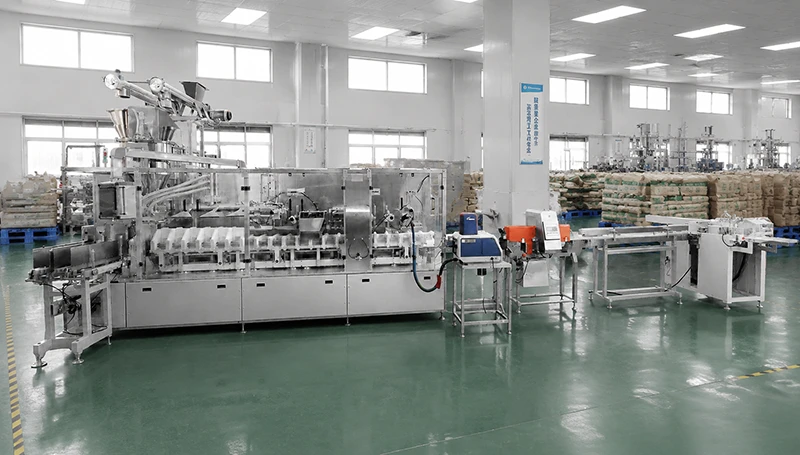
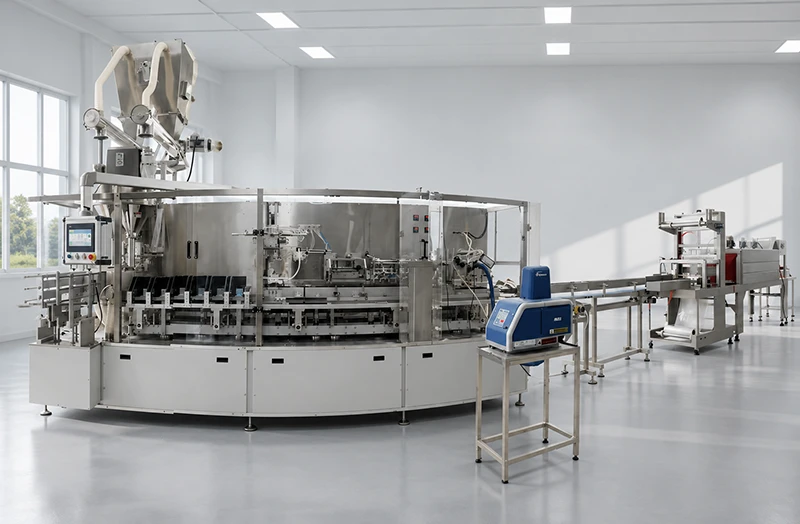
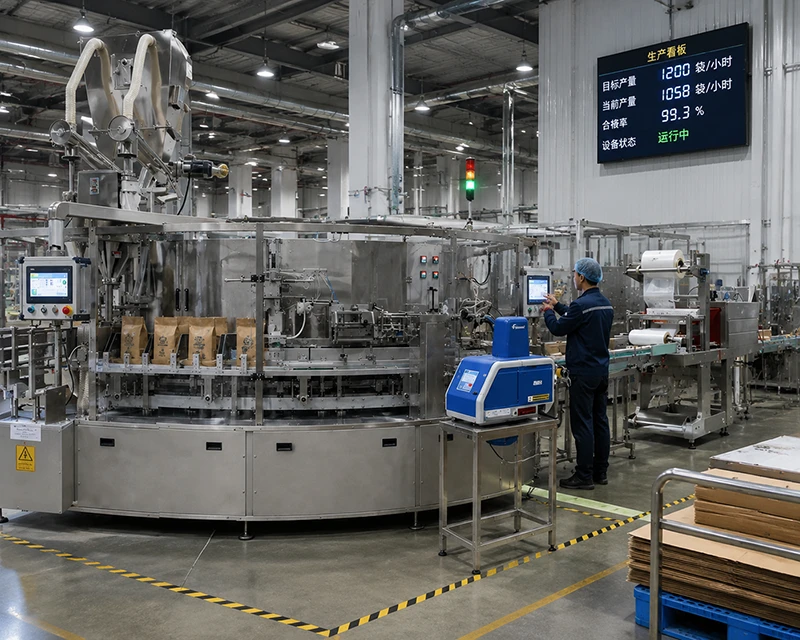
Zpacker is built as a dual-station linear machine for premade paper or paper-plastic bags, not as a form-fill-seal unit working from a roll. Two bag magazines feed flat M-gusset bags on a belt; each bag is picked by vacuum, opened into a three-dimensional shape, transferred to the filling station and clamped at the mouth. A vertical screw doser fills the bag while the clamp holds it, and dust extraction works at the filling position rather than somewhere downstream. After filling, the bag passes vibrating and dust-extraction positions that settle the product and let air out, then the M gusset is folded back, the top edge is trimmed, the fold is rolled, hot-melt glue is applied as spots or a line, and a top press closes the bag into the square block that retail shelves and case packers expect.
The two stations are what make continuous output possible. When one lane runs out of bags, that lane stops and alarms while the other lane keeps packing, so the line does not have to be emptied and restarted. The same interlock logic blocks opening, filling and sealing when no bag is present, and the machine stops on air-pressure faults, open safety guards, main motor or inverter faults, and abnormal glue temperature. In practice the operator becomes a supervisor of bag magazines and glue, not a person holding a bag under a stream of flour.
Why glue instead of heat sealing. Kraft paper and paper-plastic laminates do not weld to themselves the way a PE film does. Hot-melt spot or line application on a trimmed, rolled fold gives a mechanical bond that survives the fold geometry, which is why the machine trims and rolls the top edge before the nozzle fires. If a paper-plastic bag is used, the bond between paper layer and film has to be confirmed with the bag supplier first; a delaminating laminate will fail at the fold no matter how the glue is set.
Specifications that decide output and bag fit
Zpacker is quoted in two size classes so that one machine family covers a retail flour range without rebuilding the line for every SKU. The reference figures below come from the technical proposal; final speed, air pressure and gusset dimensions are fixed against the customer bag sample and acceptance conditions, because flour density, feed consistency and site conditions move the real number.
| Item | 1–2 kg configuration | 2.5–5 kg configuration |
|---|---|---|
| Reference output | approx. 30–35 bags/min | approx. 15–20 bags/min |
| Filling accuracy | approx. ±0.5% | approx. ±0.5% |
| Bag width | 80–140 mm | 80–140 mm |
| Bag length | 240–320 mm | 240–320 mm |
| Side gusset (M fold) | approx. 60–80 mm | approx. 60–80 mm |
| Bag type | premade kraft or paper-plastic, flat-bottom M gusset | premade kraft or paper-plastic, flat-bottom M gusset |
| Закрытие | hot-melt spot or line glue plus top press | hot-melt spot or line glue plus top press |
| Управление | 10.4 in touchscreen with PLC | 10.4 in touchscreen with PLC |
| Power and mass | 15.5 kW, 380 V / 50 Hz, approx. 3000 kg | 15.5 kW, 380 V / 50 Hz, approx. 3000 kg |
Product-contact and exposed parts are 304 stainless steel, while the main frame is a coated carbon steel structure with anodised aluminium sections in places. That combination matters on a flour floor: the surfaces that meet food are cleanable, and the frame still carries the mass of a machine that runs two filling stations without walking. Pneumatic circuits, low-voltage components and bearings are specified in the BOM, so the brand list should be confirmed on the final quotation rather than assumed from a brochure.
What to send before a quote on a flour packing machine
Flour is not a single material. Bread flour, cake flour and wholemeal behave differently in a screw doser and in a bag, and the dust load changes with extraction rate. The fastest way to a usable proposal is to send the material and the bag together, because the machine is configured around the pair.
- Bag sample, ten pieces or more. The bag decides the magazine, the opening tooling and the gusset fold. Orientation matters: the printed front and back cannot be swapped, so the sample must show how the bag sits in the magazine.
- Target weights and the size split. If the plan is 1 kg and 2 kg, the small class covers both; if 5 kg is in the range, the line needs the larger class or two machines. Mixing all three on one lane is a layout decision, not a software setting.
- Flour specification. Bulk density, fat content, extraction rate and whether the product is sifted or wholemeal determine the screw diameter, the extraction points and the settling time.
- Upstream supply. A screw conveyor or bucket elevator feeding the doser hopper has to match the machine’s consumption at peak output, otherwise the two lanes starve.
- Air and power. Budget for roughly 0.6–0.8 MPa and about 0.76 m³/min of air at the reference figures, plus a 15.5 kW supply. The pressure is confirmed in the final technical proposal.
- Downstream plan. A checkweigher and metal detector directly after the machine catch what the doser cannot, and the reject conveyor needs space before the case packer or shrink wrapper.
- Floor space and layout. A full line runs around 17 m by 3.6 m in the reference discussion, but that is a planning figure and must be replaced by a CAD layout against the actual hall.
What changes on the packing floor
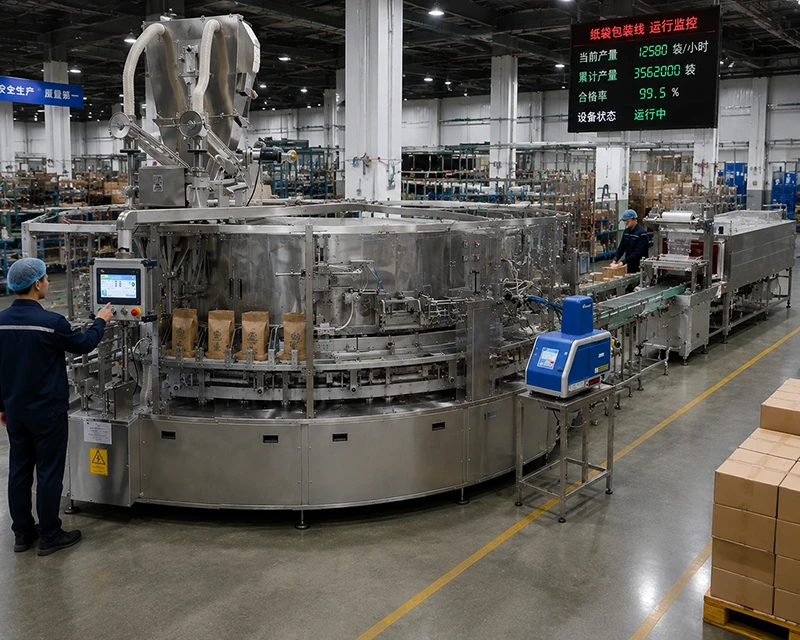
The visible change is that nobody holds a bag. The second change is quieter: because dust is pulled at the filling position and again at the settling positions, the glue area stays clean enough for the fold to bond, and because the doser closes on weight rather than on a person’s judgement, the checkweigher rejects less. Bags leave the top press as square blocks with a flat glued seam, which is what makes the downstream checkweigher, labeller and shrink wrapper behave predictably.
If you are still comparing machine types, the useful distinction is bag supply, not speed: a vertical roll-fed machine makes its own bag from film, while this machine consumes premade kraft or paper-plastic bags and closes them with glue. Mills that already buy printed retail bags, and Russian retail formats built around 1 kg, 2 kg and 5 kg paper packs, are the cases where the premade route fits. For a closer look at the same platform in other weight classes, see the 2 kg twin-station paper bag line and the 1–5 kg kraft bag packaging machine.
Send your bag sample, not just your weight range
A flour packing machine is only correct when the bag, the flour and the target speed are tested together. Send a bag sample with its dimensions and gusset, the target weights and your hourly requirement, and the line will be quoted against your material instead of a catalogue number.
Request a line proposal English
 Русский