
Преимущества упаковки "мешок в мешке" для экспортных товаров
 | Your rock salt is top-grade, but is it arriving at the destination port as a solid, caked block inside a broken bag? Unstable pallets don’t just waste container space; they destroy profit margins and your brand’s reputation with every collapsed stack during transit. The manual labor involved in your downstream packaging isn’t just slow—it’s the weakest link in your entire export operation. |
Преимущества упаковки “мешок в мешке” для экспортных товаров
For large-scale producers of Каменная соль (rock salt) and Пищевая соль (food-grade salt), the journey from the mine to the international market is fraught with challenges. The primary obstacle isn’t production, but packaging. Manual and semi-automated downstream packaging processes are a constant source of “invisible” losses that directly impact your bottom line.
The Export Nightmare: Common Pain Points in Salt Packaging
1. Corrosive Wear and Tear: Salt dust is relentless. It settles on machinery, causing premature corrosion on standard carbon steel frames and components. For the Механик цеха фасовки (Packaging Workshop Mechanic), this means constant downtime, frequent parts replacement, and a struggle to maintain operational efficiency.
2. Moisture Caking & Product Spoilage: During long sea voyages, temperature and humidity fluctuations are inevitable. An inconsistently sealed bag, a common issue with manual sealing, allows moisture to penetrate. This turns your free-flowing, high-quality salt into a solid, unsellable “brick,” leading to costly customer claims and damaging your brand’s reputation for quality.
3. The “Slippery Stack” Problem: Primary 1kg salt bags are often filled with air, making them puffy and unstable. When manually packed into a larger Полипропиленовые мешки (PP woven bag), the result is a rounded, unstable master bag. These are notoriously difficult to palletize, often leading to 滑垛 (pallet collapse) inside shipping containers or warehouses. This not only results in product loss but also means you’re paying to ship air, as the low pallet density drastically underutilizes expensive container space.
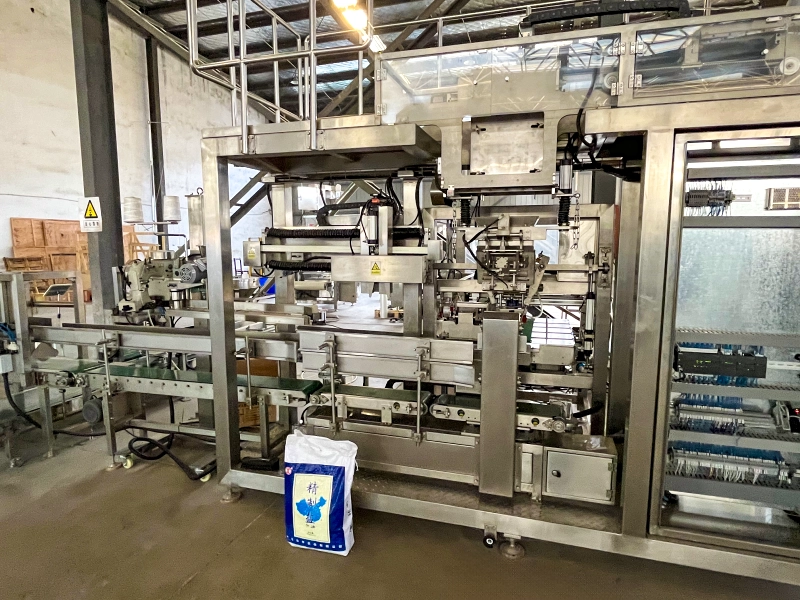
The core automatic bag-in-bag unit, shown here handling refined salt.
From Manual Chaos to Automated Precision: The Engineered Solution
A true export-grade packaging solution must be engineered to master salt’s unique properties. Our Автоматическая вторичная пакетировочная упаковочная машина (automatic secondary bagging machine) is not a generic packer; it’s a purpose-built system designed for the salt industry.
Key Feature 1: The Anti-Corrosion Fortress
We understand the aggressive nature of chloride ions. That’s why all surfaces in direct contact with the salt are constructed from Нержавеющая сталь 316 (316 Stainless Steel). This isn’t just an upgrade; it’s a fundamental design choice that guarantees equipment longevity, minimizes maintenance, and ensures the purity of your product, a critical factor for food-grade salt exports.
Key Feature 2: The “Brick-Making” Magic for Ultimate Stability
To solve the “slippery stack” problem, we don’t just pack the bags; we condition them. Our unique double-deck shaping conveyor gently but firmly presses the puffy 1kg bags, expelling excess air and transforming them into flat, dense “bricks”. This crucial step is the secret to creating perfectly square, interlocking patterns within the master bag.
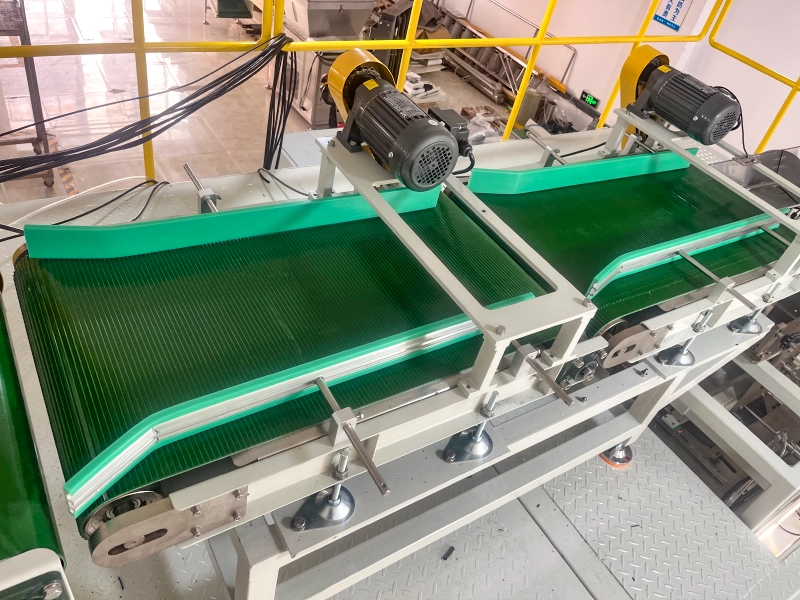
The dual-belt shaping system flattens individual bags for dense, stable packing.
Key Feature 3: Intelligent Grouping and Flawless Sealing
The entire process is orchestrated by a Siemens ПЛК (PLC). The system automatically counts the flattened bags, arranges them into the precise configuration (e.g., 5×5 for a 25kg bag), and gently places them into the automatically opened woven bag. The final step is a strong, consistent industrial stitch from a Newlong sewing head, which provides a seal far superior to manual methods, locking out moisture for the entire journey.
The Tangible ROI: Your Competitive Edge in the Global Market
Investing in a fully automated bag-in-bag system moves your packaging from a cost center to a strategic asset.
1. Ship Product, Not Air: By creating dense, stable master bags, our system allows for higher, more stable palletization. This can increase your pallet load from a typical 750kg to a robust 1.2 tons. For exporters, this is a game-changer: you can ship up to 50% more product in the same container, drastically reducing your cost-per-ton and increasing your profit margins.
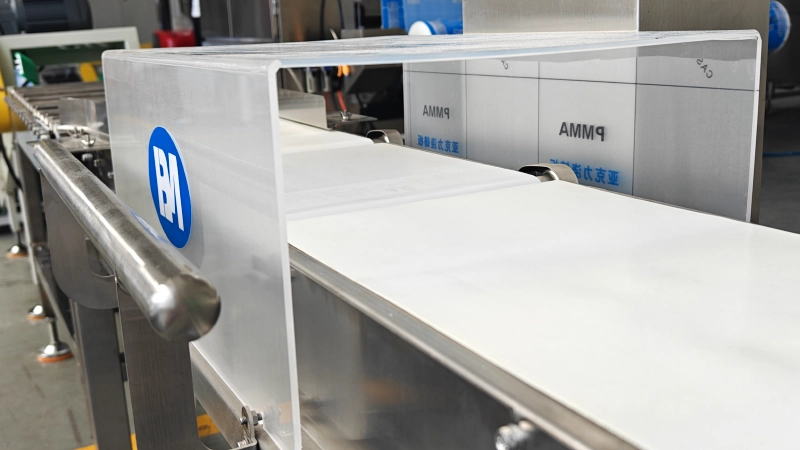
2. Zero Customer Complaints: The combination of integrated checkweighers, optional broken bag filtering, and superior sealing virtually eliminates the risk of underweight products or moisture damage. This protects your brand and ends the costly cycle of handling customer claims and returns.
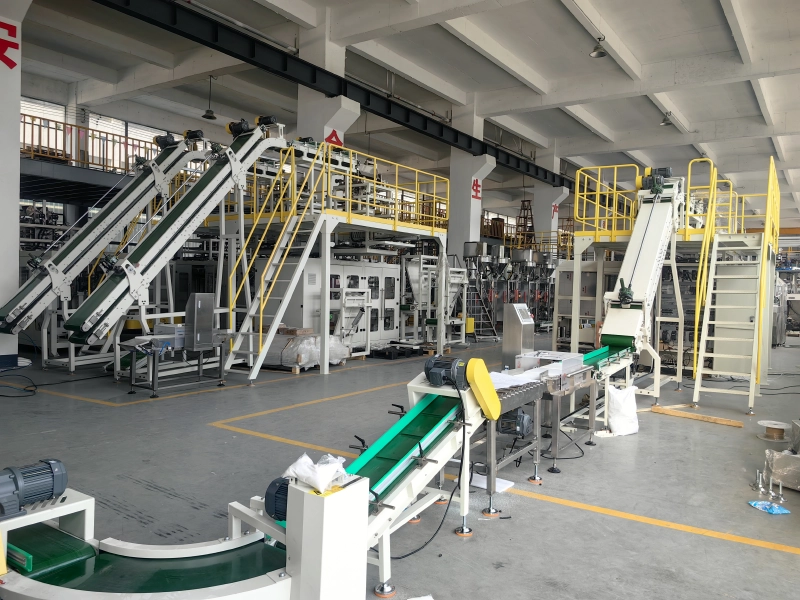
3. Full-Scale Production, Unlocked: The downstream packaging is no longer your bottleneck. A Линия для групповой упаковки (group packaging line) that runs 24/7 allows your upstream milling and drying operations to perform at their full capacity, enabling you to meet peak season demand and capture larger export contracts without hesitation.
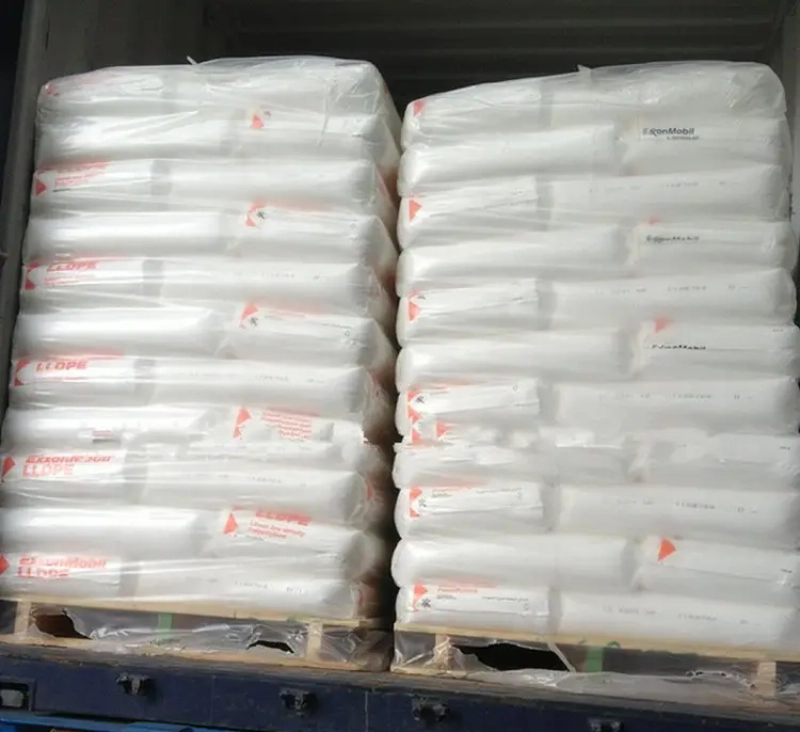
The final result: perfectly stable, container-ready pallets that maximize shipping efficiency.
Часто задаваемые вопросы
1. How does the system handle the highly corrosive nature of salt dust?
The system is specifically designed for corrosive environments. All critical components that come into contact with the salt, including conveyors, hoppers, and framing, are constructed from 316L stainless steel, which offers superior resistance to chloride corrosion compared to standard 304 stainless steel or carbon steel.
2. Our 1kg salt bags are often puffy with air and hard to stack. How do you solve this?
This is a common and critical problem we solve with our integrated double-deck shaping conveyor. After primary packaging, the small bags pass through this unit, which applies gentle, even pressure to expel excess air. This transforms the “puffy” bags into uniform, flat “bricks” that are ideal for dense, stable stacking inside the larger secondary bag.
3. What is the typical Return on Investment (ROI) for a salt packaging line like this?
While the exact ROI depends on local labor costs and production volume, most of our clients see a full return on investment within 18-24 months. The savings come from three main areas: drastic reduction in manual labor (the line can replace 8-10 workers per shift), elimination of product “giveaway” through precise checkweighing, and significantly lower freight costs due to increased pallet density.
4. Can this machine handle different secondary bag sizes, like 25kg and 50kg PP woven bags?
Yes, the system is designed for flexibility. It can be configured to handle various secondary bag sizes and materials, including the most common 25kg and 50kg PP woven bags. Changeovers for different bag counts and arrangement patterns can be easily managed through the Siemens HMI (touch screen interface).
5. We need to comply with export regulations and traceability. How does your system support this?
The line can be fully integrated with upstream and downstream traceability systems. We can incorporate thermal transfer printers (TTO) to print unique codes, production dates, and batch numbers on each primary bag. The PLC system logs all production data, and the final palletized load can be labeled for complete “mine-to-port” traceability, ensuring compliance with international food safety and import standards.
Нужна консультация по упаковочному оборудованию?
СВЯЗАТЬСЯ С НАМИ → English
 Русский
Leave a Reply