
How a Salt Plant Stabilized Secondary Packaging Before Sewing With a BibPU Line
A Russian salt operation needed cleaner sack handoff, tighter alignment, and less rework before sewing. The answer was not a single machine tweak. It was a secondary packaging line built to keep woven bags controlled from filling to stitching, with stainless contact parts, guided compression, and a layout that matches the plant’s daily throughput.
Why the plant needed a different secondary packaging setup
The customer scenario was straightforward: a salt producer had to move from filled product to a stable secondary pack without letting the bag body wander, bulge, or arrive at sewing in an inconsistent shape. In salt packaging, small defects become expensive quickly. If the sack is not squared up before closing, operators compensate by hand, sewing quality drifts, and the line loses rhythm.
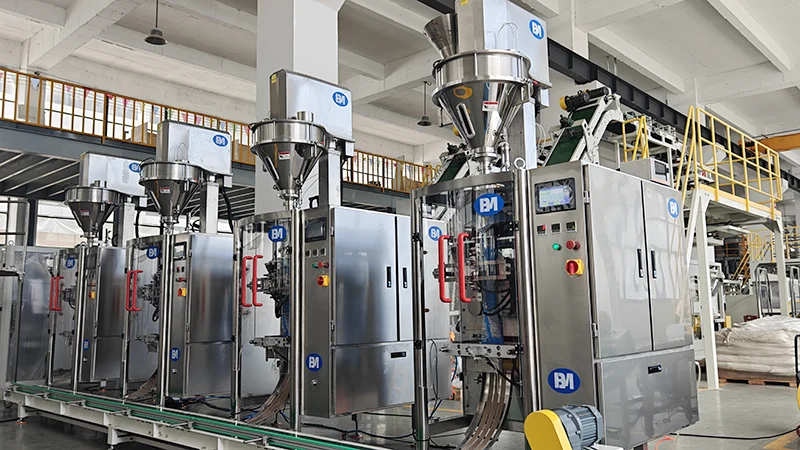
That is where bibpu fits. The line is designed around controlled handoff, compression, and final sealing discipline. The image evidence matters: the machine set is built as a row of vertical form fill seal units with stainless steel hoppers, and the downstream secondary packing stage uses pneumatic clamping and alignment before sewing. This is not decorative automation. It is a process chain meant to keep the package geometry predictable.
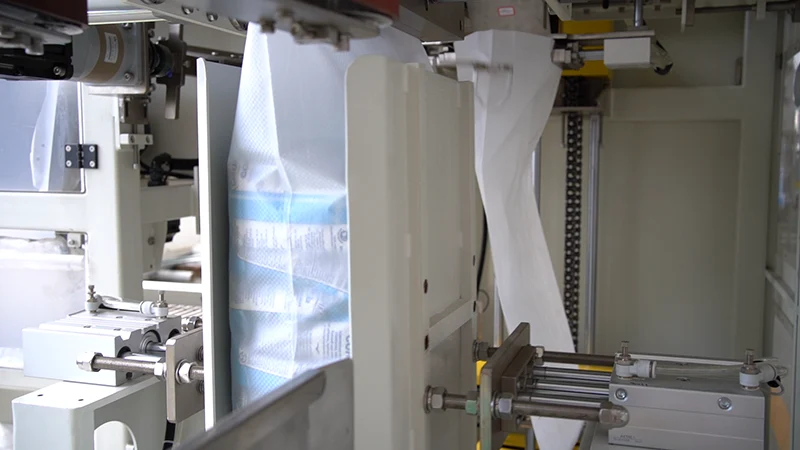
When woven sacks arrive uneven, the sewing head has to handle a moving target. That creates inconsistent top edges, more operator correction, and a higher chance of poor closure quality.
How bibpu addresses the real process problem
The practical reason this line works for a salt plant is control. The line combines stainless steel contact surfaces, guided transfer, and a secondary compression stage so the package is physically prepared before it reaches the sewing point. The image set shows the system from two important angles: the upstream VFFS group with four machines and stainless hoppers, and the downstream pneumatic alignment stage that compresses loaded woven PP sacks before sewing.
For a plant handling refined salt, the value is not just speed. Salt is abrasive, moisture-sensitive, and unforgiving when a bag is misaligned. A line that keeps the product path constrained helps reduce rework, keeps the sack face flatter, and gives the sewing station a repeatable input. That is the difference between simply moving bags and running a dependable secondary packaging process.
bpmpack Инженерный взгляд: Secondary packaging problems usually appear at the handoff stage, not at the filling stage. If the sack body is not stabilized before sewing, every downstream adjustment becomes a human workaround. BibPU is built to remove that instability by combining controlled discharge, compression, and final closure into one repeatable sequence.
What the structure and evidence point to
The visual evidence supports a simple conclusion. First, the line is organized as a multi-machine packaging system rather than a loose collection of stations. Second, the stainless hopper construction supports a cleaner material path. Third, the secondary sack compression stage shows that the process is designed to prepare the bag for sewing, not just to move it along.
For the salt plant, that structure translates into a better final result: cleaner handoff, steadier bag shape, and a more consistent closure sequence. The line is especially relevant when the plant wants to reduce manual correction at the end of the run and keep secondary packaging stable over long shifts.
| Stage | Observed structure | Operational result |
|---|---|---|
| Upstream packaging | Four VFFS machines with stainless steel hoppers | Stable filling and a cleaner start point |
| Secondary handling | Pneumatic compression and alignment before sewing | Flatter bag body and more repeatable closure |
| End result | Controlled handoff into the sewing station | Less correction, steadier output, better line rhythm |
Need a secondary packaging line built for salt bags?
If your plant has the same issue, bibpu is the kind of setup worth reviewing: controlled handoff, compression before sewing, and a structure built for repeatable packaging work in a real production environment.
Talk to bpmpack English
 Русский