
What Types of Cement Bag Packaging Are Used on Modern Packing Lines
A working look at the bag formats cement producers actually run today — from 25 kg valve sacks to big bags — and how a valve bag packing line fits those formats without choking on dust, weight drift, or unstable pallets.
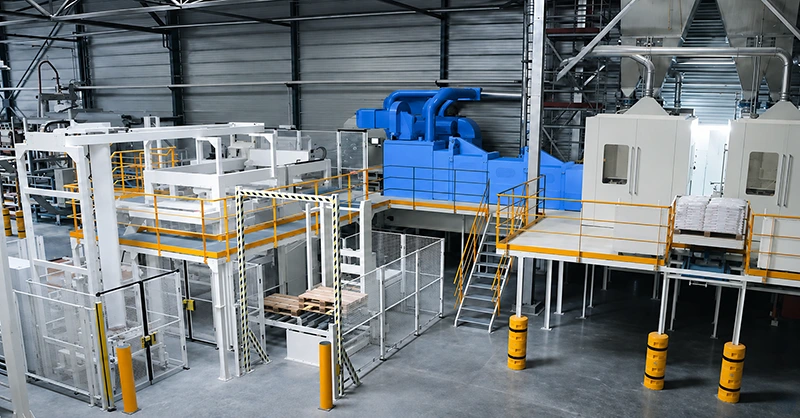
The Cement Bag Formats Buyers Actually Compare
Most cement and dry-mix plants evaluate four bag formats side by side: 25 kg valve bags, 25–50 kg open-mouth bags, 1–2 ton FIBC / jumbo bulk bags, and small retail packs under 10 kg. Among them, the 25 kg paper or laminated woven valve bag is the workhorse for finished cement, dry-mix mortar, and most fine powders because it matches a standard pallet pattern (50 bags per layer on a typical EUR or EPAL pallet), survives international shipping on a shrink-wrapped or stretch-hooded pallet, and feeds cleanly into a closed-filling interface. Open-mouth bags remain common for fly ash, slag, or plants that already own stitching lines, but the format loses ground wherever dust control and operator exposure matter.
Beyond the format itself, buyers compare how the bag is sealed. Valve bags self-seal under the pressure of the material during filling, so the seal is created inside the bag at the filling nozzle. Open-mouth bags need a separate stitching, gluing, or heat-sealing station after the bag leaves the filler. That single difference is what pushes dust-controlled cement and dry-mix plants toward valve bag lines: they eliminate the open sealing station and the dust it leaks. It is also why the question “what types of cement bag packaging are there in bags” almost always comes back to a valve-bag-versus-open-mouth comparison in real procurement meetings.
Many plants still run an open-mouth line with manual bag hanging, a hand-held stitching head, and a forklift-driven palletizer. The list of daily failures repeats: dust escapes at the open spout before sealing, operators’ hands touch the filled spout, filled bags sit too long on the conveyor because the palletizer is busy, and any bag with trapped air bulges into the next layer and pushes the pallet out of square.
How a Valve Bag Packing Line Solves These Failure Modes
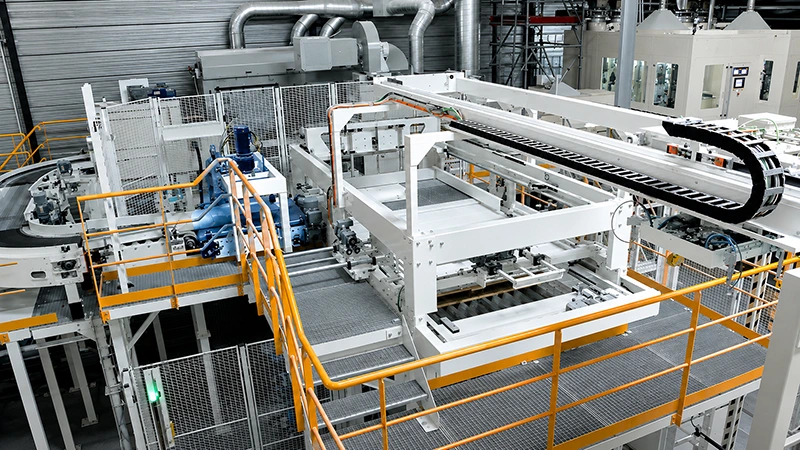
An automatic valve bag line replaces the open spout with a closed filling interface. On BPM’s VPLINE, the bag is slid onto an inflatable valve nozzle, material is fed through the inner channel while displaced air returns through the outer channel, the nozzle deflates, and a 20–40 kHz ultrasonic head seals the valve area while the bag is still on the nozzle. Because the bag never opens to room air during filling, dust stays inside the line and connects to the dust extraction duct instead of escaping to the operator station. The dual pneumatic grippers shown on the bagging head remove the manual bag-handling step that usually causes inconsistent bag placement and torn valve corners.
After ultrasonic sealing, the bag is dropped onto a checkweigher with a reject arm and continues through a metal detector, so an underweight or contaminated bag never reaches the palletizer. The remaining trapped air is removed by a negative-pressure shaping station before the bag goes to the robotic palletizer, which is what keeps the pallet square and prevents the leaning-stack failures seen on hand-stacked pallets. On VPLINE, the same controller sequence runs the entire line, which means a single HMI screen can show bag count, weight deviation, and pallet pattern at a glance instead of forcing the operator to walk between three or four isolated cabinets.
VPLINE design note: the line is delivered as one continuous action chain from mobile bag magazine loading to stretch-hood wrapping — not as a stack of stand-alone machines bridged by hand. That delivery model is the source of most dust and stack-failure fixes in real cement plants.
Spec Range and What to Confirm Before You Order
Spec ranges for a 25 kg valve bag cement line look like this on BPM’s VPLINE data sheet: bag weight 10–50 kg with 25 kg as the typical cement format, throughput 5–12 bags per minute depending on bulk density and compressed-air stability, weighing accuracy of ±1–2‰ as stated by the manufacturer with the actual test condition to be confirmed against your material, ultrasonic sealing at 20–40 kHz, material contact parts in 304 stainless steel with the rest in structural carbon steel, air supply at 0.5–0.7 MPa, and packing-unit power at AC 380 V, 50 Hz, around 15 kW. The plant footprint is around 15–20 m straight-line length by 4–6 m width with about 4.5 m or more of clear ceiling height — those are planning references from real VPLINE layouts, not fixed dimensions.
The table below maps each cement bag format to what it asks of the line and where it sits inside the VPLINE scope. Read it as a procurement filter: if your product is in the “primary” row, you are inside the standard scope; if it is in the “adapted” row, expect additional engineering; if it is in the “outside scope” rows, the right equipment is a different BPM line, not a re-configured VPLINE.
| Bag format | Typical weight | Sealing method | Best fit on VPLINE |
|---|---|---|---|
| 25 kg valve bag (paper or laminated woven) | 25 kg | Self-seal at valve under product pressure + 20–40 kHz ultrasonic | Primary application — full line ready |
| 25–50 kg open-mouth bag (paper or PE) | 25–50 kg | Stitch / heat-seal after filling | Possible on adapted line with separate stitching station — not the primary target |
| 1–2 t FIBC / jumbo bulk bag | 500–2000 kg | Top tie / filling spout | Outside VPLINE scope — covered by FIBC filling lines |
| Small retail pack (under 10 kg) | 5–10 kg | Heat-seal / stitch | Outside VPLINE scope — covered by VFFS / small-pack lines |
Need a Cement Bagging Layout?
Send us your cement grade, target bag weight, daily tonnage, plant ceiling height, and compressed-air capacity — we’ll return a VPLINE layout, throughput estimate, and a list of items you’ll need to confirm on-site against your bag supplier.
Запросить коммерческое предложение English
 Русский