
Cement M400 50 kg Valve-Bag Packing Line: Cleaner Filling and More Stable Pallet Dispatch
For a cement plant searching for a Cement M400 50 kg packing machine, the practical question is not simply which bagging machine to buy. The line must match the cement’s flow behaviour, the valve-bag construction, the available air supply and the palletizing layout. VPLINE is an automatic valve bag packing line for dry powders and suitable fine particles, linking bag loading, enclosed filling, ultrasonic valve sealing, inspection, bag shaping, robotic palletizing and stretch-hood protection.
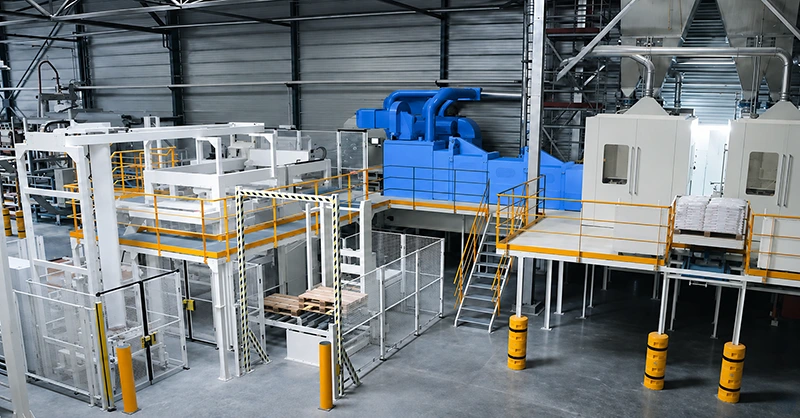
Why an open-bag cement packing process becomes a production constraint
A plant filling Cement M400 into 50 kg bags often starts with manual or semi-automatic bag filling: an operator positions an open sack, a dosing point fills it, and a sewing machine closes the top. This arrangement can work at low volume, but it leaves several interfaces dependent on people. Bag presentation varies, powder can escape while the sack is being held open, and the sewing step adds a separate handling movement.
The same weakness appears after filling. A bag with trapped air is difficult to place into a compact interlocked pallet pattern. Manual movement and stacking make the result sensitive to operator fatigue, while a missing weight check or metal inspection point allows an abnormal bag to continue toward the finished-goods warehouse or dispatch area. Replacing one machine without connecting these stages does not create a complete automatic cement packing line.
A 50 kg target must be confirmed against bulk density, flowability, valve dimensions, bag venting and the available receiving height. The project data lists 10–50 kg as a possible range, while 25 kg is the typical video demonstration. Final speed and accuracy require a material and bag test before a production commitment.
How VPLINE adapts the filling and sealing interface
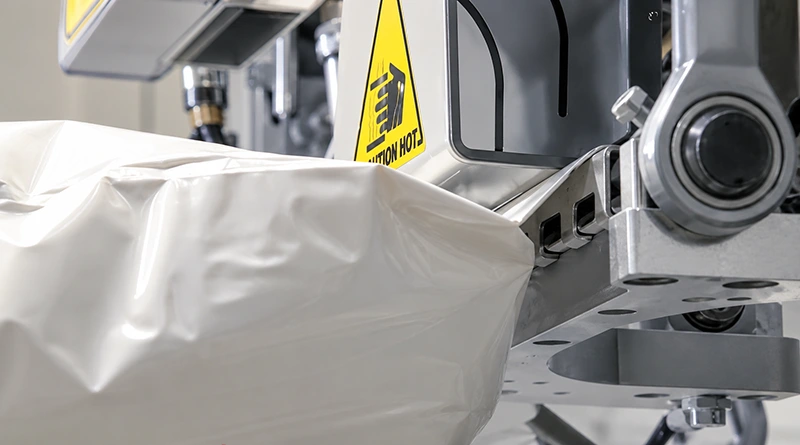
VPLINE uses a pre-made valve bag. The automatic bag loading system takes a sack from the bag magazine, grips and opens it, then positions the valve over an expansion-type filling nozzle. The nozzle creates a controlled filling interface with a larger product passage and a smaller air-return path. When the powder and bag are correctly matched, this enclosed arrangement supports low-dust dry-mix packing by limiting the open exposure seen in a conventional open-bag station.
After filling, the valve area is sealed by ultrasonic equipment. The documented operating principle is vibration in the 20–40 kHz range, generating interfacial friction heat. This is not a universal promise for every bag: the laminate or coated layer, valve tolerance and residual powder must be tested to confirm the ultrasonic sealing window. That boundary is important when specifying cement bag packing equipment.
Engineering point: the correct selection is a pneumatic valve-bag packing line, not a VFFS, Doypack or Flow Pack machine. Those systems form or fill different package types. VPLINE is built around automatic valve-bag filling and can be integrated with upstream silos or feeders and downstream warehouse logistics.
Inspection, negative-pressure shaping and pallet protection in one flow
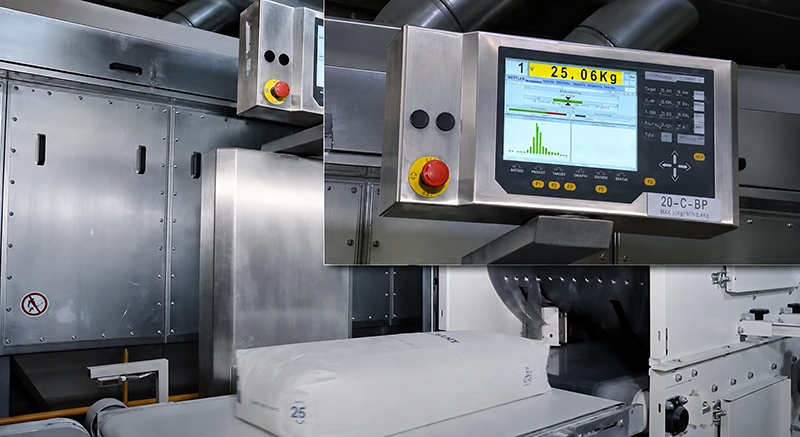
The line continues beyond the filling nozzle. A conveyor transfers the filled sack through online checkweighing and metal detection before the palletizing stage. A checkweigher with reject handling provides a defined quality gate for weight deviations; the metal detector provides a separate foreign-metal control point. These stations do not replace calibration or the plant’s quality plan, but they prevent inspection from depending only on a final manual check.
Before robotic palletizing, negative-pressure shaping removes excess air and helps make the bag profile more uniform. The robot can then build an interlocked pallet pattern—shown in the process description as three bags per layer, with orientation adjusted by rotation. Layer count and pallet dimensions remain project values. An automatic pallet magazine, roller conveyors, divider-sheet handling where required, and final stretch-hood or shrink protection connect the finished stack to the packing warehouse and dispatch route.
| Project item | Documented VPLINE reference | What must be confirmed for Cement M400 |
|---|---|---|
| Bag format | Valve bags; 10–50 kg listed, 25 kg typical demonstration | 50 kg bag dimensions, valve tolerance, venting and seal layer |
| Filling method | Expansion nozzle with product and air-return paths | Powder flowability, bulk density and dust behaviour |
| Operating references | 5–12 bags/min; ±1–2‰ listed without test conditions | Acceptance test method, target speed and accuracy |
| Utilities | 0.5–0.7 MPa air; AC 380 V, 50 Hz, 15 kW packing unit | Stable dynamic pressure, air consumption and site connection |
| End of line | Checkweigher, metal detector, negative shaping, robot palletizer and stretch hood | Pallet size, layer plan, clear height and warehouse interface |
Specify the 50 kg cement line from the real plant conditions
Send the Cement M400 bulk density and flow data, 50 kg valve-bag drawings, required bags per minute, air and power conditions, pallet pattern, available clear height and dust-extraction interface. BPM can then assess the automatic line for cement packing, define the filling and ultrasonic sealing tests, and configure the inspection, palletizing and stretch-hood sections around the actual warehouse route.
Discuss your valve-bag packing line English
 Русский