
How an FFS Packaging Line Keeps Bag Output, Outfeed, and Pallet Flow Steadier in a Busy Workshop
When a plant needs bagging speed, stable transfer, and less manual handling in the same footprint, the layout matters as much as the machine itself. This article looks at what an FFS line does on the floor and why the outfeed section usually decides whether the line feels calm or congested.
What the line has to do before anyone notices the machine
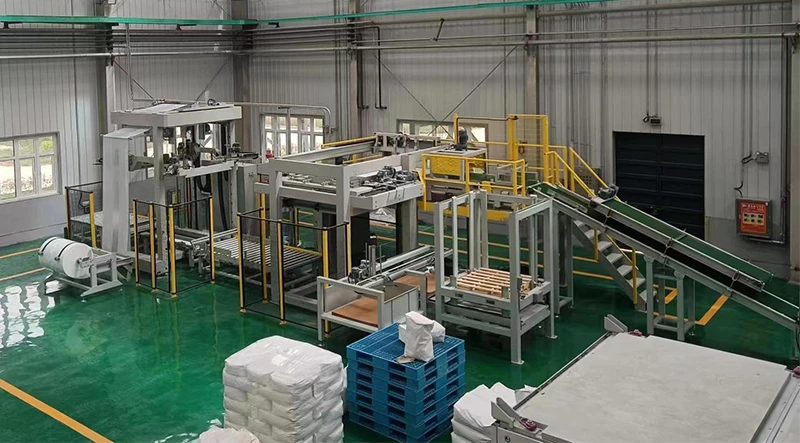
An FFS line does more than form, fill, and seal bags. In daily production it has to accept product, keep the bag path controlled, move the finished bag without a hard drop, and leave enough room for operators to inspect the line without fighting for space. That is why the workshop view matters. You can see the platform, the guard rails, the conveyor path, and the bag output area in one frame. If those parts are arranged badly, the line still runs, but the workshop feels cramped and the transfer points start creating their own problems.
On bpmpack FFSline projects, the useful number is not only bagging speed. The line is built for stable flow. The product brief puts the line at up to 1200 bags per hour, with weighing accuracy around ±0.1–0.2%, and a compact installation footprint of roughly 5.5 × 5 × 6 meters. Those figures matter because a plant rarely buys a bagging machine in isolation. It buys a flow that must sit between upstream supply and downstream palletizing without forcing the whole workshop to reorganize around it.
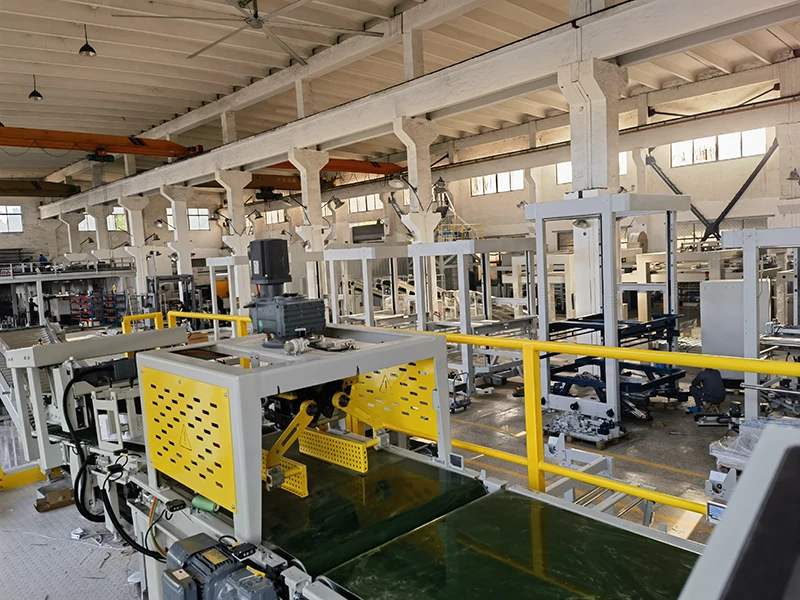
Most bottlenecks show up after the bag is already made. The discharge point is too sharp, the conveyor path is too short, or the next unit sits too close to the operator aisle. Then the line speeds up on paper but slows down in practice.
Why the outfeed and platform section decide the real line rhythm
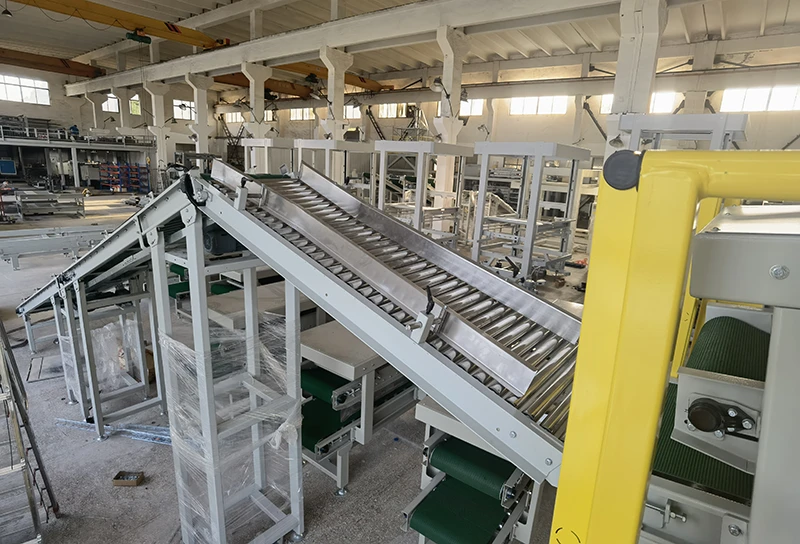
The inclined conveyor and elevated platform are not decorative. They let the line move bags into the next stage with less handling and less drop shock. That helps when the product is dusty, fragile, or simply expensive to rework. In a salt, sugar, fertilizer, grain, or granular product plant, a clean transfer is worth more than a faster machine that drops bags hard and scatters material around the floor.
The same section also makes maintenance easier. Operators can reach the control zone, inspect the bag path, and deal with minor adjustments without standing in the middle of the transport lane. That is where the line saves time in a way that shows up every shift. If the outfeed is controlled, the palletizing zone stays calmer. If the outfeed is messy, the whole line starts leaking time through small interruptions.
Practical reading: if the workshop needs less manual bag lifting, better transfer stability, and tighter integration with palletizing, the line should be judged by its discharge geometry, platform access, and downstream spacing, not only by the nominal bagging rate.
What to check before you match an FFS line to a real plant
The first check is product behavior. Free-flowing granules, powdery materials, and blends do not need the same discharge setup. The second check is bag size and downstream handling. A 25 kg or 50 kg bag may sound simple, but the line has to keep weighing, sealing, and transfer stable at speed. The third check is the plant itself. If the workshop is tight, a compact layout saves more trouble than squeezing in one more station.
bpmpack FFSline is designed around those checks. It supports a continuous bagging workflow, can be paired with optional metal detection and checkweighing, and can be configured for film-based packing that lowers pack material cost compared with pre-made bags. The practical value is straightforward: less manual bag handling, less wasted motion, and a cleaner path from fill to pallet.
| Item | What it means on the floor |
|---|---|
| Bagging speed | Up to 1200 bags per hour for stable line output |
| Weighing accuracy | About ±0.1–0.2% to reduce rework and giveaway |
| Installation size | Compact footprint around 5.5 × 5 × 6 m |
| Outfeed control | Inclined conveyor and platform help keep transfer calm |
| Optional protection | Metal detector, checkweigher, gas flush, and explosion-proof options |
| Packaging material | Roll film can reduce pack cost versus pre-made bags |
Need a steadier bagging flow, not just a faster machine?
Start with the product, the bag size, and the downstream layout. Then match the FFS line to the workshop, not the other way around.
Связаться с BPMPACK English
 Русский