
How a Russian Polymer Warehouse Standardized Bagging and Dispatch with an FFS Line
When a warehouse must move polymer bags from filling to transfer and dispatch without creating bottlenecks, the line layout matters as much as the machine itself. This project shows how an FFS line can connect bag forming, filling, safe access, and end-of-line palletizing into one orderly flow.
What the site needed before the upgrade
The customer’s situation was typical for a busy polymer storage and shipping site: bags had to be formed, filled, moved, and prepared for dispatch with less manual handling and fewer interruptions. The old arrangement created the usual friction points. Bag transfers were too dependent on operators. Access around the machine was cramped. The end of the line lacked a clean visual structure, so the warehouse team had to work around the flow instead of with it.
An FFS line is a better fit when the goal is not only to package material, but to keep the entire handling chain readable and controlled. The line must support stable filling, clear movement paths, safe maintenance access, and a visible discharge area that can connect to downstream palletizing or temporary staging.
Manual handoffs slow dispatch. Exposed movement zones make access awkward. A mixed machine layout makes it hard for operators to understand where filling ends and downstream handling begins. In a polymer warehouse, those issues quickly turn into uneven output and avoidable labor pressure.
Why the FFS layout fits this polymer warehouse use case
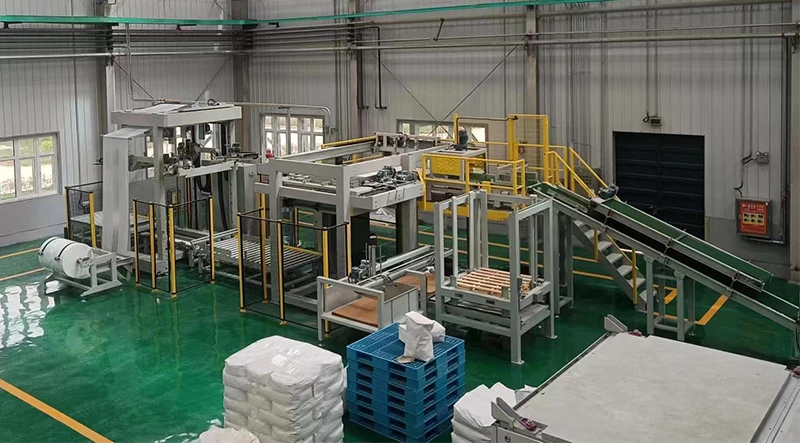
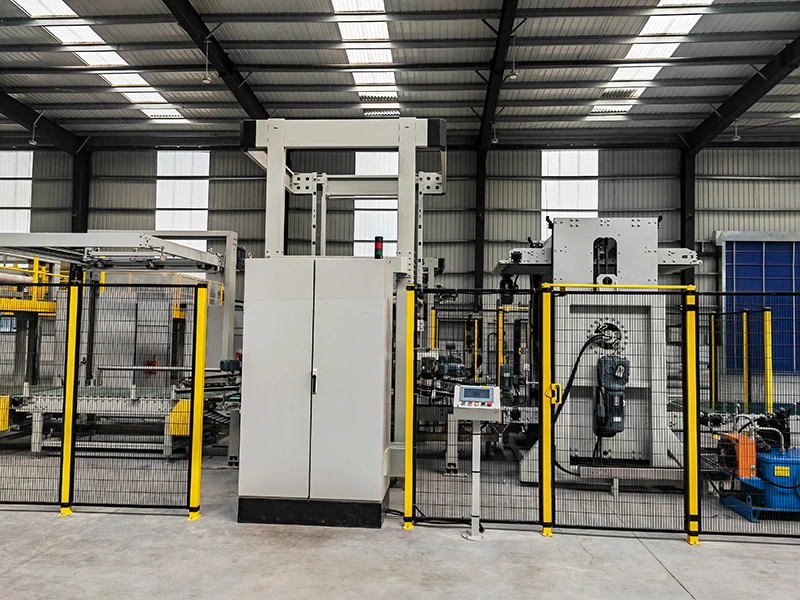
The photo set makes the match easy to see. The main frame is built as a defined machine body, the service platform lifts operators out of the active zone, and the safety rails keep access organized. That matters because bagging lines fail in the margins: poor access, unclear walkways, and uncontrolled transfer points create more trouble than the filling process itself.
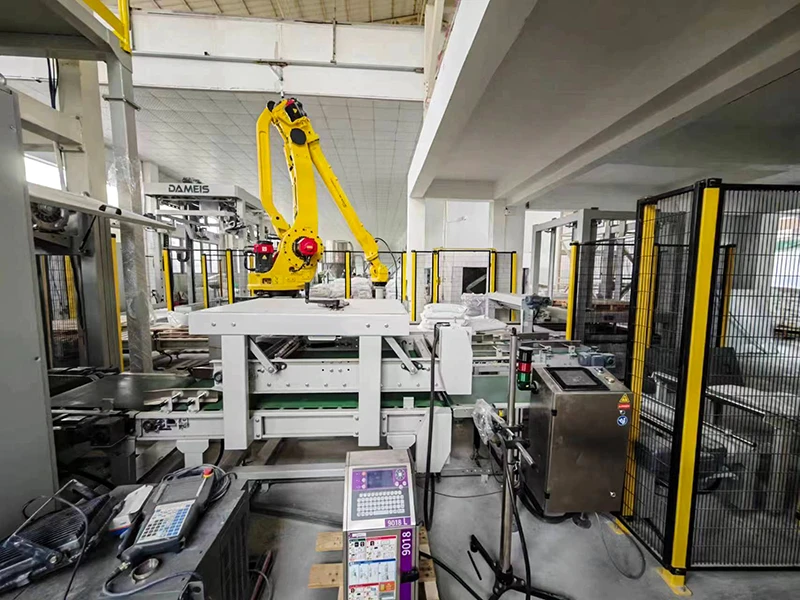
The same logic continues at the end of the line. The conveyor path and robot palletizing station create a cleaner handoff from packaged bag to dispatch preparation. Instead of relying on ad hoc movement, the warehouse gets a visible sequence: fill, release, transport, stack. That is the practical reason an FFS line performs well in polymer handling environments.
Field note: In bagging projects like this, the value is not only throughput. It is the combination of controlled material flow, safer operator access, and a line structure that makes dispatch easier to manage every shift.
Structure, access, and discharge: the evidence in the images
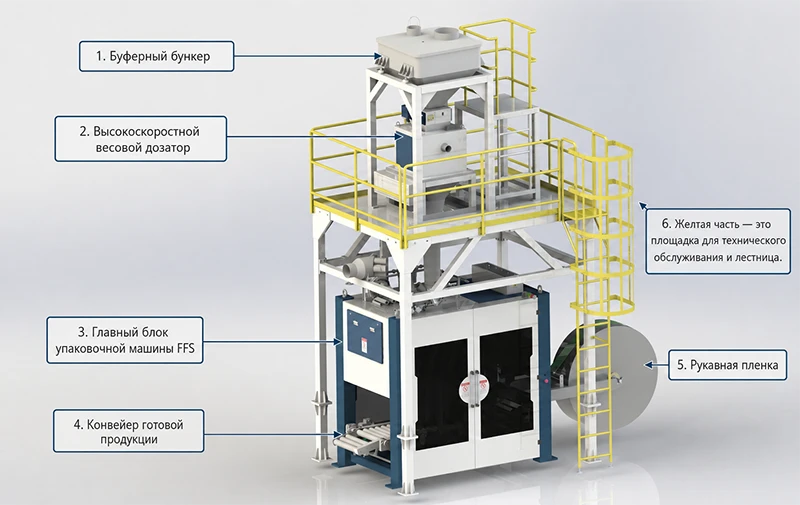
The annotated diagram shows the parts that matter most for a warehouse team: process modules, the machine frame, the control area, film handling, and service points. The workshop images then confirm how those modules behave in real space. You can see the elevated platform, the yellow protection rails, and the compact arrangement of the line inside a production floor.
The palletizing image adds the final proof point. It shows that the line does not stop at filling. It continues into downstream handling, where the finished bags can move into a more predictable dispatch rhythm. That is exactly what a polymer warehouse needs when labor consistency and output regularity are both important.
What changed after the line was organized this way
Once the FFS line was arranged around controlled bagging, clearer transfer points, and a visible end-of-line stack area, the warehouse could treat packaging as a continuous process instead of a series of disconnected tasks. That typically means steadier bag output, fewer awkward manual moves, and better operator confidence around the machine.
For polymer storage and dispatch, that is the real result. The warehouse does not just get a machine. It gets a working layout that supports the daily rhythm of filling, transport, and shipping preparation. The line becomes easier to understand, easier to supervise, and easier to keep steady over time.
| Observed need | Изобразительные доказательства | Practical result |
|---|---|---|
| Cleaner bagging flow | FFS main machine and workshop layout | More orderly filling and transfer |
| Safer access | Service platform and safety rails | Better maintenance and operator movement |
| Clear process logic | Annotated module diagram | Easier understanding of each function |
| Steadier dispatch | Robot palletizing station | More predictable end-of-line handling |
Planning a polymer bagging line with safer access and steadier dispatch?
If you need an FFS line for polymer bags, we can help you match the machine layout to your warehouse flow, access requirements, and downstream handling needs.
Discuss your line layout English
 Русский