
Как один сибирский солерудник собрал отгрузку в ровный поток
When fasovka of salt is already stable, the weak point often appears not in the doser and not on the seam, but at the handoff to dispatch. Bags need to be gathered, held, aligned, and moved to storage or transport packaging so they do not spread, leak dust, or tear during manual transfer. At one Siberian salt enterprise, this exact section had become the point of loss.
One control loop keeps the line in one mode
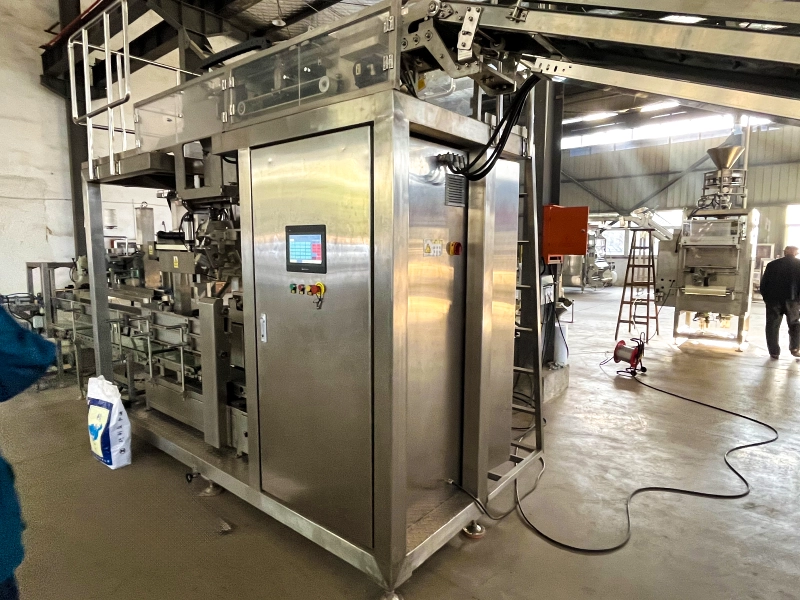
For a salt plant, this is not a decorative detail. When start, reset, and speed are gathered into one interface, the line stops behaving like a collection of separate machines. The operator no longer runs between different control points and gets a clear view of the whole path. On this kind of section, it is especially important to see a stop, a warning, or a manual-mode change quickly, because salt does not forgive long pauses: dust, humidity, and a continuous bag flow can turn disorder into the norm if control is fragmented.
What happens inside the machine once the bag enters the tract
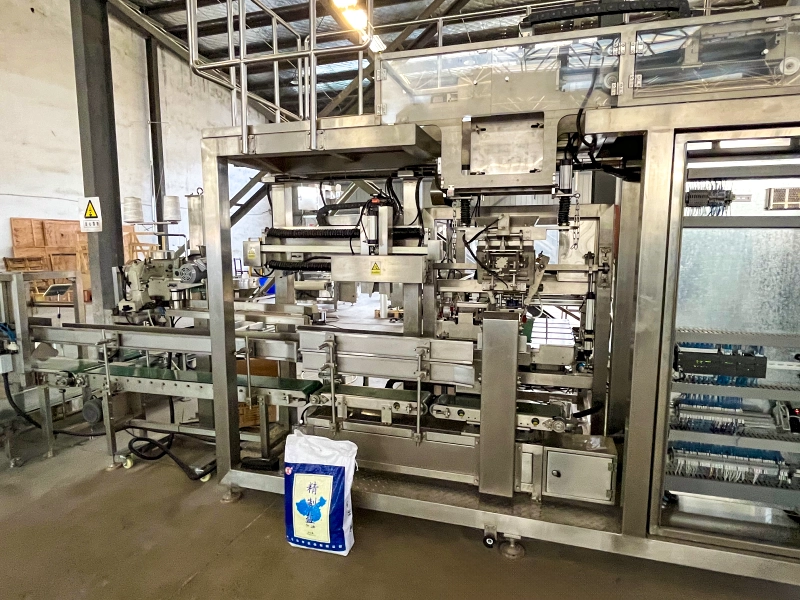
From the outside, secondary packaging looks like a simple sequence: feed, position, load, close. But inside, the result is decided by guides, cylinders, and motion geometry. That is where the bag must move without a jerk, without skew, and without unnecessary manual contact. The enclosed body and service doors matter not only for safety. They keep the process repeatable, and repeatability in salt production means fewer jams, less spillage, and fewer unplanned stops.
How loose packets become one transport unit
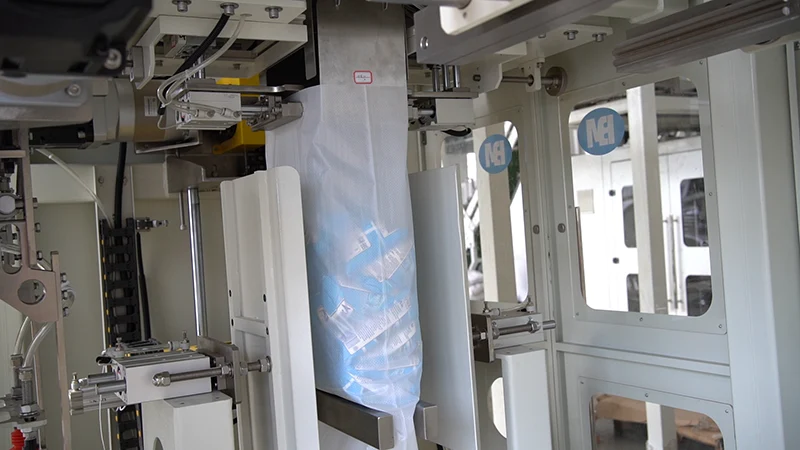
This is where secondary packaging delivers its main value. Finished packs should not travel to the warehouse one by one. They are gathered into one outer package that is easy to move, stack, and palletize. For the plant, that means dispatch becomes manageable: instead of many individual units, there is one transport form that is easier for the forklift driver, the warehouse zone, and logistics to handle. The smoother this transfer, the lower the risk of damaging the packaging and the more stable the whole lot looks.
Why the bag closure should never be left to manual routine
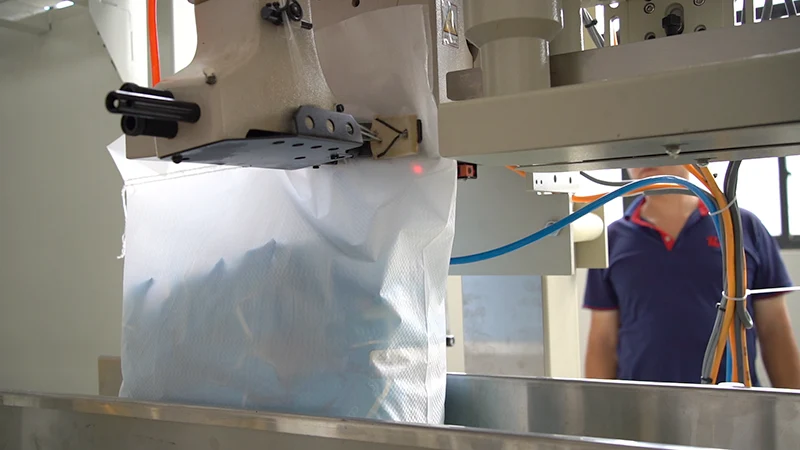
Salt is not a “light” product just because it is familiar and free-flowing. In real dispatch, it quickly shows every weak point: if the seam is unstable, the sack opens on a turn, on impact with the truck side, or while it is stacked. That is why the sewing head in the line is not an accessory, but part of process discipline. A machine seam gives a consistent result that does not depend on operator fatigue, line tempo, or a habit of tightening the bag “however it works.”
What changes for the salt plant in the end
When the whole chain is assembled properly, secondary packaging stops being a separate “last operation” and becomes a continuation of production. Fewer manual touches, less spillage, less damage to the outer package, a cleaner stack, a calmer warehouse, and faster dispatch. For a Siberian salt enterprise, this matters even more: climate, dust, and long logistics always test the package before sales even close the paperwork.
If the task is not just to pack salt but to build a stable transport unit from finished packs, BPM configures the secondary packaging route around the actual bag format, line speed, and warehouse flow. In such a setup, the winner is not one machine but the whole chain: control, internal mechanics, loading, and reliable bag closure.
Нужна консультация по упаковочному оборудованию?
СВЯЗАТЬСЯ С НАМИ → English
 Русский