
25 kg Powder Bagging Line: Hygienic Stainless Steel Design
A hygienic 25 kg powder bagging line is the last surface a 25 kg bag of milk powder, flour, starch, or food-grade powder touches before palletizing. Open guarding, dust drift, and unstable transfer are where the line quietly turns a daily audit into a corrective action. Below we show how Mipline’s enclosed stainless steel bagging station, blue inspection windows, and guided transfer earn their cost on a food-grade floor — and what to verify before you sign the PO.
Why the Bagging Station Is the Workhorse of the Line
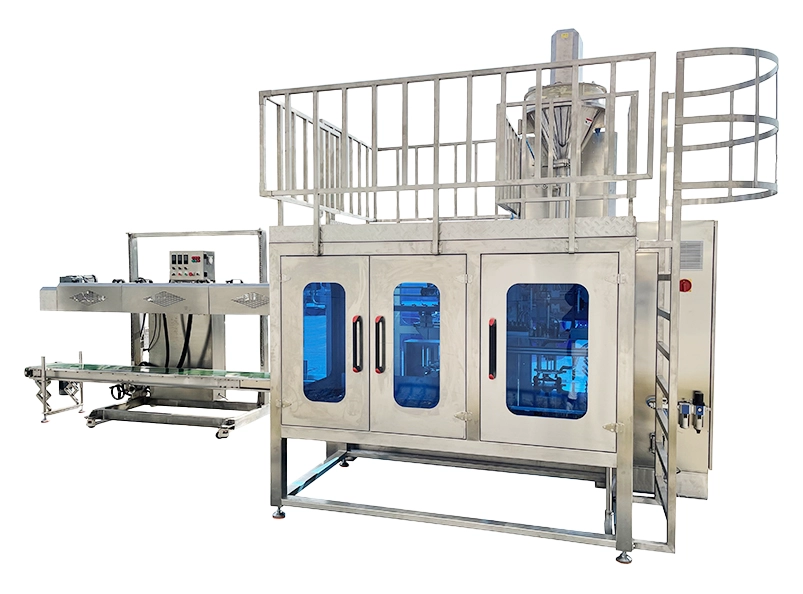
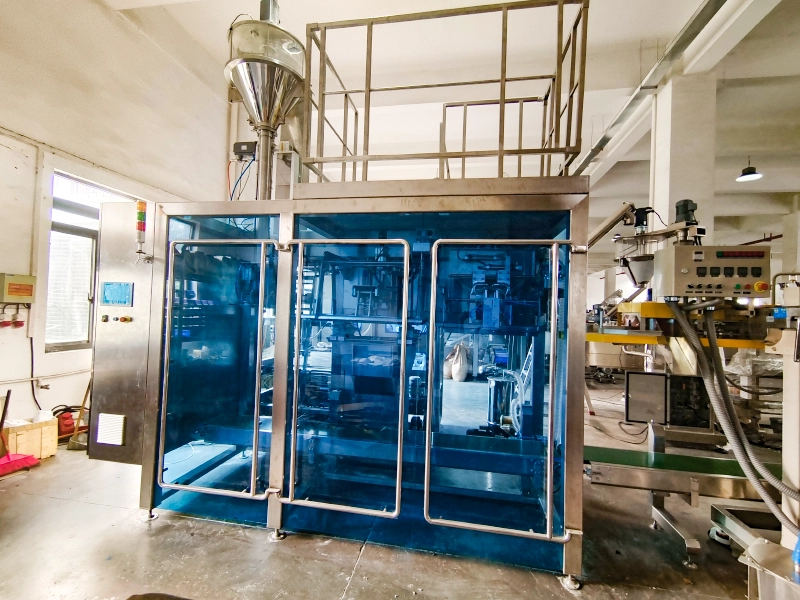
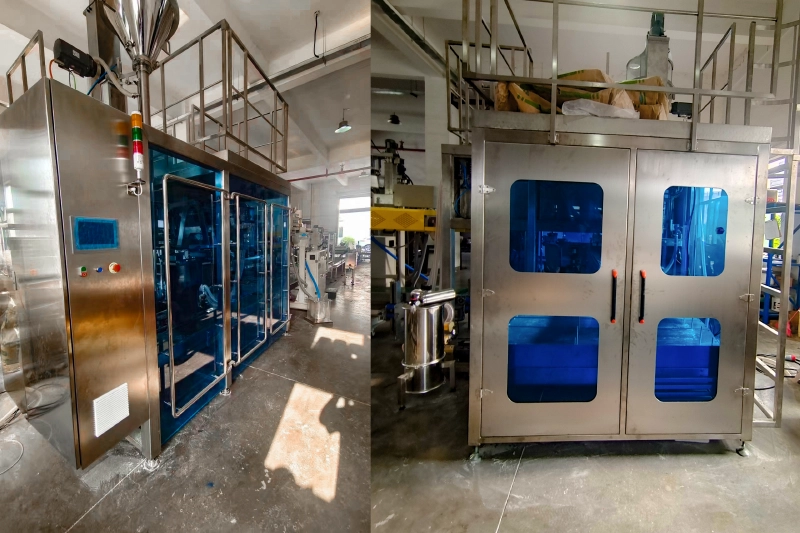
Most problems on a 25 kg powder bagging line start at the bagging station, not at the filler. That station feeds the empty bag from a magazine, opens the mouth with a vacuum pickup, grips the bag on a clamp, and uses a bottom-up filling head that follows the powder as the bag rises. If any of those four steps slips, the bag mouth arrives skewed at the next station and operators end up straightening it by hand. Mipline builds the bagging station as a single welded stainless steel frame, with a bag magazine conveyor on the infeed side, three blue inspection windows on the operator face, a top access platform with safety railing, and a stainless steel control cabinet on the side. The magazine, pickup, clamp, and filling head sit on one rigid frame so the bag mouth stays aligned from the moment the empty bag is opened to the moment it is released onto the transfer conveyor.
The reference layout sizes the station so a 25 kg kraft paper bag clears the magazine rails with about 30 mm of slack on each side, and the clamp pad pressure is tuned for 110–140 g/m² paper-plastic composite bags without crushing the seam. That geometry is what lets the line run at 1.5–2 bags per minute on a dairy powder line without the operator touching the bag mouth between the clamp and the transfer conveyor.
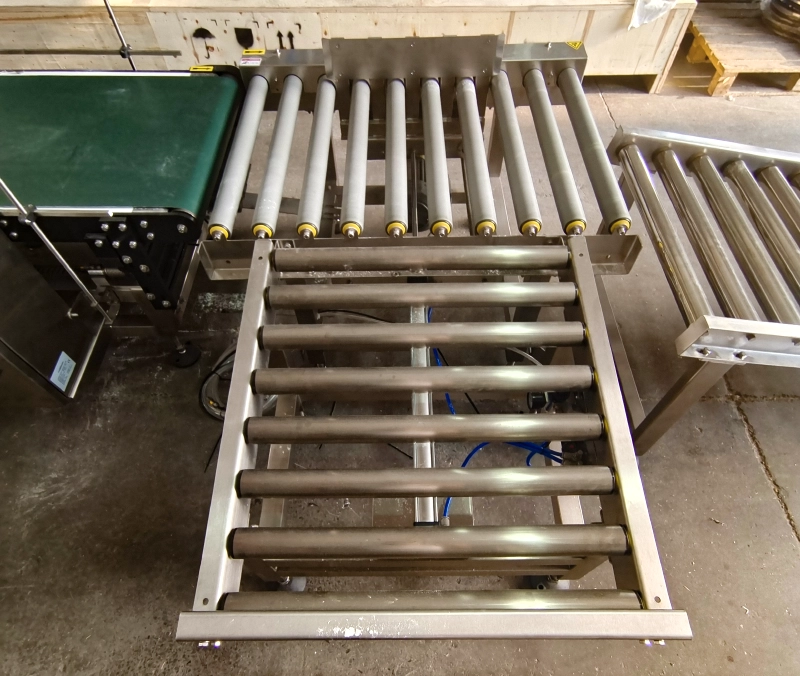
On most generic packing lines, the bag mouth leaves the clamp and crosses about one meter of open belt before the next station grabs it. In that meter the bag can twist, lean, or sag — and the operator is the one who straightens it. Mipline closes that meter with a guided roller and twin-belt transfer so the bag arrives at the sewing head square, not skewed.
Stainless Steel and Food-Grade Compliance
On a dairy or food powder floor, the bagging station, hoppers, sealing head, and every conveyor in the fill path sit inside the hygiene zone. The Mipline 25 kg powder bagging line uses SUS304 stainless steel on the bagging station frame, control cabinet, and the enclosures around the filler, with a 2B or polished finish on product-contact panels. Side guards are polycarbonate with a blue tint that reduces glare under HMI lighting. The control cabinet, bag magazine rails, clamp arms, filling head nozzle, and the inner surfaces of the discharge chute are all reachable for wipe-down cleaning through the inspection windows and access doors. There is no paint to chip, no carbon steel to rust, and no exposed wiring to trap powder.
The pneumatic manifold, the vacuum line, and the cable routing all sit on the non-contact side of the frame, and the emergency-stop loop runs through a stainless junction box on each station. That means the line can be hosed down for wet cleaning on a food plant floor without tripping ground faults or coating the room in rust dust.
Engineering note: Stainless steel is not a finish on this line — it is the structural material. The same welded frame that holds the bag magazine in alignment also carries the inspection windows and the control cabinet, so a 25 kg bag of powder cannot deflect the bag mouth by flexing the frame.
What to Verify Before You Buy a 25 kg Powder Bagging Line
A food-grade 25 kg powder bagging line is a long-term purchase. The spec sheet can list 1.5–2 bags per minute, 5 kW of main power, 5.5 m³/h of air, and a SUS304 frame — those numbers are easy to match across vendors. The harder questions are about the bagging station itself, the inspection windows, and the discharge transfer. Below is the short list a dairy or food powder engineering team should run through before a 25 kg powder bagging line is approved.
| Verification Point | What to Check | Mipline Reference Answer |
|---|---|---|
| Bagging station material and finish | SUS304 frame, 2B or polished contact panels, no paint on product-contact surfaces | Welded SUS304 frame, polished product-contact panels, blue polycarbonate guarding |
| Bag magazine geometry | Clearance for 25 kg kraft and paper-plastic bags, clamp pressure tuned to bag weight | 30 mm magazine clearance, clamp pad pressure tuned for 110–140 g/m² composite bags |
| Operator visibility | Inspection windows at eye height covering pickup, opening, fill, and release | Three blue inspection windows on the operator face, plus a top access platform with safety railing |
| Transfer between bagging and sealing | Roller and twin-belt transfer with side guides, no open belt gaps in the hygiene zone | Stainless steel roller conveyor with adjustable guides, then twin-belt transfer with central housing |
A vendor can ship a 25 kg powder bagging line that meets the headline throughput and still fail the audit because the bagging station frame flexed, the inspection windows were too small, or the discharge conveyor left an open belt gap. Confirming the four points above — frame and finish, magazine geometry, operator visibility, and the transfer between bagging and sealing — covers the most common line-level complaints we see on dairy, flour, and starch projects.
Real-World Use: 25 kg Kraft Paper Milk Powder Bags
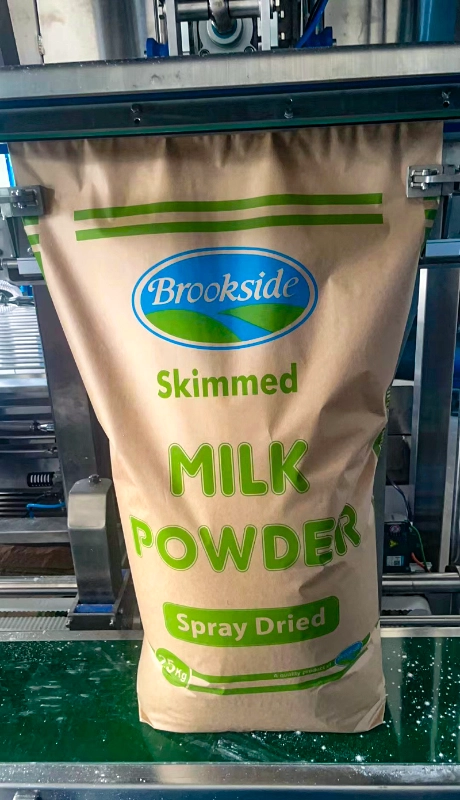
On a recent dairy powder project, a kraft paper milk powder bag moves from the bagging station through the bottom-up fill, the clamp release, the roller transfer, the twin-belt transfer, and into the sewing head with the bag mouth staying square across the whole run. The kraft paper construction shows the kind of bag the line is sized for, and the clamp geometry is what lets the 25 kg powder bagging line run that bag without manual straightening at the sewing head.
Talk to a Mipline Engineer About Your 25 kg Powder Bagging Line
Send us your bag size, target weight, material, throughput, and floor layout. We will return a Mipline line layout, a station-by-station specification, and a reference list of comparable dairy, flour, and starch projects.
Request a Line Layout English
 Русский