
Powder Bagging Line: Settling and Shaping Before Final Bag Inspection
For a 25 kg powder bag, sealing is not the end of the process. A controlled settling and shaping sequence helps prepare the closed bag for metal detection, checkweighing, reject handling, and roller discharge.
Why a sealed bag still needs controlled handling
In a milk powder, flour, starch, feed, or other dry-powder plant, the filled bag can leave the closing station with trapped air, an uneven base, or a body that is not square. The issue is not only appearance. A twisted or collapsed bag may present an unstable surface to a metal detector or checkweigher, and it can make the final roller discharge less predictable.
A common older arrangement sends the bag directly from sealing to inspection. Operators then straighten, push, or hold each bag while trying to keep the mouth and body within the inspection path. This manual correction adds a variable between closure and quality control. It also makes the last section of a powder packaging line harder to connect to palletizing or warehouse handling.
Inspection equipment can only assess what arrives in its working window. If the bag is still settling, leaning, or moving sideways, the line needs a defined conditioning and handoff stage before the detector and checkweigher.
How Mipline coordinates settling, shaping, and inspection
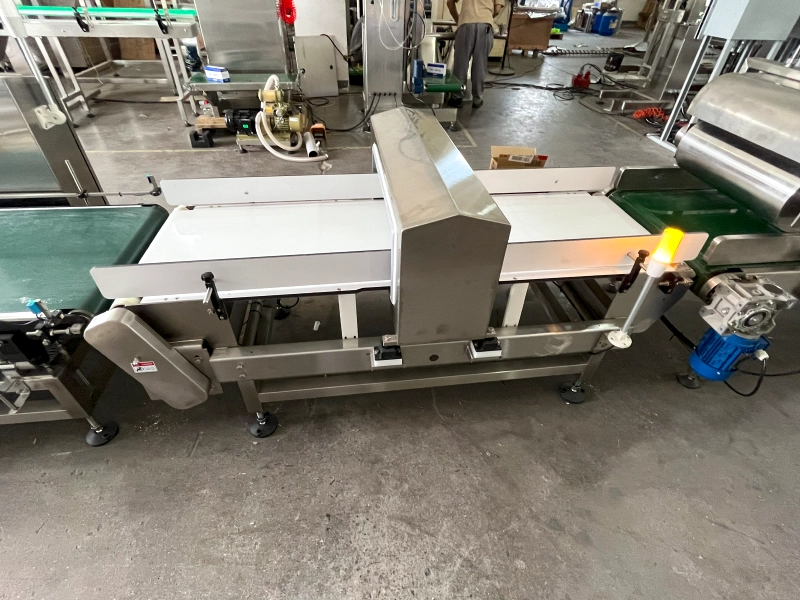
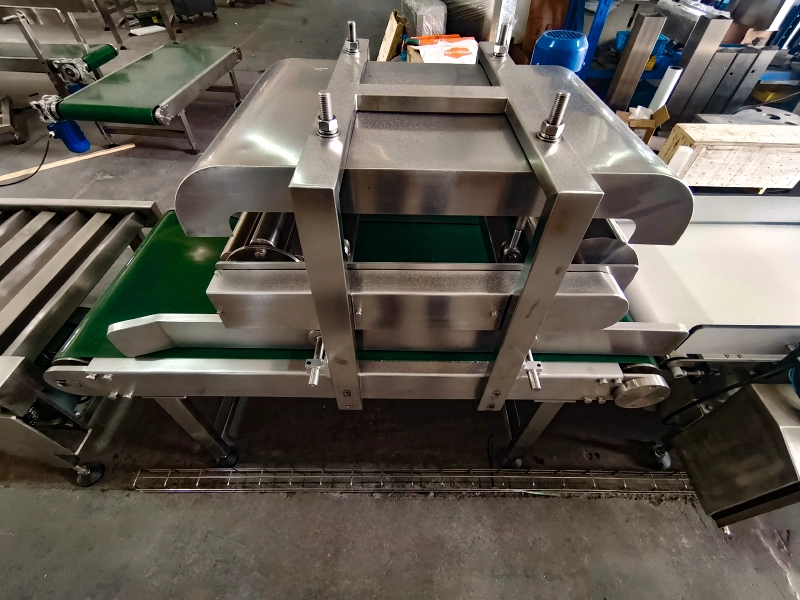
Mipline treats post-seal handling as a sequence rather than a single conveyor. Depending on the project layout, the closed bag can be turned or transferred into a settling conveyor, followed by a shaping section that supports a more consistent bag profile. The indexed equipment references include a 3,000 mm settling conveyor and a 1,500 mm shaping section, both described as configurable conveying references rather than universal line promises.
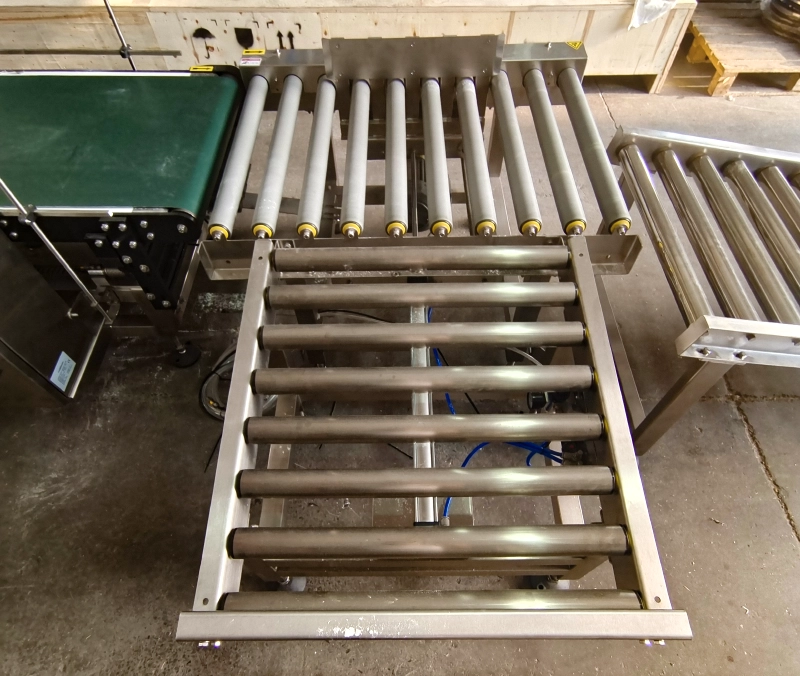
After this conditioning stage, the bag can move toward metal detection, checkweighing, reject handling, and final roller discharge. The production images show stainless-steel frames, side guides, belt and roller transfer sections, control housings, and adjustable supports. Those visible components support the physical story of guided handoff and line integration; they do not, by themselves, prove a detection result, checkweigher accuracy, or a fixed production rate.
Engineering note: Checkweigher source references for this line vary by configuration. The selected model, product effect, target weight, bag dimensions, and required throughput should be confirmed from the project-approved datasheet before any accuracy or capacity commitment is made.
What the end-of-line arrangement should confirm
A reliable automatic bagging machine for powder is not selected only by its filler. The final inspection section must match the bag and the quality-control plan. For a 25 kg powder bagging line, the settling time, shaping method, detector window, checkweigher belt, reject device, and discharge direction should be reviewed as one material flow.
The following points are practical inputs for configuring a powder filling and bag sewing line or a sealed-bag line. Each one changes how the Mipline stations are connected and validated.
| Input to confirm | Why it affects the line | Mipline coordination point |
|---|---|---|
| Powder and bulk behavior | Air retention and flow affect settling and final shape. | Review filling, de-aeration, settling, and shaping as one sequence. |
| Bag material and dimensions | Kraft, composite, and coated woven bags respond differently after closure. | Match guides, belts, rollers, sealing, and inspection openings to the bag. |
| Inspection requirement | Metal detection and weight control need defined product and process limits. | Select and validate the detector, checkweigher, alarm, and reject path by project. |
| Downstream handling | Palletizing or manual removal may require a specific discharge orientation. | Reserve a stable handoff to the final roller conveyor and next station. |
Start with the bag and inspection brief
To configure a Mipline powder packaging line, share the material, target weight, bag construction and dimensions, closure method, required speed, metal-detection specification, checkweigher range, reject logic, utilities, and downstream palletizing or discharge layout. The engineering team can then define the settling, shaping, inspection, and transfer arrangement without turning variant data into a universal claim.
Discuss Your Powder Bagging Line English
 Русский