
Peat Valve Bag Packing Line: 25–50 kg Retail Format
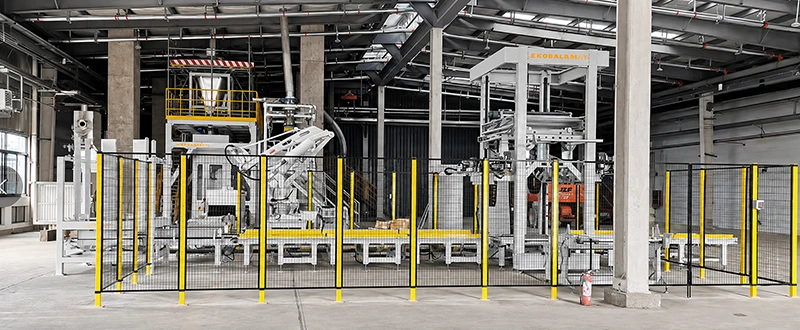
A peat valve bag packing line turns bulk peat into sealed 25–50 kg valve sacks for horticulture and garden-center shelves. VPLINE ties air-conveyed valve filling, ultrasonic sealing, checkweighing, negative-pressure bag shaping and robotic palletizing into one closed cell so a fibrous, air-bearing material reaches the truck dry, square and stackable.
Why peat producers leave FIBCs behind
Horticultural buyers, garden-center chains and the bagged-soil aisle cannot unload a one-tonne FIBC with a fork truck. They want 25 kg, 40 kg or 50 kg valve sacks that shelf on a wooden pallet and stack in a retail back-room. The shift from FIBC to valve bag opens three pain points that are easy to ignore while peat still ships in bulk.
First, peat is fibrous and air-bearing. Free-fall filling puffs the bag up, and any trapped gas stays inside the fibre wall long after the line stops. Second, giveaway on a low-density, high-volume product is expensive: a few hundred grams of peat per bag becomes a few truckloads per year. Third, dry peat throws dust at every transition — the operator, the floor, the load-cell and the open valve mouth.
A peat bag that leaks from the valve mouth on the pallet is not just a hygiene problem — it loads the next pallet, the forklift deck and the customer’s delivery truck with fibre. Peat producers know this. The question is whether the discharge end of the peat valve bag packing line is the cause or the cure.
How VPLINE closes the loop for fibrous peat
VPLINE starts with a wheeled bag magazine that an operator tops up while the line runs, so the bag pickup is never the bottleneck. Twin-arm pneumatic grippers seat the valve mouth onto an expandable nozzle; the boot inflates against the inner bag wall and the air-conveyed fill starts at the lower corner and progresses upward through the valve port. That upward fill path is what keeps the air out of the bag body instead of trapping it inside the fibre.
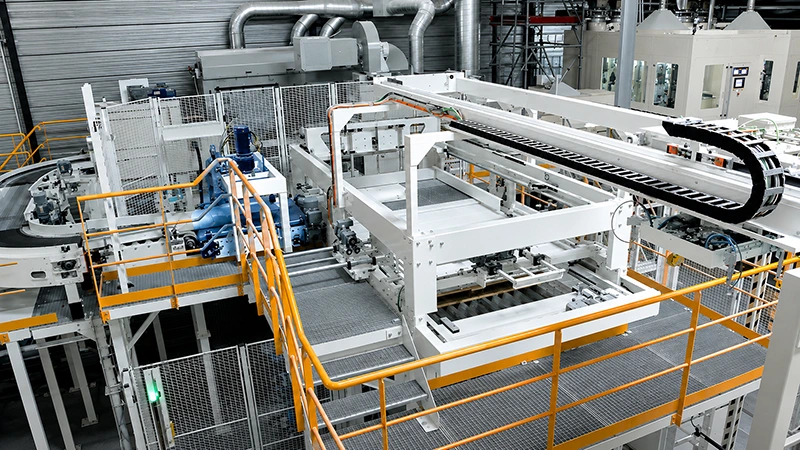
After gross weight stabilises, a 20–40 kHz ultrasonic head closes the valve mouth — no thread, no glue, no heat that would scorch the coating on a coated paper or PE-lined valve sack. The bag then runs through checkweighing and metal detection, drops onto a flat-belt conveyor with side guides, and enters a negative-pressure station that pulls the trapped air out of the body before a robotic palletizer lays an interlocking three-bag-per-layer stack on an EPAL pallet. From the operator’s chair, the peat valve bag packing line reads as one continuous motion: bag picked, bag filled, bag sealed, bag shaped, bag stacked.
Why ultrasonic, not heat: For a fibrous material that holds air, a heat sealer that brings the bag surface to 160–200 °C scorches the PE coating and lifts dust into the seal line. Ultrasonic seals by friction inside the valve mouth itself — the heat stays inside the seal line, the bag skin stays cool, and the dust never reaches the weld.
Throughput, accuracy and bag sizes — what to verify before you specify
The numbers below are line targets, not promises. They depend on peat moisture, fibre length, bulk density and the bag maker. Treat them as the figure you confirm during the site-acceptance trial, not a number you print on a quotation. A peat valve bag packing line that ships with a fixed “800 sacks/h” label is signalling that the supplier has not read your peat yet.
Three project decisions are usually locked in before the peat valve bag packing line ships: bag weight range, valve-port geometry and pallet layer pattern. Get these wrong and the rest of the line compensates around them. Get them right and the line runs the way the layout drawing said it would.
| Параметр | Range / Value | Project note |
|---|---|---|
| Bag weight range | 10–50 kg (typical 25 kg) | project-confirmed against peat bulk density |
| Производительность | 5–12 bags/min | scales with fibre length and moisture |
| Filling precision | ±1–2 ‰ | validated against the downstream checkweigher |
| Bag material | coated woven, kraft paper, PE-lined valve sack | valve-port tolerance must match ultrasonic head |
| Contact parts | 304 stainless steel | seal-side surfaces in fill path |
| Air supply | 0.5–0.7 MPa | dynamic pressure stability tested on site |
| Sealing | 20–40 kHz ultrasonic | bag-material validation trial before order |
| Pallet pattern | 3-bag interlock, layer height per project | EPAL 1200 × 800 mm wooden pallet |
Send us your peat spec, get a closed-loop layout back
Share your current bulk format, target retail bag size, peat moisture range and the pallet pattern you ship today. We will return a peat valve bag packing line layout with throughput matched to your fibre, an ultrasonic-seal validation plan against your bag supplier, and a pallet-stack drawing your truck driver can read at a glance.
Talk to a VPLINE engineer English
 Русский