
Pellet Bagging Machine: PE Bags Formed, Filled and Sealed Inline
Pellets do not behave like flour. They roll, they abrade, they throw fines onto the seal faces — and a 25 kg polyethylene bag filled with them is judged at the pallet, not at the spout. A pellet bagging machine forms the bag from PE roll film on the frame, fills it on load cells to ±0.1–0.2%, cools the bottom and top seams before release and hands a square bag to the outfeed conveyor.
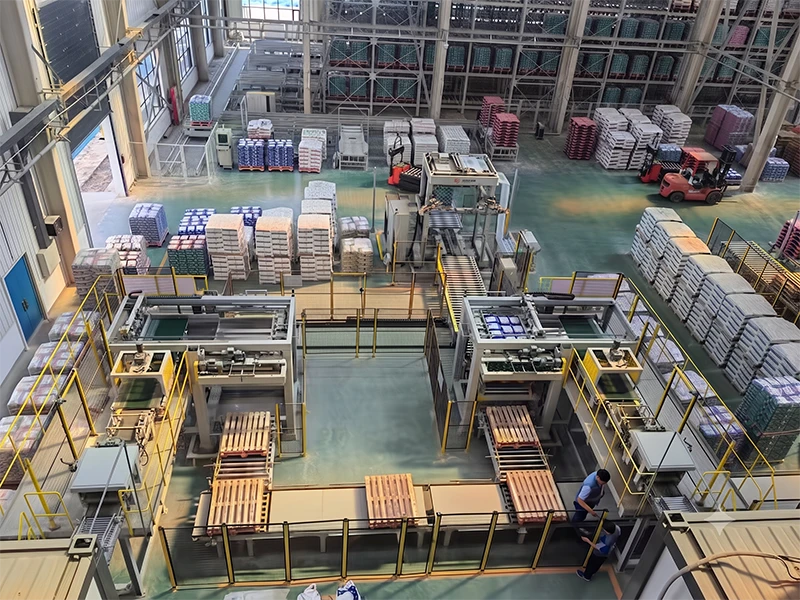
Why premade bags and sewn sacks fail on pellets
Most pellet plants start with a premade open-mouth PE bag or a woven PP sack closed by a sewing head. Woven sacks are cheap per unit but they breathe: wood pellets pick up moisture in an unheated store, feed pellets cake at the bag face, and PP granules take on contamination between the bagging hall and the extruder hopper. Premade PE bags solve the moisture side but add a second supply chain — bags are ordered by format, stored flat, fed one at a time from a magazine, and every format change becomes a machine setup with a stack of leftover stock behind it.
Abrasion is the second cost, and it is the one nobody budgets for. Pellets sliding down a filling spout rub against each other and against the tube wall, and the fines they generate settle exactly where the seam has to close. On a sewn sack this shows up as sifting at the needle line; on a heat-sealed PE bag it shows up as a pinhole that only opens after the pallet has travelled and been stacked twice. That is the point where a pellet bagging machine has to be judged: not at the spout, at the seam, and not on the day of commissioning but on the pallet.
Premade bag logistics, fines at the seam, moisture pick-up in store and a bag that collapses on the palletizer. All four are decided before the product is weighed, which is why the front of the line matters more than the dosing screw.
What a pellet bagging machine changes in the layout
The FFS route deletes the premade bag from the supply chain. A roll of PE tubular film is mounted on the unwind, the bag former turns the flat film into a tube, the vertical seam is closed, and the bottom seal is made and pneumatically cooled before a single pellet is dosed. Film width from 200 to 1200 mm covers formats roughly between 10 and 50 kg, so a plant running 25 kg retail bags and 50 kg export bags uses the same machine and changes a recipe instead of a bag warehouse.
Dosing runs on load cells with a servo-driven weighing hopper, holding fill weight to ±0.1–0.2% across the 10–50 kg range — tight enough that a checkweigher becomes a confirmation step rather than a rework loop. On this pellet bagging machine the horizontal seal is made with an Italian heating wire and cooled on both faces by pneumatic plates, which is what keeps a PE bag with 25 kg of pellets pressing on the fold from thinning out at the jaw. Pulling rollers index the film in step with the dosing cycle, so a printed panel lands in the same place on every bag and the palletizer gripper always finds the same edge.
Field note: pellets with a high fines content dose better through a short-drop outlet. A shorter fall means less abrasion inside the tube and less dust settling on the seal faces, so the outlet geometry should be set for your bulk density and pellet size rather than shipped at a default.
Structure and numbers to fix before the line is quoted
A pellet bagging machine is quoted from four numbers: bag format, film width, output and downstream. The FFSline runs forming, filling and sealing at up to 1200 bags per hour, and with a high-level palletizer the end of line reaches 1500–2000 bags per hour. The cell sits on roughly 5.5 × 5 × 6 m with the electrical cabinet integrated into the machine frame, which keeps cable runs short and lets the line drop into an existing dispatch hall instead of demanding a new bay.
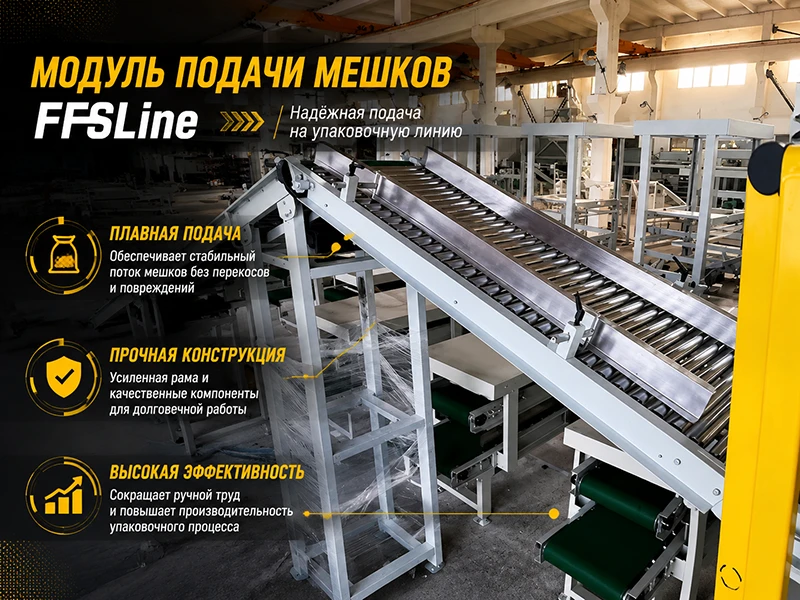
After the seal, bags transfer on a flat belt with adjustable side guides, pass a metal detector and checkweigher where specified, and arrive at the palletizer square and settled. Film is the other saving: PE roll film costs at least 30% less per bag than paper sacks, paper-plastic composites or woven PP, and because the bag is made inline there is no premade bag freight, no flat-bag storage and no obsolete stock when the retail format changes. For granules and pellets the same pellet bagging machine also covers nitrogen flushing for oxygen-sensitive product and an explosion-proof execution where the dust classification requires it.
| Параметр | Значение |
|---|---|
| Bag type | PE tubular film bag, pillow or M-gusset, formed inline |
| Fill range | 10–50 kg |
| Film width | 200–1200 mm |
| Fill accuracy | ±0.1–0.2% |
| Output | Up to 1200 bags/h forming, filling and sealing |
| Output with palletizer | 1500–2000 bags/h end of line |
| Sealing | Vertical seam plus horizontal seal, Italian heating wire, pneumatic dual-face cooling |
| Line footprint | Approx. 5.5 × 5 × 6 m, electrical cabinet integrated |
| Опции | Metal detector, checkweigher with reject, nitrogen flushing, explosion-proof execution |
| Materials handled | Wood and feed pellets, PP and PE granules, mineral granules |
Send the pellet, the bag weight and the output you need
Tell us the material, its bulk density, the bag weight and the bags per hour you have to ship. We will come back with a pellet bagging machine layout showing film width, seal configuration and the downstream stations sized to those numbers.
Request a line layout English
 Русский