
Powder Packaging Line: 25 kg Bag Mouth Alignment Before Sewing
A dry milk plant filling 25 kg kraft or paper-plastic bags rarely loses output at the dosing screw. It loses it in the last three metres, where a dusty, still-aerated bag twists and its mouth arrives skewed at the sewing head. This powder packaging line treats bag supply, clamping, bottom-up filling, shaping and transfer as one controlled process, so the mouth is already aligned before the closing station sees it.
Where a 25 kg dry milk bag actually goes wrong
Free-fall filling is the first place a dairy powder bag starts to fail. Spray-dried skimmed milk is fine, light and easily airborne. Dropped through open air into a bag, it pushes powder back out of the mouth, and that dust settles on the exact strip of paper the sewing head has to close. The operator then holds the bag open with one hand, straightens the mouth with the other, and the seam starts the shift with a wrinkle in it. On a coated woven or paper-plastic composite bag the effect is worse, because dust on the inner layer interferes with the heat-sealing step that follows.
The second failure is geometry, not dosing. A filled 25 kg bag is aerated, and it settles unevenly as it travels. If the conveyor only moves the bag, nothing holds both faces, so the bag rotates a few degrees on the belt, the mouth leans and the shoulders drop. By the time it reaches the sewing head, the mouth is skewed, the sewing guide rides up one edge, and somebody walks to the last metre to straighten it by hand. That manual correction is the hidden cost inside most so-called automatic powder bagging lines, and it is what a controlled powder packaging line is built to remove.
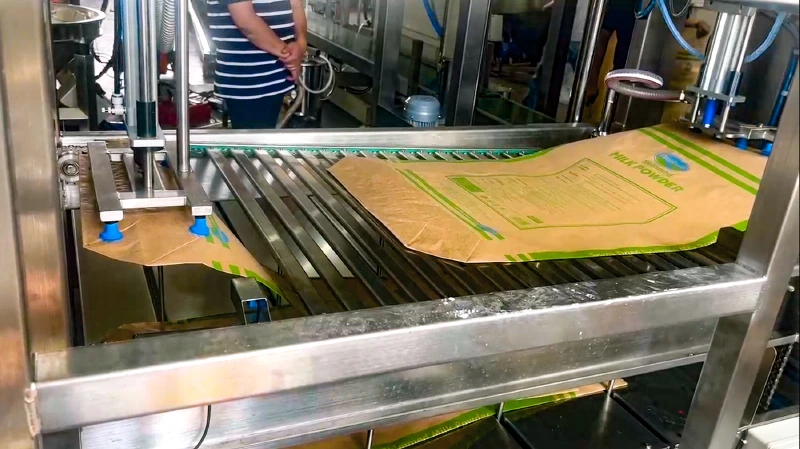
Most complaints on a 25 kg dairy line trace back to the handoff, not the weighing accuracy. A bag that leaves the clamp square and arrives at the sewing head square needs no operator. A bag that arrives skewed cannot be fixed by a better dosing screw.
Why Mipline fits a dry milk powder packaging line
Mipline is configured as a controlled line rather than a standalone filling unit. Bags are taken flat from a magazine, opened by vacuum pickup and placed in a clamp that closes before any product enters. Because the clamp holds the mouth from the empty state onward, the bag never has to be re-gripped after it is heavy. Filling is bottom-up: a lifting platform carries the bag down as the level rises, so the fill point stays close to the material instead of dropping powder through open air. A three-stage screw handles fast, medium and slow final dosing, and where the powder is highly aerated, vacuum extraction or de-aeration runs before closure.
Downstream, the same principle continues. The bag is held and guided through belt and roller transfer, side guides are set to the bag width, and a twin-belt section keeps both faces parallel so the mouth stays vertical between stations. Enclosed stainless-steel stations with blue inspection windows and guarding let an operator watch the clamp and the mouth line without opening a door, and the HMI and emergency-stop boxes sit on the frame where the line is actually run. That is the difference between a powder packaging line and a set of conveyors bolted together: the bag has a controlled owner at every metre.
Engineering note: specify the bag before the machine. Bag construction and stiffness, bulk density, flowability, moisture and aeration of the milk powder, the closure method, target bags per minute and the palletizing layout are the inputs that decide clamp geometry, guide widths, screw stages and settling length. Two dairy powders at the same 25 kg target weight can need different transfer settings.
Structure, settings and the handoff that decides bag quality
The table below shows how each station on this powder packaging line contributes to a square bag mouth. Values are reference figures from stated configurations, not one universal promise; they are confirmed against the material test and the project datasheet.
| Station | What it controls on a 25 kg bag | Reference values to confirm per project |
|---|---|---|
| Bag magazine and vacuum pickup | Bag is taken flat and opened squarely before the clamp closes | Bag stack height and bag stiffness per bag construction |
| Clamp and lift platform | Mouth is held from empty to full; fill point follows the product level | 25 kg nominal; one stated configuration at 1.5–2 bags/min |
| Three-stage screw dosing | Fast, medium and slow final dosing hold the weight band | Stated accuracy ≤±0.1–0.2% on that configuration |
| Guided transfer with side guides | Both bag faces held, mouth kept vertical between stations | Guide width set to measured bag width |
| Settling and shaping section | Aerated powder settles and the bag is squared before inspection | 3,000 mm settling belt, 600 mm wide, 15 m/min; 1,500 mm shaping section |
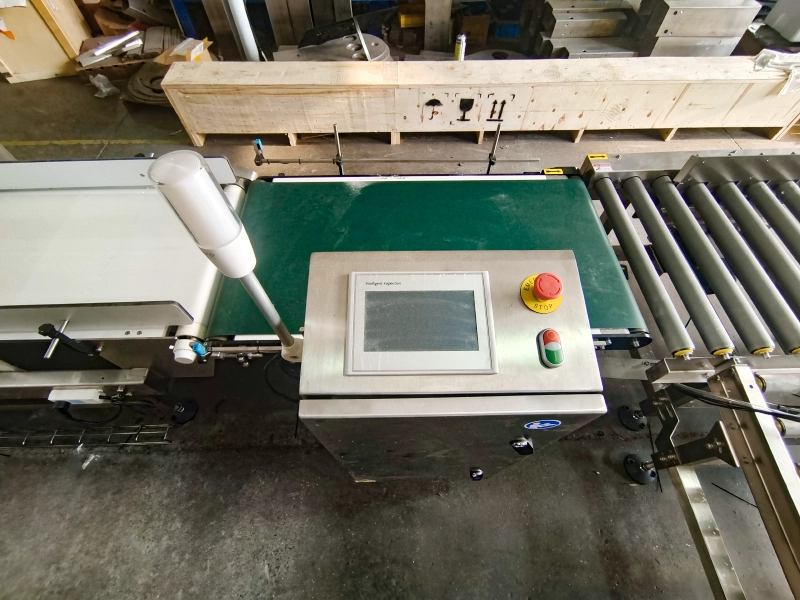
| Metal detection and checkweighing | Finished bag checked after closure, with a defined reject path | ER6023 reference window 600 × 230 mm; checkweigher rated to 50 kg |
| Roller discharge | Square, closed bag handed to palletizing or warehouse handling | Transfer length per layout; 5,000 mm belt at 10 m/min is one reference |
The result is measurable on the floor rather than in a brochure. Operators stop walking to the last metre to straighten bags, the sewing or sealing head receives a mouth that is already square and dust-free, bag shape stays consistent into palletizing, and underweight or contaminated bags are rejected after closure instead of being found at dispatch. On a dairy powder plant running three shifts, that removes the small steady losses that never appear in a capacity figure but do appear in the monthly bag and rework count — which is the practical reason a powder packaging line is specified as one continuous process rather than a filler plus conveyors.
Specify the line around your bag, not around a catalogue
Send the bag construction and dimensions, the powder and its bulk density, the target weight, the closure method and the required bags per minute. We will come back with the station list, the transfer layout and the settings that hold a 25 kg bag mouth square before sewing.
Request a line layout English
 Русский