
ppline for Dust-Safe Sack Handoff in a Southern Grain Warehouse
In a grain warehouse, the hard part is not only filling woven sacks. The real bottleneck is keeping the bag mouth stable, moving the sack cleanly into the next station, and doing it without dust spill, rework, or wasted handling time. This ppline layout uses a hopper-fed bagging machine, operator-facing HMI control, and a rigid steel structure to keep the handoff predictable.
Why the old handoff created bottlenecks
In many warehouse lines, the previous setup depended on operators to catch each filled sack, reorient the mouth, and push it toward the stitching or palletizing point. That sounds simple until the sacks start arriving at different angles, the bag mouth shifts under its own weight, and the next station has to wait for correction. Every pause breaks the rhythm of the line.
For a southern grain warehouse handling dry bulk product, the problem is even sharper. Woven sacks flex, settle, and rub against each other as they move. If the transfer point is weak, the floor gets dustier, the stitch line gets less consistent, and the pallet face becomes harder to keep square.
When a filled bag is lifted, turned, or guided by hand too often, the mouth shifts, the stitch line skews, and the next station spends more time correcting than packing.
Why ppline fits this job
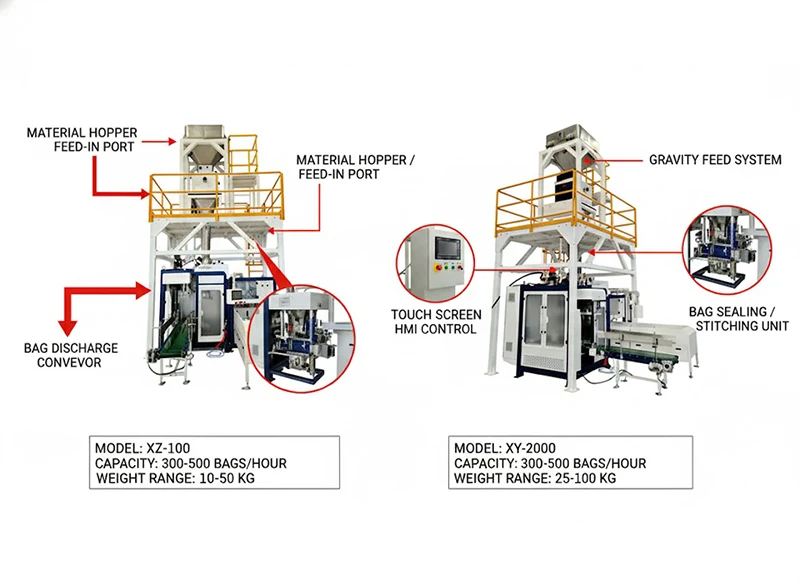
The ppline concept works here because it treats the handoff as part of the machine, not as an afterthought. The hopper feed keeps material entry organized, gravity dosing keeps the fill rhythm steady, and the HMI gives the operator a clear view of machine status without walking around the line. The sealing and stitching unit sits directly in the workflow instead of forcing bags into a loose transfer zone.
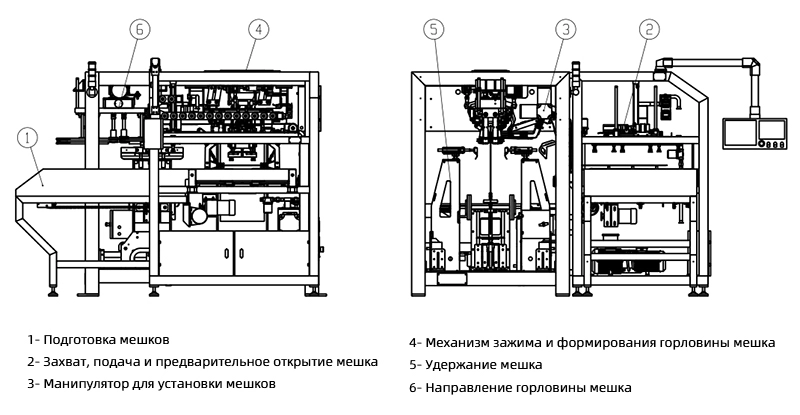
The CAD blueprint supports that logic: it shows the bag magazine, pickup arm, and positioning hardware as one controlled set of actions. The machine photo reinforces the same idea in physical form, with the hopper, dosing path, control screen, and stitching unit built into a single structure that is easy to place on a warehouse floor and easier to keep aligned during daily operation.
bpmpack Инженерный взгляд: In dry-bulk bagging, the real gain is not just faster filling. The gain comes from controlling the bag mouth from the moment it leaves the clamp to the moment it reaches the next station. A rigid frame, a visible HMI, and a direct discharge path reduce rework, reduce lost seconds, and make the whole line easier to operate with fewer interventions.
What the warehouse gets after the line is tuned
Once the transfer point is stable, the warehouse team usually sees the improvement in three places at once: the line runs with fewer stoppages, the floor stays cleaner, and the pallet stacks become easier to square up. Operators spend less time regripping sacks and more time keeping the flow moving. That matters more than a simple speed number on paper.
For grain handling, the best result is a line that can be repeated every shift without creating extra correction work. That is where ppline adds value: it brings filling, transfer, stitching, and downstream handoff into one practical layout that can be trained, serviced, and scaled without turning the warehouse into a manual catch-point.
| Line point | What the equipment does | Operational result |
|---|---|---|
| Filling | Hopper feed and gravity dosing keep the bag fill cycle steady. | Less fluctuation at the outlet and fewer corrections by operators. |
| Transfer | Controlled discharge path keeps the filled sack moving in a predictable way. | Cleaner handoff and less bag-mouth skew before stitching. |
| Управление | HMI gives a clear operating point for the line crew. | Faster changeover and easier daily monitoring. |
Need a bagging layout that matches your warehouse flow?
Send us the material type, bag weight, and target throughput, and bpmpack can map the filling, transfer, stitching, and palletizing points into one workable ppline layout.
Связаться с BPMPACK English
 Русский