
Valve Bag Packing Line for Sifted Sand and Crushed Stone at a Kandalaksha Aggregates Plant
How an automated 25 kg valve bag packing line replaces manual loading and stop-start filling on a sifted sand and crushed stone line in Kandalaksha, where humidity, fines and sharp aggregate edges punish every moving part on a cement-style bagger.
Why sifted sand and crushed stone punish an ordinary cement bagger
On a Kandalaksha aggregates line the duty cycle is not what a generic cement bagger sees. Sifted sand carries surface moisture that migrates into the bag valve, and washed crushed stone — even in the 5–20 mm fraction — leaves sharp edges that score the inside of a kraft paper valve bag as it rides the loading nozzle. Every minute the line runs, those two effects stack: the valve leaks, the seam tears, and the operator has to stop the line to wipe the nozzle and rebag the rejected sack.
Valve bag packing works because the bag is the package. The valve closes itself under the pressure of the fill column, and the loaded sack stands upright without a top seal. That geometry fits an aggregates yard better than an open-mouth bag plus heat sealer, and it avoids the second forklift move you would pay for with a big-bag station. The trick is keeping the valve open during fill and re-seating it cleanly after fill — every cycle, every shift, regardless of humidity or aggregate sharpness.
Three failure modes show up before throughput does: the loading nozzle wears from stone abrasion, the pneumatic bag-gripper slips when the kraft paper softens with moisture, and the ultrasonic seal head fouls with fines that ride the bag edge. A line that is “still running” in month one is usually the same line that quietly drops to 60 % of its rated bags-per-hour by month six, and nobody notices until an order ships short.
How the VPLINE valve bag packing line handles abrasive, moist aggregates
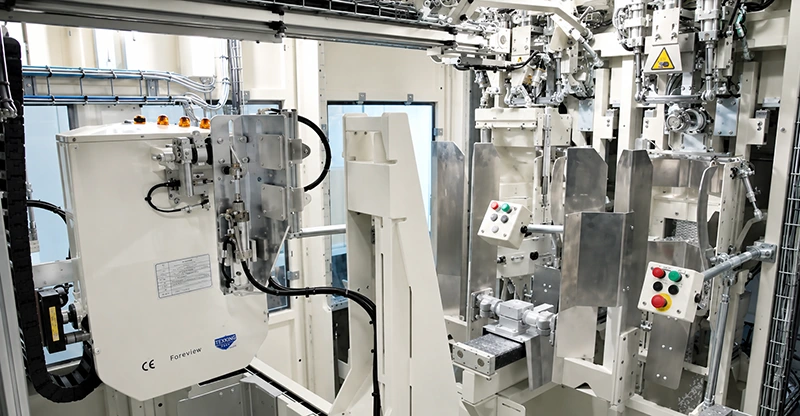
The line starts where the empty bags wait. A movable bag magazine holds the kraft valve bags in a guided stack, and a dual-arm pick-and-place head — driven by pneumatic cylinders on a stainless steel frame — pulls one bag at a time, opens the valve, and slips it onto the filling nozzle. On a sifted sand run that motion has to be gentle (the paper is wet) and precise (the valve has to seat on the first try, not the third), which is why the bagging head uses dual opposed grippers rather than a single suction cup.
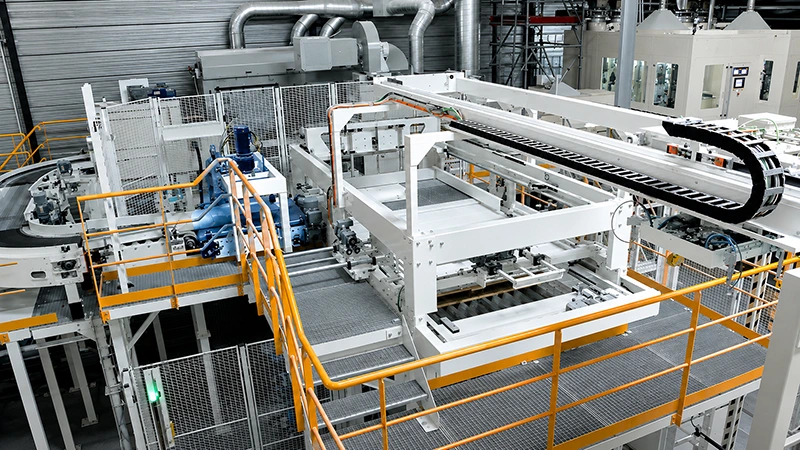
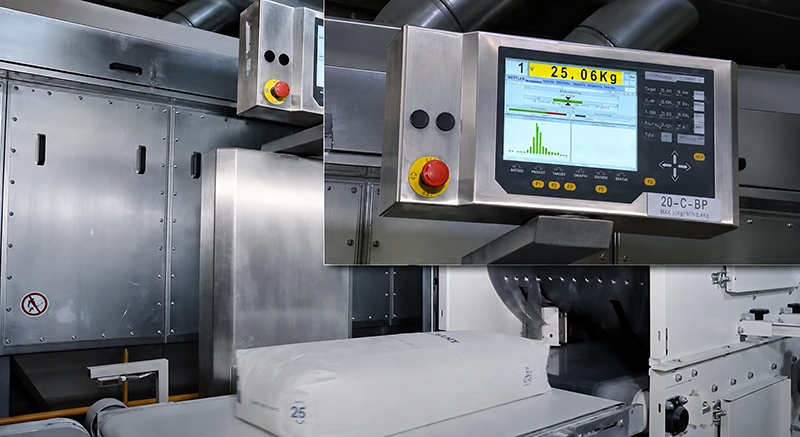
Once the bag is on the nozzle, the line does three things in parallel: an impeller-style air-conveyed filler pressurizes the column so the valve stays open and the sand or stone flows in, the bag sits under controlled vibration so the column compacts without bridging, and the moment the load cell reads the target weight, the ultrasonic heat-seal head closes the valve and a negative-pressure former squares the filled sack. From there it drops onto a checkweigher conveyor with a touchscreen HMI, runs through metal detection if the line is configured for it, and rides onto a roller conveyor into the palletizing cell.
Engineering note. The filling nozzle on the VPLINE is a clamped, replaceable stainless steel collar — not an adhesive-bonded rubber sleeve. When crushed stone fines score the seal face, the operator swaps the collar in under ten minutes instead of waiting for a service call. That single design decision is what takes most aggregate plants from two unscheduled stoppages a month down to none.
Where the VPLINE valve bag packing line puts its numbers
The figures below are the working envelope we quote for a Kandalaksha-class aggregates plant running sifted sand (0–2 mm) or washed crushed stone (5–20 mm) at ambient temperatures of −10 °C to +35 °C. They are taken from the running line, not from a marketing brochure.
These are the parameters that map directly onto the pain points above: the bag weight tolerance is what the checkweigher enforces after the seal, the bagging rate is the figure you actually book against shift output, and the bag-size range is what lets the same line switch between sand and stone without a mechanical changeover.
| Параметр | Working value | Why it matters on a sand and stone line |
|---|---|---|
| Bag weight range | 20–50 kg (25 kg is the working point) | 25 kg is the default; 40 kg and 50 kg run on the same nozzle set |
| Bagging rate, sifted sand at 25 kg | 250–350 bags/hour | Driven by the impeller fill column and vibratory compaction; the upper end needs the dryer sand fraction |
| Bagging rate, washed crushed stone at 25 kg | 180–220 bags/hour | Lower because of compaction density; still well above two-operator hand loading |
| Fill accuracy | ±0.2 % of target weight | Enforced by load cell + PLC cut-off, not by operator feel |
| Valve seal type | Ultrasonic heat seal on the bag valve | Replaces the old glued valve that fouled with stone fines |
| Bag magazine capacity | 200–400 empty bags per load | Wheeled cart; one operator refills in under five minutes |
| Air supply | 0.6–0.8 MPa, clean and dry | Integral FRL unit on the frame; site compressor must hold 0.8 MPa minimum |
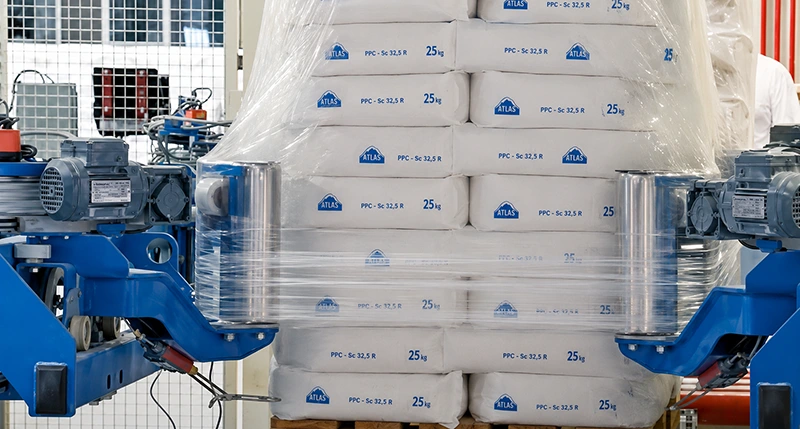
| Pallet stack pattern | 5-layer or 6-layer, with interlayer sheet option | Handled by the gantry palletizer; up to 8–10 bags per layer at 25 kg |
| Line power | 380 V / 50 Hz, three-phase + neutral | Configurable for 220 V site supply on request |
| Operator station | Twin pendant controls + central HMI | One operator per shift covers bag refill, seal inspection and pallet outfeed |
| Ambient temperature | −10 °C to +35 °C | Cold-rated pneumatic kit for Kandalaksha winter operation |
| Installed footprint | ~9 m × 4.5 m for the pack-and-palletize core | Excludes upstream storage silos and downstream stretch wrapper |
Tell us what you are bagging and we will size the line
Send us your aggregate gradation (0–2 mm sifted sand, 5–20 mm washed crushed stone, or both), target bag weight, hourly output and the air supply available on site. We will return a VPLINE valve bag packing line layout with the nozzle set, the seal type, the palletizer pattern and a working price — usually inside two working days.
Request a VPLINE Quote English
 Русский