
Flour Packaging Line for 1–5 kg Paper Bags: How Zpacker Automates Packing and Dust Removal
For flour mills, milling complexes, bakeries, and food production plants, Zpacker is a full automatic paper bag packaging machine for pre-made M-fold bags. Its linked bag feeding, screw dosing, filling, settling, dust removal, sealing, and downstream inspection path turns a labor-heavy packing task into a controlled automatic packaging line for common 1 kg, 2 kg, and 5 kg retail formats.
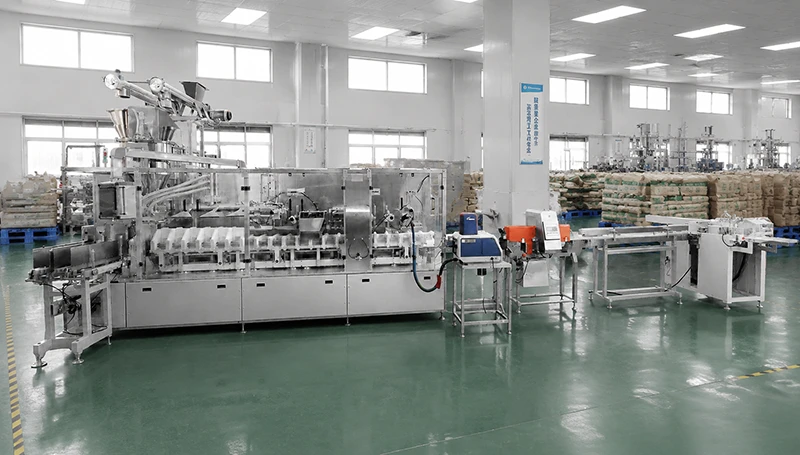
Why flour producers move beyond manual and semi-automatic packing
A flour mill or food plant serving retail distribution may need several paper-bag formats during the same production week. Manual filling still requires an operator to pick a kraft bag, open it, hold it under the filling point, settle the powder, clean the mouth, fold the M-shaped side gussets, and close the top. A semi-automatic machine can improve dosing, but it may leave bag handling, sealing, and handover to the next process as separate operations.
This separation becomes costly when the material is dusty and the bag is a pre-made paper or paper-plastic package rather than a film roll. Powder can escape around the mouth, the product may not settle evenly, and a bag that is not correctly oriented cannot move smoothly through folding and sealing. The line therefore needs more than a powder filling machine: it needs a coordinated paper bag handling and sealing sequence.
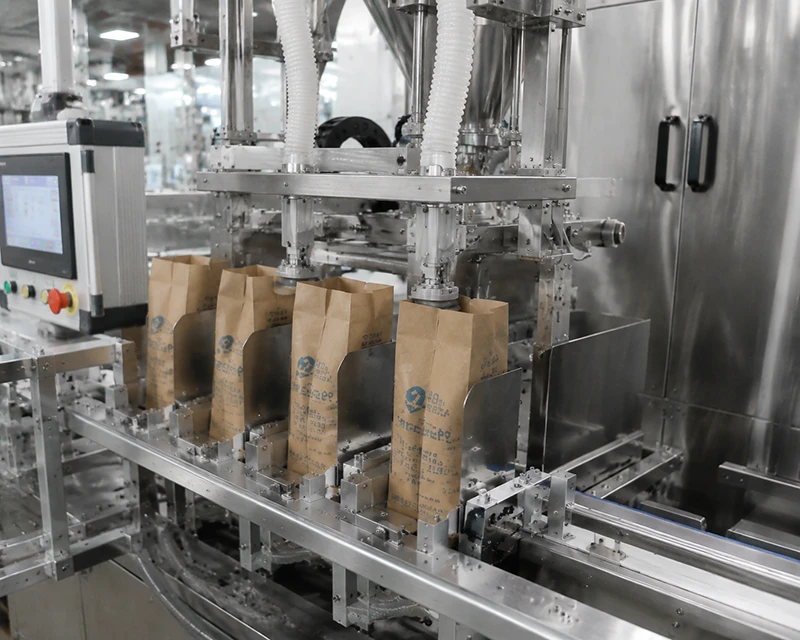
The plant must match the product flow, target weight, bag dimensions, M-fold geometry, bag direction, air supply, and available floor space before selecting equipment. Ignoring any one of these points can create stops between dosing, bag closing, checkweighing, and secondary packaging.
How Zpacker fits the pre-made M-fold paper bag process
Zpacker is designed around the actual sequence of a square-bottom, M-fold pre-made bag. A belt-fed bag system takes a flat bag from the magazine, opens it into a stable three-dimensional form, and positions it for filling. The dosing stage can be configured around a twin-screw dosing arrangement for flour and compatible powders. After filling, vibration and dust-removal stations help release air and settle the product before the bag returns to its M-fold shape.
The closing sequence continues with edge trimming, edge rolling, hot-melt glue application by dot or line spray, and top pressing. This is different from heat sealing a film pouch, so the correct comparison is a premade paper bag packaging machine against the customer’s existing paper-bag workflow—not an assumption that a vertical packaging machine can replace every operation. Paper-plastic bags require confirmation of layer bonding and glue compatibility through the final bag sample.
Engineering note. The automatic line is strongest when the bag sample and powder are tested together. Bag width, length, side gusset, orientation, flowability, dust behavior, and required speed should be fixed in the final technical proposal and acceptance conditions.
Reference configuration for 1–5 kg flour packaging
The available reference range separates smaller and larger retail formats: approximately 30–35 bags per minute for 1–2 kg and approximately 15–20 bags per minute for 2.5–5 kg. Other recorded project discussions cite about 40–50 bags per minute for 1 kg, about 30–35 for 2 kg, and about 16–20 for 5 kg. These figures are reference values only; flour properties, screw dosing, feeding capacity, bag quality, and site conditions determine the final speed.
A complete flour packaging line can connect a silo or buffer hopper, screw conveyor or elevator, the Zpacker bagging machine, conveyor transfer, checkweigher, metal detector, date printer, bag arranger, and secondary packaging. Multiple small bags may then be grouped in shrink film or placed into a larger outer bag. The PLC controller and touchscreen provide the operating interface, while no-bag, air-pressure, safety, motor, and glue-temperature conditions can trigger protective stops and alarms.
| Selection point | Zpacker reference | Почему это важно |
|---|---|---|
| Retail weight | 1–2 kg or 2.5–5 kg configurations | Sets dosing range, bag handling, and expected line speed |
| Bag format | Pre-made paper or paper-plastic M-fold square-bottom bag | Controls opening, orientation, folding, glue, and top pressing |
| Bag dimensions | Reference width 80–140 mm; length 240–320 mm; side gusset about 60–80 mm | Must be checked against the actual sample before quotation |
| Accuracy and utilities | About ±0.5%; 15.5 kW; 380 V ±10%, 50 Hz; air consumption about 0.76 m³/min | Supports utility planning and acceptance discussions |
| Quality and logistics | Optional checkweigher, metal detector, marking, arranging, and secondary packaging | Reduces manual handover after the bag is sealed |
Start with the flour, bag sample, and target format
Send the powder characteristics, 1 kg/2 kg/5 kg target, bag drawings or samples, expected output, and site utilities. BPM can then define the screw dosing, dust-removal, sealing, inspection, and secondary-packaging path around the actual Zpacker application.
Discuss your flour packaging line English
 Русский