
Salt Filling Machine for Humid Salt Lines: Stable Flow, Clean Sealing, and Secondary Packaging
BIBPU salt filling machine
Why Humid Salt Needs a Different Filling Logic Before Sewing
When salt picks up moisture, the problem is no longer only dosage accuracy. Flow stability, film release, sealing quality, and the handoff into secondary packaging all start to decide whether the line runs continuously or stops for cleaning and rework.
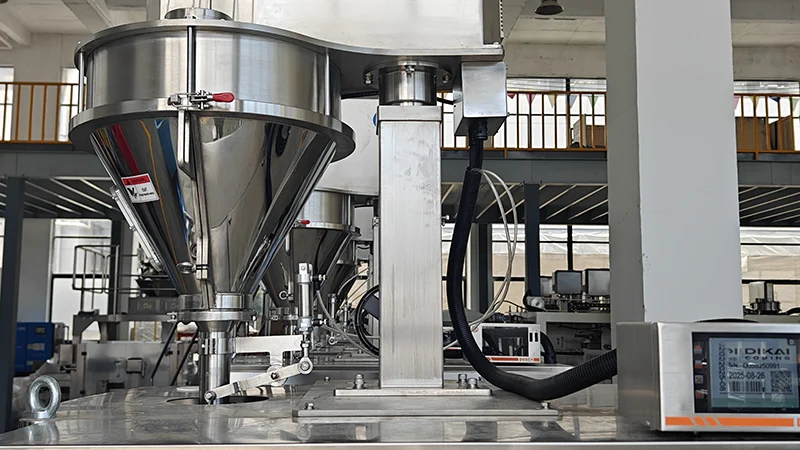
The real bottleneck is not the bag, it is the material behavior
Humid salt does not behave like a free-flowing dry product. It bridges in the hopper, clings to forming surfaces, leaves residue near the discharge path, and can create unstable bag fill weights when the line speed rises. If the downstream sewing or outer-pack process is waiting on a clean discharge, every small fluctuation becomes a production loss.
This is why a salt filling machine for humid salt must be treated as a full transfer system, not a single dosing head. The machine has to keep the flow consistent, protect contact surfaces from corrosion, and maintain a clean transition into sealing and secondary packaging.
Why BIBPU fits humid salt lines
BIBPU is built around the parts that usually fail first on salt work: material contact surfaces, film guidance, discharge stability, and sealing consistency. The hopper shown above uses UNS S31603 316L stainless steel on contact surfaces, which is important for salt environments where corrosion and pitting are not theoretical risks.
The line structure also supports a stable upper dosing section, so the machine can keep the product moving without forcing operators to clear buildup by hand. That means less interruption, less contamination risk, and less chance of uneven pack formation before the bag reaches the sealing area.
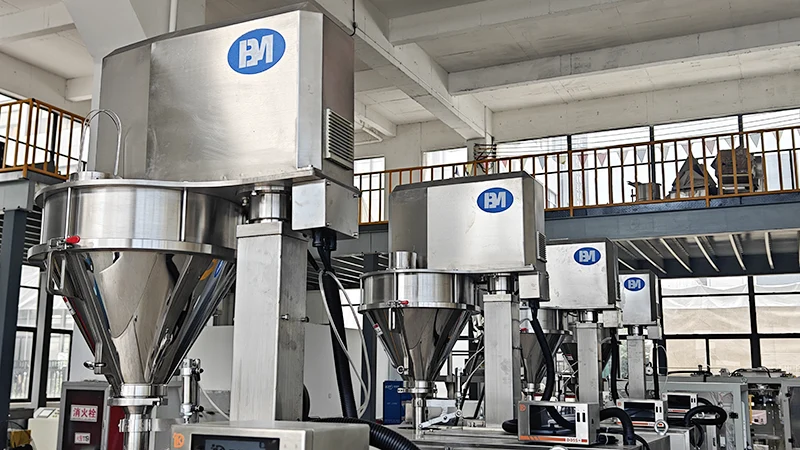
Structure evidence that matters on the shop floor
| Line element | What it solves | Image evidence |
|---|---|---|
| 316L contact surfaces | Resists corrosion in salt-rich, humid conditions | UNS S31603 dosing hopper |
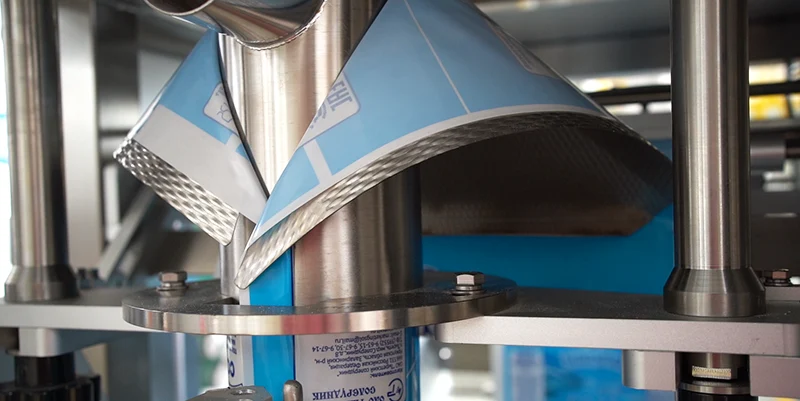
| Textured forming shoulder | Reduces film sticking during bag formation | Dimpled stainless shoulder |
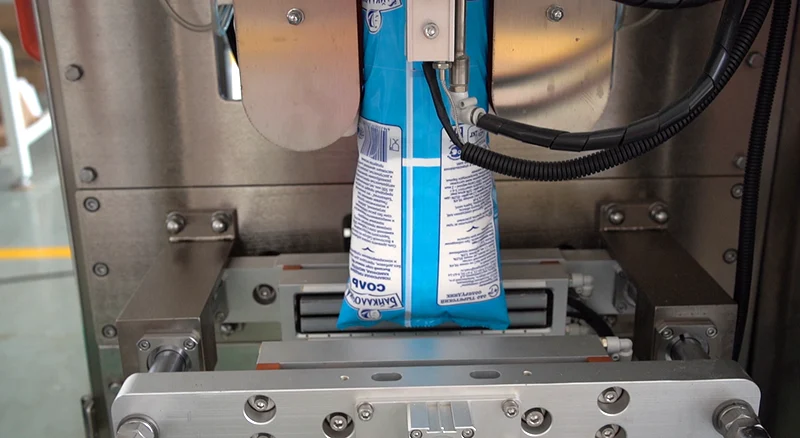
| Controlled heat sealing | Helps prevent leaky seals and powder escape | Heated cross-sealing jaw |
| Secondary bag handling | Keeps filled packs aligned for outer packaging | Pneumatic clamp transfer |
Film release and sealing are where humid salt usually exposes weak design
On humid salt lines, the film does not always slide cleanly, especially when the product surface carries moisture or fine residue. A smooth forming shoulder helps, but it is not enough on its own. The machine also needs a sealing section that stays thermally stable and mechanically consistent so the bag edge closes without wrinkling, air trapping, or weak welds.
The dimpled forming shoulder reduces sticking when the film is pulled around the collar, while the heated cross-sealing jaw keeps the sealing cycle focused on repeatability instead of operator guesswork. That combination is what makes the line suitable for products that are dry in theory but difficult in real plant conditions.
From primary filling to secondary packaging, the handoff stays controlled
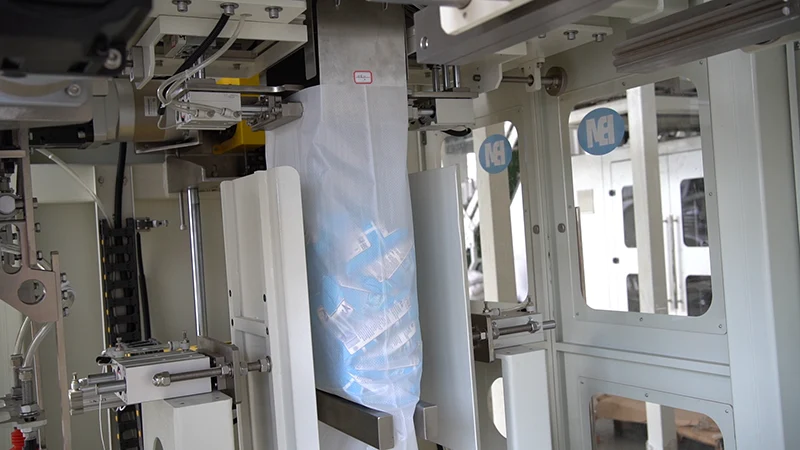
Humid salt packaging rarely ends at the first bag. Many plants still need a secondary woven PP bag or grouped outer pack for transport, palletizing, or warehouse protection. If the inner packs are not aligned well, the next step becomes a manual correction point. That is where the packaging line loses time, consistency, and labor efficiency.
BIBPU keeps the transfer controlled so the filled packs arrive in a condition that is easier to group, stack, and send onward. The result is not only a cleaner fill, but a better total line rhythm from dosage to outer packaging.
What the line delivers at the end
The practical outcome is simple: less bridging, less residue buildup, more stable bag formation, cleaner sealing, and a more predictable transfer into outer packaging. For plants running humid salt, that means fewer stops for correction and a better chance of holding output when the shift gets busy.
If your current salt filling machine works only when the product is perfect, it is too sensitive for real production. BIBPU is designed for the line conditions that operators actually face.
Need a humid-salt line that stays stable from fill to seal?
Use a machine concept that treats corrosion resistance, film release, sealing, and secondary packaging as one linked process. That is the difference between a line that looks good on paper and a line that keeps running in the plant.
Request a line review English
 Русский