
1 kg Gypsum Powder Packaging Machine: Beige Plaster in Kraft Bags
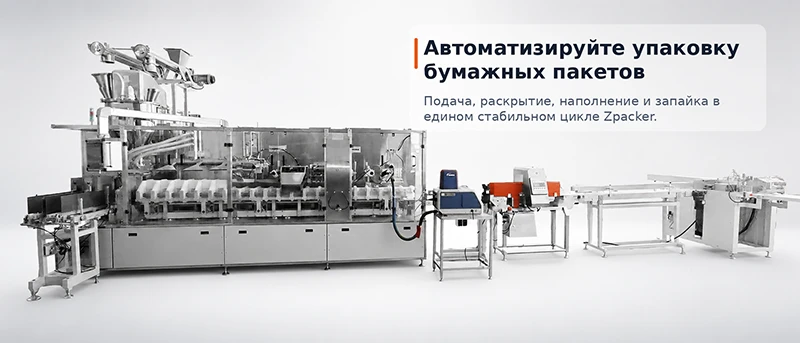
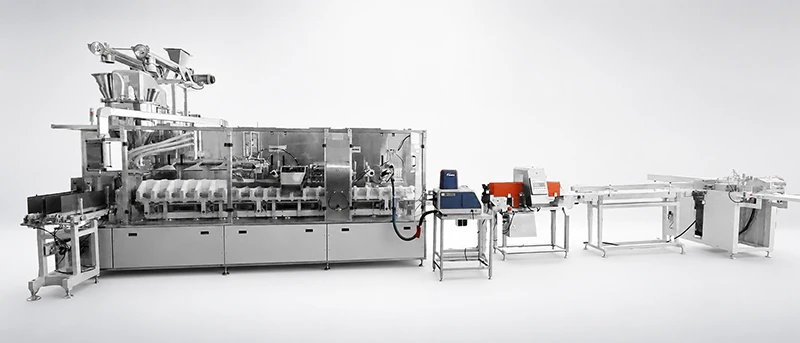
Gypsum powder is cheap to produce and expensive to pack. A 1 kg gypsum powder packaging machine runs beige plaster and putty into premade M-fold kraft bags: flat bag pickup, opening, auger dosing under dust extraction, vibration settling, M-fold reforming, edge trim, hot-melt dot or line glue and top press. The walk-through below follows one retail programme, station by station.
Where a 1 kg beige gypsum bag fails before it reaches the shelf
A plaster producer we quote for sells beige gypsum in printed 1 kg kraft bags for touch-up and small repair work. The manual line has not changed for years: an operator takes a flat bag from a stack, opens the mouth against a spout, holds it with one hand, steps the pedal and watches the scale. Nothing in that motion controls the bag mouth. Fine beige gypsum leaves the spout at speed, the paper mouth takes a dust coat, and a second operator closes the bag by folding the M gusset by hand and running it over a glue pot. On a beige kraft surface the dust marks show in daylight, so cosmetic rejects are added to the weight rejects.
The failure pattern is predictable. Filling weight drifts because a cup or a timer cannot follow bulk density changes between silo batches. Bag shape collapses because a 1 kg premade M-fold bag keeps its block shape only if it is opened square and re-formed after filling. The seam opens because hot-melt glue will not bond to a paper surface carrying powder. And throughput depends on how fast a person repeats the same four actions, which is where the second and third shifts become expensive. A 1 kg gypsum powder packaging machine is bought to remove those four dependencies, not to add a faster spout.
On fine powders the cost sits between the dosing spout and the glue seam. Dust on the paper, an unopened gusset or a bag leaning a few millimetres out of square will fail the checkweigher, the carton or the pallet long after the weight itself was correct.
Why the 1 kg gypsum powder packaging machine is built around a premade M-fold bag
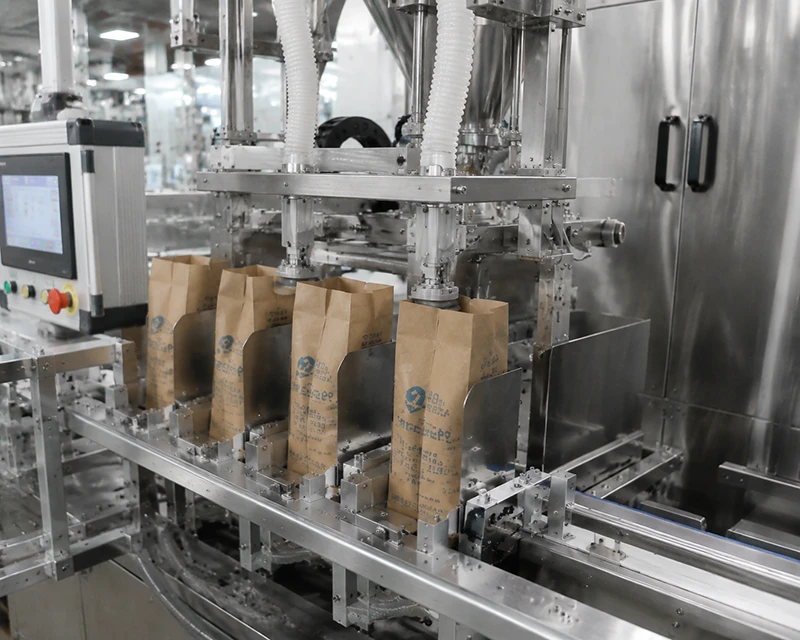
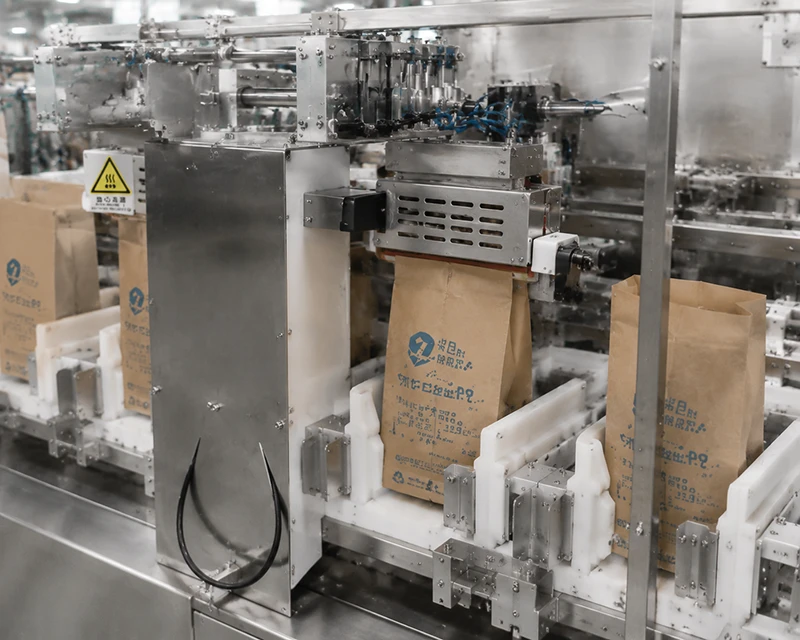
Zpacker is a twin-station in-line machine for premade paper and paper-plastic bags. Two bag magazines feed flat M-fold flat-bottom bags that are picked, opened into a three-dimensional block and clamped under the dosing head. The 1–2 kg specification covers bags 80 to 140 mm wide and 240 to 320 mm long with a 60 to 80 mm M gusset; the 2.5–5 kg specification uses the same architecture for larger formats. Because the bag is finished before it enters the machine, the printed brand panel, barrier layer and retail look are already fixed by your bag supplier, and the machine’s job is to dose, settle, re-form and close without damaging them. That is also the practical difference from a vertical form-fill-seal unit, which makes the bag from roll film on the same frame: if your 1 kg beige gypsum bag is already printed, glued and approved by the retail chain, a premade bag platform is the shorter route. The trade-off is bag handling, and that is exactly what the twin stations are for.
Dust is handled in the layout rather than at the end of the line. The filling station is fitted with extraction, and the bag then passes several vibrating and dust-extraction positions that settle the powder, release air and firm the block before the M gusset is folded back. Trimming and edge rolling follow, then hot-melt glue is applied by dot or line, and the top is pressed. Sequence matters for beige gypsum: the powder is dense and marks easily, so a bag that is settled and squared at the filling stage arrives at the trimmer straight, and the seam stays clean enough for the glue to hold. See how the same settling logic is applied on a flour packing machine with dust capture at the bag mouth.
Field note: Gypsum is not flour. Bulk density, abrasion and the tendency to cake differ between batches, so we quote a 1 kg gypsum powder packaging machine only after a bag sample and a material test. The same rule applies to paper-plastic bags: the bond between paper and film has to survive the M-fold and the glue, or the seam opens in the carton.
The numbers behind a 1 kg gypsum powder packaging machine
Use the table as a filter, not as a promise. Output on the 1–2 kg specification is listed at roughly 30 to 35 bags per minute, while walk-through notes for the same frame record about 40 to 50 bags per minute at 1 kg and 30 to 35 at 2 kg; the difference comes from material flow, feed capacity, bag size and how the glue station is timed. Weight accuracy is stated at about ±0.5%, which is what a 1 kg retail bag needs to stay inside legal tolerance without systematic giveaway. Every figure below is confirmed on the final technical scheme and on the acceptance run, not on a brochure.
| Parameter | Published value | What it decides on a 1 kg beige gypsum bag |
|---|---|---|
| Machine type | Twin-station in-line machine for premade paper and paper-plastic bags | Retail bag design stays with your bag supplier |
| Weight range | 1–2 kg specification; 2.5–5 kg specification on the same architecture | 1 kg retail bags plus 2 kg and 5 kg SKUs |
| Bag dimensions | Width 80–140 mm, length 240–320 mm, M gusset 60–80 mm | Verified against your printed bag sample |
| Output, 1–2 kg spec | About 30–35 bags/min in the technical table; about 40–50 bags/min at 1 kg in walk-through notes | Material flow, feed and glue timing set the real rate |
| Weight accuracy | About ±0.5% | Legal tolerance without giveaway |
| Dust control | Extraction at the filling station plus multi-position vibrating and dust stations | Clean glue seam on beige paper |
| Closure | Hot-melt glue, dot or line spray, then top press | Paper is glued, not heat sealed |
| Contact material | 304 stainless steel contact and exposed parts; powder-coated carbon steel frame | Mineral powder duty and daily cleaning |
| Control | 10.4-inch touchscreen, Siemens PLC | Recipe change and fault access for the operator |
| Air and power | 0.6–0.8 MPa, about 0.76 m³/min; 15.5 kW at 380 V ±10%, 50 Hz | Utility capacity before the machine arrives |
| Machine weight | About 3000 kg | Floor loading and rigging plan |
Two more conditions decide whether a 1 kg gypsum powder packaging machine runs as drawn. First, air: the machine works on 0.6–0.8 MPa at roughly 0.76 m³/min, so a dedicated supply and dryer belong in the project, not in a later retrofit. Second, space: the reference layout discussed for a full line is about 17 m long and 3.6 m wide including feeding, checkweighing, metal detection, coding and secondary packing. That is a layout reference only and is replaced by a CAD drawing against your hall. The downstream stations are not decoration on a gypsum line: a checkweigher rejects the 1 kg bag that drifted, a metal detector removes the foreign body before it reaches the retail carton, and a coder keeps the batch legible on a beige printed panel.
With those stations in one line, the result on a beige gypsum programme is a 1 kg bag that leaves the machine square, settled and glue-sealed, weighed and checked before it is packed. One operator supervises instead of four people handling bags, and the dust that used to settle on the printed panel stays inside the extraction system. The same frame covers the 2 kg twin-station format described in our 2 kg flour bag packaging machine reference, and the general format logic is set out in the 1–5 kg paper bag packing machine guide.
Send a 1 kg beige gypsum bag before you sign
The fastest way to size this line is a bag sample plus three numbers: bulk density, target bags per minute and the retail weight tolerance your market enforces. BPMpack checks the bag against the 1–2 kg specification, proposes the dosing, dust and closure stations, and returns a scheme with speeds and acceptance conditions written down.
Send your bag sample English
 Русский