
Powder Bagging Line for PE Bags From 10 to 50 kg
Most powder plants build the line around kraft paper or woven sacks, then a customer asks for 10 to 50 kg PE bags and expects the same equipment to keep running at the same rate. It usually does not, because a polyethylene bag has almost no stiffness of its own. On a powder bagging line the bag has to be supported, clamped and guided from the magazine all the way to the sealer. If it is not, the filled bag folds over in the last metre and the sealing jaw closes on a wrinkle instead of a flat mouth.
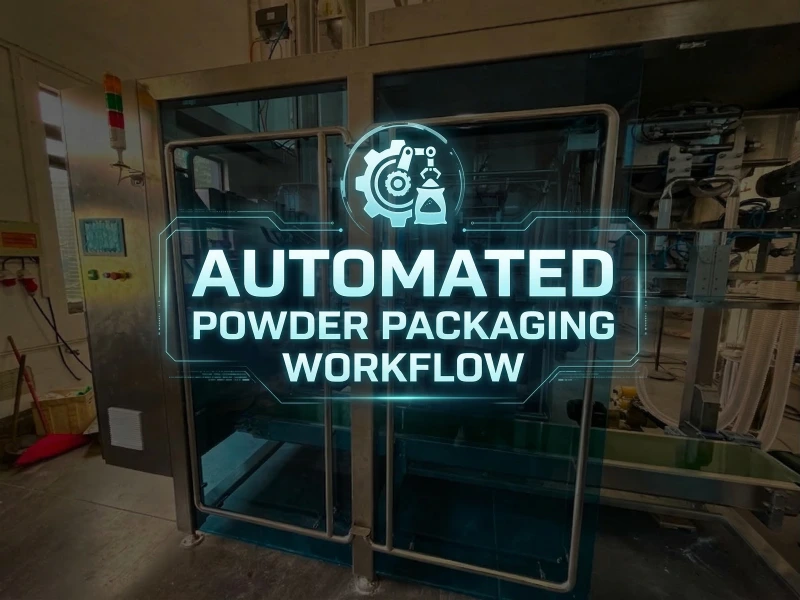
Why a PE bag from 10 to 50 kg behaves nothing like a kraft sack
At 10 kg the bag is light and airy: the film lifts with the product and the mouth will not stay open by itself. At 50 kg the same film spreads under load, the base bulges, and the mouth pulls out of square. Kraft paper hides both problems because the sheet holds a crease once it is folded. PE film does not hold anything. So every step in the weight range changes how the bag must be held, and a powder bagging line that was set up for one weight will fight the rest of the range. The symptom always shows up in the same place: the bag reaches the closure station twisted, and an operator stops the line to straighten it by hand.
We size the front end around a flat bag magazine conveyor rather than a sack hopper. One bag is taken from the stack, opened and placed at the clamp station, where the mouth is held before any product enters. Clamping before dosing is the only moment you can fully control a soft bag, so it is the moment we use. The station sits inside a stainless steel enclosure with blue inspection windows, which lets the operator watch the mouth and the fill without opening the guarding. The range itself is set from the touch-screen control panel, with the emergency stop at the operator position and roller transfer sections carrying the bag away from filling.
A line tuned for 25 kg kraft sacks has nothing to support a limp PE bag. Operators end up straightening bags by hand at the last metre, the sealer head runs unevenly because the mouth arrives skewed, and the rejects come back as leakers that nobody can trace to a station. The cause is almost never the filler.
Where the transfer, not the filler, decides the bag
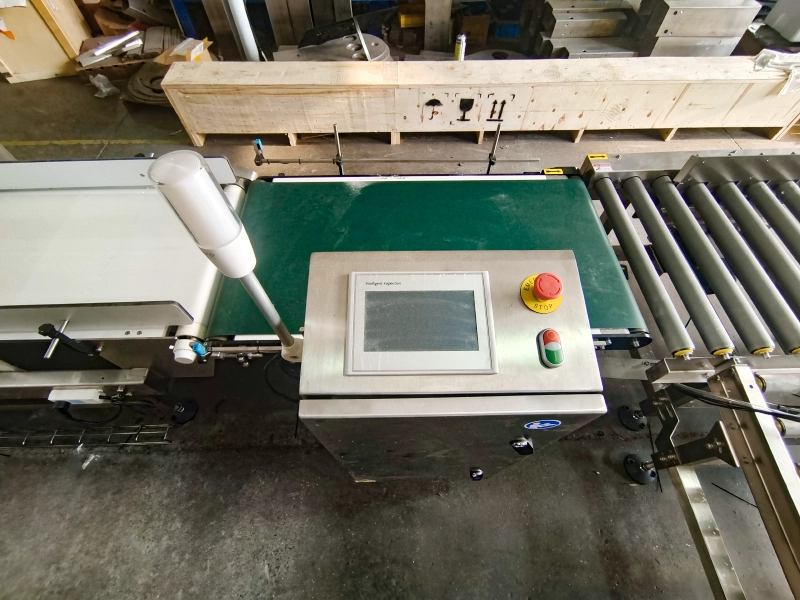
Filling accuracy is rarely the problem on a powder bagging line. The problem lives in the two metres between the clamp and the closure station. A soft PE bag that leaves the clamp with a lean keeps that lean, because nothing downstream pushes it back into shape. Mipline holds both faces of the bag through the handoff and releases it at guide height, so the bag is carried square instead of being dragged along a belt. Adjustable side guides on the twin-belt transfer section are set to the width of the bag being run, and the roller sections after the belts keep the base flat so the bag settles instead of tipping.
The hardware is visible in the photos on this page: the twin-belt transfer conveyor with its central control housing and adjustable side guides, stainless roller conveyor sections on welded frames with levelling feet, and the HMI box with the emergency stop where the operator actually stands. Nothing in that path lifts a filled bag by its mouth, which is the single most common reason a PE bag folds over just before sealing. Open roller sections and blue inspection windows give the operator and the maintenance team a clear line of sight to the mouth without stopping production.
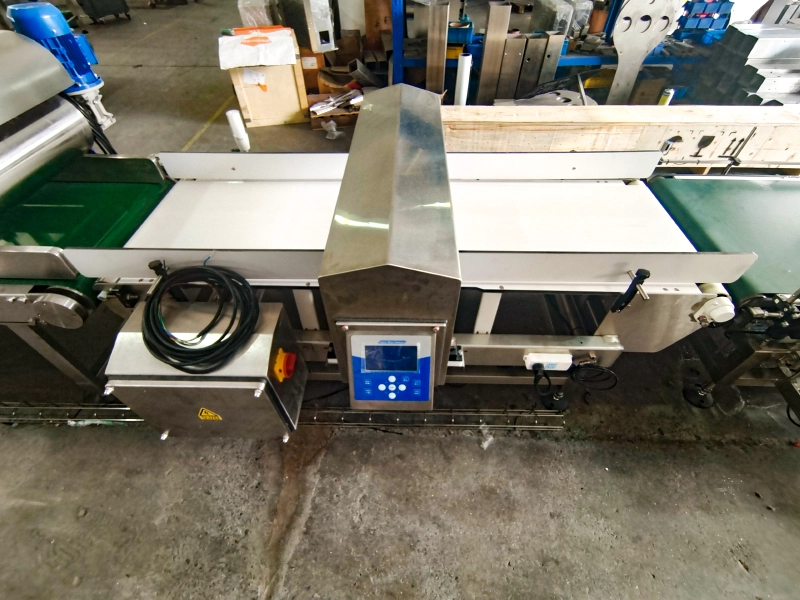
Field note: judge the line by the last metre, not by the dosing screw. If the bag mouth is a few millimetres out of square when it reaches the closure station, the seam will leak no matter how accurate the fill was. A camera check at the sealer tells you more than a week of weight data.
What to verify before you commit a 10 to 50 kg range
A 10 to 50 kg range is really four or five different handling problems sharing one powder bagging line, and each of them asks a different question of the machine. Before quoting we ask for the bag drawing, the film gauge, the bulk density of the product, and the target bags per minute at both ends of the range. Those four answers decide the magazine format, the clamp opening, the guide settings and whether closure is a sealer or a sewing head with a creped tape.
On the Mipline powder bagging line each of those points is answered mechanically rather than by operator skill. The magazine takes the flat bag format the plant actually buys, the clamp holds the mouth before dosing, the side guides are set to the bag width, and the bag arrives at the closure station square and settled. Where a plant still packs 25 kg kraft or woven sacks for other customers, the same line runs both formats with the closure changed, so the capacity is not stranded the day the next order arrives in PE film. For a look at the handoff in isolation, read guided bag transfer before sewing, and for a dairy example see the dry milk bag handoff walk-through.
| Bag weight | What a PE bag tends to do | What the line has to hold |
|---|---|---|
| 10 kg | Light film lifts with the product and the mouth collapses | Clamp the mouth before dosing and support the base through transfer |
| 20 kg | Bag settles slowly, trapped air keeps it fat and unstable | A settling run on the belt before the closure station |
| 25 kg | Bulges at the base where the film stretches around the product | Side guides set to bag width and a flat roller base under the bag |
| 40 kg | Film stretches under load and the mouth pulls out of square | Hold both faces through the handoff, never lift by the mouth |
| 50 kg | Bag leans and tips as soon as it leaves the clamp | Guided transfer at guide height and a square bag at the sealer |
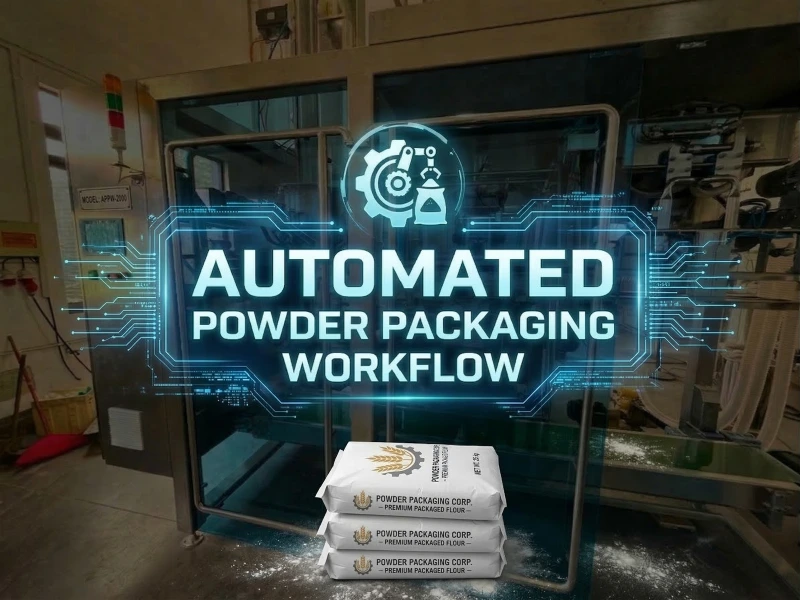
Send the bag drawing, not just the weight
Weight alone does not size a powder bagging line for PE film. Send the bag drawing, the film gauge, the bulk density and the target output at 10 kg and at 50 kg, and we will come back with the station layout, the clamp and guide settings, and the closure option that fits your format.
Request a line layout English
 Русский