
How a Bulk-Products Packing Line Reduces Sack Rework Between Filling and Sewing
For a regional grain warehouse running woven sacks, the issue is rarely the fill itself. The real pain starts after discharge, when a sack leaves the filling point slightly skewed, needs to be straightened by hand, and then still has to arrive at sewing in a clean, stable position. This ppline layout is built to keep that handoff calm, square, and repeatable.
1) What changes when sacks must move from filling to sewing without extra rework
In a mixed-facility packing room, one loose bag can slow the whole shift. The filling point may be working, but if the sack exits with a twisted mouth, an unstable body, or a poor landing angle, operators spend time pulling it straight before it reaches sewing or stacking. That is where throughput is quietly lost.
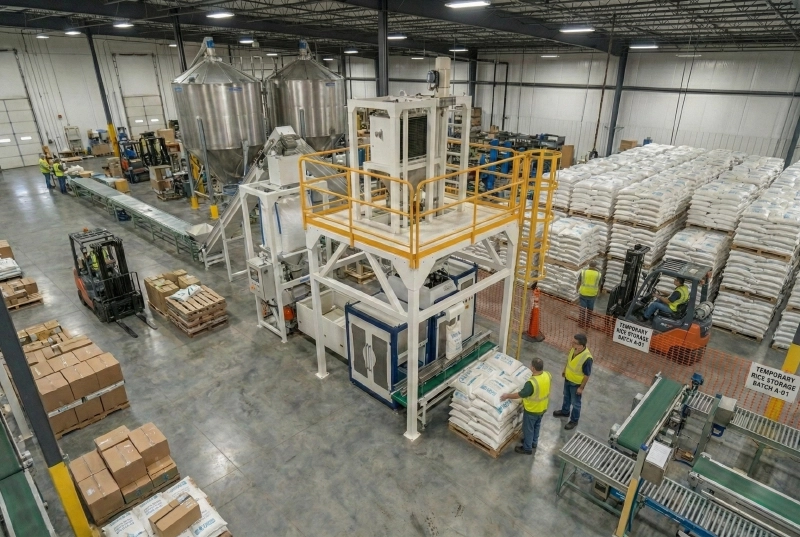
The operational photo above shows the scale of the job: twin stainless steel storage silos, conveyors, and palletized woven sacks all operating in the same space. When bags are moving through that kind of environment, the handoff has to stay controlled. Otherwise the line begins to depend on manual correction instead of machine discipline.
When the bag mouth does not land squarely, the team must re-grip, re-align, or re-stack before sewing. That adds labor, creates uneven pallet faces, and raises the chance of damaged sacks or inconsistent presentation at dispatch.
2) Why the ppline layout fits this job
The transfer module shown in the second image uses a steel frame, guide rails, and a motorized green belt to move sacks in a more disciplined path. That matters because woven sacks do not behave like rigid cartons; they flex, slip, and drift if the support path is not controlled. The guided belt keeps the bag body centered instead of letting it skate across the line.
The close-up view makes the logic even clearer. Vacuum suction cups, a robotic placing arm, and a green conveyor are doing the work that used to be done by hand. The machine is not just moving material; it is helping the sack stay oriented, which is the real requirement before sewing. Once the bag body is stable, the operator can focus on sealing quality instead of chasing bag position.
Engineering point: in bulk-products packing, the best improvement is often not a faster fill rate but a steadier transition from fill to take-away. A stable path reduces correction work, and that is what protects the next station.
3) The structure, parameters, and photo evidence behind the result
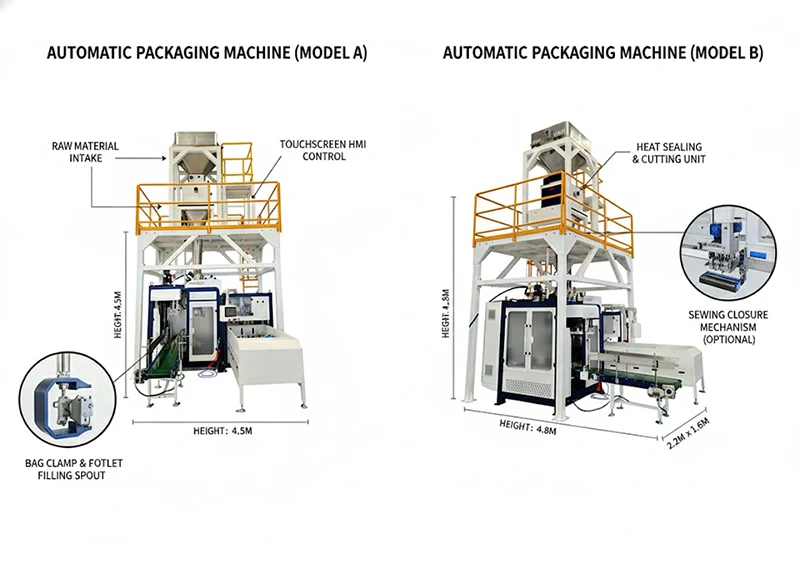
The third image adds the equipment logic that ties the whole line together. The 3D render of automatic packaging machine models A and B shows HMI control, heat sealing, and an optional sewing closure. That combination is important because the line can be tuned to different bag specs and closure methods without changing the overall layout discipline.
At a glance, the system is built around a clear chain: storage feed, controlled transfer, stable bag positioning, and closure. The photo set supports that chain from two angles. The high-angle plant shot proves the line can run in a real warehouse environment. The transfer-machine image shows the guided bag movement. The internal close-up shows how the bag is held and guided before it moves on. The 3D model shows the control and closure options that make the layout flexible for different output targets.
| Issue seen on old lines | What the ppline setup shows | Result on the floor |
|---|---|---|
| Bag leaves filling station skewed | Guide rails and motorized belt keep the sack centered | Less manual straightening before sewing |
| Bag body drifts during transfer | Vacuum suction cups and placing arm hold orientation | Cleaner handoff into the next station |
| Different closure requirements across jobs | HMI-controlled model with heat sealing and optional sewing closure | One packing line can cover more sack specs |
Need a sack line that stays square before sewing?
Send BPM your bag weight, target output, closure method, and discharge height. We will map the ppline layout around the real handoff problem instead of forcing your warehouse to absorb extra rework.
Ask BPM for a line layout English
 Русский